This page is public.
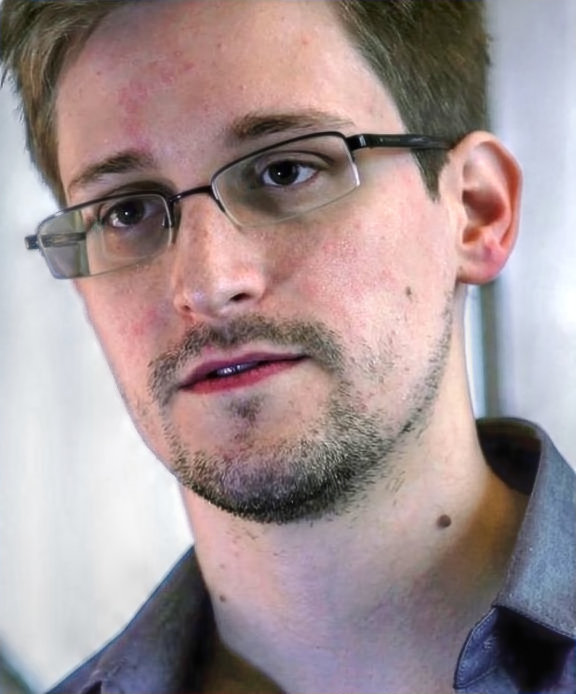
Edward Snowden (Image: Laura Poitras / Praxis Films, CC BY 3.0)
In June 2013, Edward Snowden leaked top secret NSA documents to the media, revealing the existence of numerous global surveillance programs to the public, including Boundless Informant,Prism, and XKEYSCORE. His leaks have been described as the most significant in U.S. history.
Background
Snowden’s decision was very calculated, and his background and motivations are important in understanding his decision. Edward Snowden did not follow a typical path to government employment as a high-level technical expert. In 2004, Snowden enlisted in the US Army Reserve as a special forces candidate, wishing to fight in the Iraq War to "help free people from oppression." [1] He was discharged after four months of training due to injuring both legs in a training accident [2] and worked briefly as a security specialist in Maryland. In 2006, Snowden attended a career fair where he was offered a position at the CIA. [3] Despite no formal training, Snowden had very little trouble advancing through the ranks. He had a natural talent with computers, referring to himself as a "computer wizard" [4] and was quickly admitted for training in a CIA program for technology specialists. [3] At this time, Snowden was a strong supporter of the government, reportedly saying that anyone who leaks secret documents should be “shot in the balls.” [5]
However, Snowden’s outlook changed with experience. In 2007, the CIA stationed Snowden in Geneva with diplomatic cover. [6] In this position, Snowden maintained computer network security as the "top technical and cybersecurity expert" in the country and worked closely with CIA operatives. [1] During his time in Geneva, Snowden had experiences with CIA operations that caused him to begin questioning the government's methods. Specific examples of CIA abuse of power mentioned by Snowden have been disputed as infeasible. [7]
It is believed that Snowden began collecting top secret documents with the intent to leak around this time. By 2008, Snowden had enough documents to form a substantial leak, but held off due to hopes that President Obama would institute security reforms. [8] In 2009, Snowden quit work with the CIA and began work at Dell as a NSA sub-contractee, managing computer systems for multiple government agencies. [1] During this time, Snowden collected over 50,000 classified documents, but was still uncertain if leaking was the right thing to do.
The turning point for Snowden came on March 15, 2013, when Director of National Intelligence James Clapper lied under oath to Congress about information collected by the NSA on American citizens.[9] Three days later, Snowden quit his job as lead technologist for the NSA's information-sharing office in Hawaii to work at the consulting firm Booz Allen Hamilton. According to Snowden, this choice was driven by an intention to more effectively gather data on the NSA's worldwide surveillance activity [10] and meant turning down a lucrative position at the NSA's Tailored Access Operations. [11] Snowden made digital copies of upwards of 1.5 million documents during this time, turning them over to journalists after fleeing to Hong Kong. After a brief stay there, Snowden went to Russia, where he now resides under temporary asylum. [5]
The Leak
Snowden's first leak led to the USA Freedom Act of 2015.12] This put an end to the collection of phone records and metadata but left Prism and [XKEYSCORE untouched. [13] Snowden's leaks caused public distrust in the NSA and federal government. Snowden justifies his actions by saying he just wanted the public to know what the government was doing. He felt it was unjust that "even if you're not doing anything wrong you're being watched and recorded." [13]
Size and scope
Glenn Greenwald of The Guardian, the first news outlet to interview Snowden, originally received 10,000 files from Snowden. The director of the National Security Agency, Keith Alexander, initially estimated that 200,000 documents were taken. Later, this estimate was changed to 1.7 million documents, 200,000 of which were leaked to journalists in Hong Kong [14] . Snowden claims that he gave up all classified documents to the journalists in Hong Kong, but the NSA estimates that he still had access to 1.5 million leaked documents. Many of these documents don't directly relate to the NSA's surveillance program and the Washington Post reported that 30,000 documents dealt with military capabilities and weapon systems. [15] In 2018, U.S. intelligence officials reiterated that they were still counting the scope of the Snowden's documents. They were on their seventh classified assessment of these leaks and had observed damage to five categories of classified information. [14]
Prism
PRISM, one of the revealed NSA programs (Image: National Security Agency, Public domain)
On June 6, 2013, Snowden leaked his first document about the NSA monitoring U.S. telephone metadata. A day later, June 7,2013, Snowden leaked an NSA powerpoint about Prism.[16] Prism is an NSA surveillance program that takes data directly from the servers of Google, Microsoft, Apple, and six other large tech companies.[16] The NSA claims to have direct access to these servers while the companies involved refute that claim. A slide shows that data from Microsoft has been collected since 2007. According to Snowden, Prism "is the biggest single contributor to its intelligence reports." [17]
XKEYSCORE
XKEYSCORE is the NSA’s largest surveillance program. XKEYSCORE is an expansion of the U.S. interception stations to the Internet. The NSA has tapped into the fiber optic cables that make up the Internet to collect data such as searches, emails, user keystrokes, usernames, and passwords. [18] This allows the NSA to receive data from users worldwide. The ability to track keystrokes gives the NSA access to anything with a username password combination. Large amounts of U.S. citizen data are collected in their searches, giving the NSA unauthorized access to our devices. Even though NSA employees are trained to avoid U.S. citizen data in their searches, experts believe that isn’t very effective. [18] With all of that searchable data, the NSA can use XKEYSCORE as its personal form of Google. The NSA is able to search the data based off of location, keywords in the user’s search or messages, and individual users. Snowden said that he could "wiretap anyone, from you or your accountant, to a federal judge to even the president, if [he] had a personal email.” [18]
Regardless of his decision, Snowden asserted his own moral judgement onto society in leaking. By not taking action, Snowden would have decided that government secrecy trumped the needs for an informed public. Interviews with Snowden suggest that he made a decision that agreed both with his morals and that most closely matched those of society. When Bradley Manning leaked, the public was most upset with his disclosure of documents that put soldiers in danger. Snowden was careful to avoid leaking any information that might lead to U.S. servicemen being injured but potentially negatively impacted U.S. national security. [19]
Tempora
In 2011, the British Government Communications Headquarters (GCHQ) launched the surveillance program Tempora. This program intercepts internet communications through fiber optic cables, similar to XKEYSCORE, enabling the GCHQ to process and search phone calls, emails, Facebook messages, etc. Consisting of two separate projects, Mastering the Internet and Global Telecoms Exploitation, the goal was to aggregate phone communications and online activity [20]. Interceptors were placed on an estimated 200 fiber optic cables, giving the GCHQ access to 10 gigabits of data each second. In order to decrease this massive amount of data, Tempora utilizes Massive Volume Reduction, where data is only saved if it sets off predefined triggers [21]. Between the NSA and the GCHQ, a combined 550 analysts were assigned to analyze this stream of data, looking for possible threats to national security. Snowden told The Guardian, "It's not just a US problem. The UK has a huge dog in this fight." [20]
Motivation
Snowden considered leaking government documents back in 2008, but was hopeful that President-Elect Barack Obama would approach spying/data collection with more transparency [8]. Snowden's hopes weren't realized in the President's first term, and In the summer of 2012 Snowden made his first batch of illegal downloads. However, Snowden's turning point came in March of 2013, when he saw the Director of National Intelligence, James Clapper, directly lie under oath to Congress. "Seeing that really meant for me there was no going back" he said in an interview with The Guardian[22]. Snowden cites that his unprecedented level of access to national information exposed him to a broad range of ethical dilemmas. Whereas the average employee would only encounter one or two instances of this in their life, his work saw these "abuses" frequently and fostered a culture of acceptance. Snowden's feeling of wrongdoing kept building as his concerns fell on deaf ears. Coming to the realization that these actions need to be judged by the public and not somebody "simply hired by the government," he came to his final decision. Snowden's "sole motive is to inform the public as to that which is done in their name and that which is done against them." [22] In December 2013, a U.S. federal judge, Richard J. Leon of Federal District Court for the District of Columbia, found the NSA's systematic collection of phone data to be unconstitutional. In a statement from Moscow following this ruling, Snowden emphasized that he "acted on the belief that the N.S.A.'s mass surveillance programs would not withstand constitutional challenge." [23]
Speaking out against one’s superiors is a difficult decision. In Edward Snowden’s case, the outcome of blowing the whistle was unpredictable. Rather than dealing with a clear, quantifiable physical risk, Snowden was grappling with a complex moral issue. The effect on society from leaking classified information was not obvious. Snowden had to use his professional judgement to make a decision on behalf of society without knowing the exact outcome of his actions.
In the Challenger Shuttle Explosion, and other similar cases investigated, the goals of the organization – safety and security – were often aligned with those of whistleblowers. Snowden, however, was not hired to carry out moral judgements. As late as 2007, Snowden was an ardent supporter of security and the right to secrecy of the government. The interests of the public did not necessarily line up with those of his organization, and Snowden was forced to choose between the NSA and society. In this situation, professional ethics mandate an individual to align themselves with society. As the long term goals of any government agency is to help society, it can also be argued that Snowden was simply preventing the NSA from circumventing its own goal. Snowden’s willingness to leak the documents despite his prior beliefs lends support to his decision [1].
Snowden's Flight
Snowden has come under criticism for fleeing the United States after leaking. Senator Chuck Schumer stated, “Others who have practiced civil disobedience in the past have stood up and faced the charges because they strongly believed in what they were doing. Mr. Snowden is a coward who has chosen to run.”[24] In fleeing the US, Snowden put himself beyond the reach of the judicial system and shielded himself from public response. As the saying goes, “Don’t commit the crime if you can’t do the time.” However, could Snowden expect a fair trial in the US, and should he be required to face the consequences of his actions if the public supports him?
Daniel Ellsberg has stated his support for Snowden’s decision to flee.[25] Though Ellsberg remained in the US after leaking the Pentagon Papers (and was ultimately acquitted due to prosecutorial misconduct), he believes the political climate has changed, and Snowden would not receive a fair trial today. Ellsberg points out Bradley Manning’s immediate incarceration and deplorable conditions, in addition to the ubiquitousness of the surveillance state. Ellsberg also notes that if Snowden truly helped the US (as he believes), then he shouldn’t have to face extended prison time.
The classified nature of Snowden’s case makes it difficult to compare to similar acts of civil disobedience. Snowden had few avenues to change the laws he thought were unjust. Though many have pointed out existing whistleblower protections, these usually did not apply to Snowden as a government contractor. Furthermore, Snowden’s superiors already approved of these data collection programs in the first place, so whistleblowing wouldn’t bring them any new information. Snowden’s legal advisor Ben Wizner asks, "Was he supposed to call the Senate Intelligence Committee and say, 'I'd like to report to you a program you approved in secret...'?"[26] This leaves breaking the law and appealing to the public as the only viable way for Snowden to have effected change in the NSA.
Snowden would have faced almost certain prison time had he stayed in the US. Bradley Manning received 35 years of confinement for his actions, and the Obama administration has taken a very strong stance against leakers. Perhaps the only option for Snowden to avoid serving time would be for President Obama to grant him clemency. However, the White House has ruled out this route for the foreseeable future,[27] even though the government has admitted mistakes in its handling of the NSA and made changes to its programs. Many believe that granting clemency would be politically disastrous for the Obama Administration, and note that the government’s refusal to commute Snowden’s sentence could just be politically infeasible instead of an act of righteousness.
Secrecy is necessary for any government to function, and Snowden took an oath to uphold the NSA’s secrecy when he joined as a contractor. Part of professionalism is adhering to one’s commitments, and Snowden broke these when he leaked classified information. Snowden believed the extenuating circumstances of his situation justified his decision to leak and flee, and he believes that public support of his decision would vindicate his actions. However, Snowden could not be sure the public reaction to his disclosure before making them. If the public response had been negative, Snowden should have returned to the US to face the consequences of his actions.
There is no easy or correct answer to the question of whether Snowden should have fled the US. In a perfect justice system, citizens must face the consequences of their actions when they break the law. In this case, by making a decision on behalf of society, Snowden should face the consequences that society dictates. However, our justice system is imperfect, and the consequences for Snowden’s actions wouldn’t necessarily represent society’s decisions. The usual routes to changing the system were closed off to Snowden. Ultimately, fleeing is an extraordinary act to be reserved for extraordinary circumstances. Whether these circumstances applied to Snowden remains up for debate.
Government Response
Edward Snowden’s professional ethics led his decision to leak classified information, but more than just his professionalism played a role throughout this controversy. Many government officials had to address concerns in the public because of the leaks, while also taking a hard stance against Snowden for breaking the law. Shortly after the 2013 leaks, President Obama ordered the review of government surveillance programs to ease public distrust. President Obama stated, “It is not enough for me, as president, to have confidence in these programs. The American people need to have confidence in them as well.”[28] A team of five security and policy experts, along with a team from the Privacy and Civil Liberties Oversight Board reviewed various surveillance programs. A presidential policy directive was released in January of 2014 based on information in reports from these two review teams, and assessments by the presidential administration.[28] In early 2015, the Office of the Director of National Intelligence (ODNI) issued a public report on enacted reforms for surveillance in the US. This included five-year limits on US holdings of non-citizen personal information and a three-year limit on FBI issued gag orders for user information from companies.[28]
The policy changes initiated in response to Snowden’s leaks were minimal, and many surveillance concerns remained unaddressed, mainly the continued collection of bulk telephone metadata, and the collection of ‘incidental’ data on U.S citizens. Elizabeth Goitein, the co-director of the Brennan Center Justice’s program on liberty and national security, stated, “From a big picture analysis, there’s been a whole lot of developments without a whole lot of movement. These reforms feel more like gestures.”[28]
Not long after the ODNI released their public reform report, the USA Freedom Act was passed. The name of the new legislation itself, Uniting and Strengthening America by Fulfilling Rights and Ending Eavesdropping, Dragnet-collection, and Online Monitoring Act, serves well to garner support from the public.[29] This was the successor to the USA Patriot Act which had allowed for the indiscriminate monitoring of personal information in response to the 9/11 terrorist attacks. This new legislation prohibited the collection of bulk customer data, raised transparency in Foreign Intelligence Surveillance Court (FISC) cases, and allowed technology firms to inform the public when government agencies requested sensitive information.[29] This new reform had garnered even the praise of Edward Snowden, but some individuals argued that instead of ending illegal monitoring by agencies like the NSA, it instead laid a legal framework for continued monitoring under governmental endorsement.[30]
In September of 2020, the US court of appeals issued a verdict stating that NSA’s warrantless collection of American telephone data violated the Foreign Intelligence Surveillance Act and was unconstitutional.[31] Edward Snowden commented on Twitter, “I never imagined that I would live to see our courts condemn the NSA’s activities as unlawful and in the same ruling credit me for exposing them.”[32] In December 2020, as President Trump was nearing the end of his first term, some congressional members had proposed that Edward Snowden be a potential recipient of a presidential pardon. Despite Trump calling Edward Snowden ‘a spy who should be executed,’ Trump had expressed willingness to add Snowden to his list of pardons.[33] Many congressional members expressed opposition to this pardoning, however. Newt Gingrich stated, “Snowden did enormous damage to the United States and I can’t imagine any reason for pardoning him.”[33] A house republican, Liz Cheney, echoed this by saying, “He’s responsible for largest, most damaging leak of classified information in US history.”[33]
There is no consensus of professional ethics among political officials central to this controversy. Edward Snowden’s actions had been a public service, but to the detriment of the US government. While there is some praise for his actions, Snowden broke the law and defied the trust of many government agencies. Politicians had retained the view of Snowden as a traitor, even after the NSA’s actions were deemed unconstitutional. The misalignment of Snowden’s ethics to act in society’s interests, and for those of officials to condemn the actions of a criminal kept him from receiving the presidential pardon.
Snowden in the Modern Day
Edward Snowden fled to Russia on temporary asylum. According to the Guardian at the time, "the former NSA contractor has not been granted political asylum, which would have allowed him to stay in Russia permanently. However, Kucherena [Snowden's Lawyer] said Snowden would be able to extend his residency permit for a further three years when it runs out and after five years would be eligible to apply for Russian citizenship." [34] Russia’s compliance in harboring Snowden strained US-Russian relationships. Russia's actions were in direct defiance of the White House, causing embarrassment for the United States. [35] In response to Russia's decision, US Justice Department spokesman, Peter Carr, stated, "It remains our position that Mr. Snowden should return to the United States and face the charges filed against him...If he does, he will be accorded full due process and protections" [36]
In an interview with PEN America in 2015, Snowden explained, "People say I live in Russia, but that's actually a little bit of a misunderstanding. I live on the Internet, and that’s where I spend all of my time.” [37]
Since the leak, Snowden has become an outspoken digital citizen. Snowden is active on Twitter, chiming in on issues related to digital privacy, mass surveillance, whistleblowing, and oversteps of government. [32].
Snowden has taken a strong stance against the FBI in the San Bernardino encryption debate. Snowden believes the FBI is acting unconstitutionally and against the interests of Americans: “Unbelievable: FBI sneaks radical expansion of power through courts, avoiding public debate… remember when the @FBI was concerned about compliance with court orders?”[32]. Snowden has also taken interest in the Panama Papers leak, tweeting: “The #PanamaPapers led to raids, resignations, and regulations. Yet the source enjoys no legal protection. A whistle poisoned by law.”[32] Snowden expresses his concern over politicians involved in the scandal: “Resignation of Iceland's PM may explain why the UK PM is so insistent public has no right to know a PM's "private" finances. #PanamaPapers.” He takes aim at the James Cameron, “UK Twitter right now: "Let's hope Cameron resigns." With respect, hope is not a strategy. #PanamaPapers.”[32]
In 2014, Snowden joined a non-profit organization called Freedom of the Press. This organization is “dedicated to helping support and defend public-interest journalism focused on exposing mismanagement, corruption, and law-breaking in government.” [38]. In 2016, Snowden became president of the organization and has continued to serve Freedom of the Press through 2021. [39]
Snowden has also been interviewed by major news agencies, such as the BBC, the Guardian, and NBC. In an interview with the Guardian, Snowden says, “If I end up in chains in Guantánamo I can live with that.”[40]. Snowden explained to the BBC in 2015 that “Smartphones can be taken over” [41]. In a 2014 interview with NBC, Snowden emphasizes that while he condemns mass surveillance, stating, “I take the threat of terrorism seriously”. [42]
Last Week Tonight host, John Oliver, did an interview with Snowden in Moscow in 2015 that garnered much attention.[43]
In a 2016 film directed by Oliver Stone titled Snowden, actor Joseph Gordan depicted Snowden’s experiences working with government agencies, leaking sensitive information, and immediate fallout from his actions [44]. The film received moderate ratings [45] and earned $37 million on a $40 million budget [46].
Controversy Over His Memoir
On September 17th 2019, Edward Snowden released a memoir titled Permanent Record in which he described the story of his upbringing, his career as a government agent, his rational for leaking the sensitive government secrets, and an analysis of how government surveillance has evolved since [47]. Upon release, Snowden was subject to a lawsuit by the United States Government. Snowden did not submit his memoir to the CIA and NSA for a pre-publication review, which the lawsuit claims is a violation of the non-disclosure agreements that Snowden signed with these agencies. The US government sought to recover all proceeds earned by the memoir, an action established in precedent by the Supreme Court in Snepp v. United States. Supporting the lawsuit, Deputy Attorney General Jeffrey Rosen stated that “Edward Snowden violated his legal obligations to the United States, and therefore, his unlawful financial gains must be relinquished to the government.” U.S. Attorney for the Eastern District of Virginia George Terwilliger asserted that “Intelligence information should protect our nation, not provide personal profit,” and that the lawsuit “will ensure that Edward Snowden receives no monetary benefits from breaching the trust placed in him.” [48]
Snowden defended his refusal to submit his book for pre-publication review in an interview with Trevor Noah on the Daily Show. He admitted that his actions violated Standard Form 312, a secrecy agreement that prevents agents from releasing agency secrets. However, he also shared the oath of service that he took as a government agent, that he will “support and defend the constitution against all enemies, foreign and domestic.” Snowden claimed that the actions he witnessed while working for these agencies violated the constitution, which pitted his commitment to the oath of service against his secrecy agreement. When addressing his decision not to submit his book to the CIA for approval, Snowden asked Trevor Noah whether he would let the CIA revise the memoir and “edit your life story,” to which Noah replied, “I would not.” Snowden responded, “Me neither” [49].
On Returning to the US
In the same 2019 interview with Trevor Noah, Edward Snowden shared his reservations about returning to the United States. Snowden affirmed that his “ultimate goal will always be to return back to the United States.” However, his return to the United States is contingent on what he considers a “fair trial.” Snowden goes on to describe how the Government allows no defense for sharing confidential information with a journalist and will actively forbid a jury from hearing a defense or rational for a defendant’s actions. He contrasts this against a murder case, where a defendant could plead self-defense and potentially justify their actions (justifiable homicide). Until Snowden is assured that he will be able to defend his case to a jury, he intends to remain in exile [49].
In the meantime, Snowden and his wife, Lindsay Mills, were granted permanent residence in Russia in October of 2020 [50]. Snowden and his wife have also applied for dual citizenship to protect their newborn son. In a November 1st tweet, Snowden writes, “After years of separation from our parents, my wife and I have no desire to be separated from our son. That's why, in this era of pandemics and closed borders, we're applying for dual US-Russian citizenship” [51]. 2021 marks the 8th year in exile for Edward Snowden, and it is impossible to predict if or when he and his family will return to the United States. However, he continues to hold true to his ideals, as conveyed in a January tweet, “I would rather be without a state than without a voice.” [52]
Professional Responsibility, Financial Gain, and Continuing Ethical Obligations in the Snowden Case
Snowden’s 2013 disclosure of classified National Security Agency surveillance programs sparked a global debate about privacy, government power, and whistleblowing. Several years later, Snowden’s publication of his memoir Permanent Record in 2019 generated a new set of ethical questions distinct from the original leaks. Unlike the disclosures, which were framed as urgent warnings to the public, the memoir involved retrospective narration, political advocacy, and financial compensation. The United States government responded by filing a civil lawsuit seeking to seize the book’s proceeds, arguing that Snowden violated continuing professional obligations by publishing without publication review. [6] This event provides a valuable opportunity to examine professionalism beyond the moment of whistleblowing and to consider whether ethical duties persist after an individual exits a profession.
Secrecy Agreements as Professional Commitments
As an intelligence contractor, Snowden signed secrecy agreements requiring him to submit any writings related to intelligence work for pre-publication review. These agreements are not merely legal formalities. They represent professional commitments grounded in trust. Intelligence professionals are granted access to highly sensitive information on the condition that they accept long term constraints on speech and disclosure. From a professionalism perspective, such agreements formalize the understanding that certain knowledge carries enduring responsibilities because the potential harms associated with disclosure do not disappear when employment ends.[53] Ethically, secrecy agreements serve two purposes. First, they aim to protect national security by preventing intentional disclosure of sensitive information. Second, they maintain institutional trust by ensuring that professionals do not unilaterally decide which rules apply to them. When professionals disregard obligations they previously accepted, the stability of professional institutions is weakened.
Legal Enforcement and Professional Trust
The government’s lawsuit against Snowden relied on legal precedent established in Snepp v. United States, a Supreme Court case involving a former CIA officer who published a book without pre-publication review. In that case, the Court ruled that the author violated a fiduciary duty to the government, even though the book did not contain classified information. [7] The ruling emphasized that the harm lay in breaching the process itself rather than in revealing specific secrets. From an ethical standpoint, this reasoning highlights a key feature of professionalism. Professional obligations are often procedural rather than purely outcome based. Compliance with agreed upon processes demonstrates reliability and respect for collective norms. When individuals bypass those processes, they undermine shared expectations, even if the substantive content of their actions appears harmless.
Ethical Justifications and Constitutional Loyalty
Snowden has consistently acknowledged that he violated his secrecy agreements but argues that his actions were ethically justified. He maintains that submitting his memoir for review would have allowed government agencies to shape or suppress his account, compromising transparency and democratic accountability [54]. Snowden frames his refusal as an extension of his oath to support and defend the Constitution, asserting that constitutional values outweigh institutional rules when the two conflict.[55] This argument reflects a broader ethical dilemma within professional life. Professionals often swear oaths that invoke public values such as justice, safety, or constitutional governance. When institutional practices appear to violate those values, individuals may feel morally compelled to resist. The Snowden case illustrates how professionals can experience competing loyalties, one to the organization and another to abstract public principles.
Role Based Professional Ethics
Role based theories of professional ethics emphasize that entering a profession entails accepting limits on personal autonomy. These limits exist because professional roles grant access to power, authority, or sensitive information that can cause harm if misused [56]. Under this framework, ethical behavior requires adherence to role specific obligations, even when those obligations conflict with personal beliefs. Applied to Snowden’s memoir, role based ethics suggest that his professional duty to honor secrecy agreements remained intact regardless of his moral objections. By voluntarily accepting the role of intelligence contractor, Snowden accepted constraints that extended beyond his tenure. Allowing individuals to unilaterally redefine their obligations after the fact threatens the coherence of professional systems that rely on predictability and trust.
Whistleblowing Versus Continued Disclosure
Whistleblowing theory complicates this analysis by recognizing situations in which violating professional norms may be ethically justified. Scholars argue that whistleblowing can be morally permissible when serious harm is occurring, internal reporting channels have failed, and disclosure is likely to prevent further harm [57]. Snowden’s original disclosures are often evaluated within this framework. However, Snowden’s memoir differs in important respects. It was published years after the surveillance programs became public knowledge, and it did not reveal new systemic abuses. As a result, its capacity to prevent imminent harm is less clear. From a professionalism perspective, ethical justification weakens as the connection between rule breaking and public protection becomes more attenuated. Actions that once served an urgent moral purpose may no longer be ethically defensible when circumstances change.
Financial Gain and Professional Integrity
The financial success of Permanent Record introduces another ethical dimension. Professional codes commonly prohibit using privileged access or confidential knowledge for personal gain. The government argued that allowing Snowden to profit from his memoir would reward a breach of professional trust and create perverse incentives for future intelligence workers. Supporters counter that financial compensation does not negate the moral value of whistleblowing and that individuals retain a right to earn a living through lawful expression [58]. Ethically, this raises the question of whether personal benefit undermines claims of principled action. While financial gain does not automatically invalidate moral motivation, professionalism demands heightened scrutiny when actions that violate obligations also generate personal reward.
Individual Moral Agency and Free Expression
Another ethical tension concerns individual moral agency and freedom of expression. Snowden’s defenders argue that lifelong restrictions on speech are ethically excessive, particularly when applied to personal reflection and unclassified material. They contend that professional obligations should not permanently override fundamental rights to self expression and political participation [59]. This perspective emphasizes that professionals remain moral agents rather than mere instruments of institutions. Ethical professionalism must balance institutional needs with respect for individual dignity. When restrictions become overly broad or punitive, they risk undermining the legitimacy of the professional norms they seek to enforce.
Proportionality and Timing in Ethical Judgment
Professional ethics also requires proportionality. Actions that cause significant institutional harm must be justified by correspondingly significant public benefit. Snowden’s memoir invites evaluation not only of what was done, but when and why it was done. Publishing a memoir years after the initial disclosures suggests a shift from urgent warning to retrospective advocacy. This temporal dimension matters ethically. Even if initial rule breaking is justified, continued defiance of professional obligations may no longer meet the same moral standard. Professional judgment requires ongoing reassessment of whether actions remain necessary and proportionate in light of changing circumstances.
References
- ↑ a b c d Greenwald, Glen (June 2013). Edward Snowden: the Whistleblower Behind the NSA Surveillance Revelations. http://www.theguardian.com/world/2013/jun/09/edward-snowden-nsa-whistleblower-surveillance
- ↑ Gaskell, Stephanie (June 10, 2013). "Records show Army discharged Edward Snowden after five months". Politico. http://www.politico.com/story/2013/06/edward-snowden-army-discharge-92486.html.
- ↑ a b Bamford, James (August 13, 2014). "Edward Snowden: The untold story of the most wanted man in the world". Wired. http://www.wired.com/2014/08/edward-snowden/.
- ↑ Broder, John M.; Scott, Shane (June 15, 2013). "For Snowden, a Life of Ambition, Despite the Drifting". The New York Times. Archived from the original on June 15, 2013. https://web.archive.org/web/20130615232919/http://www.nytimes.com/2013/06/16/us/for-snowden-a-life-of-ambition-despite-the-drifting.html. Retrieved April 11, 2015.
- ↑ a b Harding, Luke (January 2014). How Edward Snowden Went From Loyal NSA Contractor to Whistleblower. Retrieved from http://www.theguardian.com/world/2014/feb/01/edward-snowden-intelligence-leak-nsa-contractor-extract
- ↑ a b "Eastern District of Virginia | United States Files Civil Lawsuit Against Edward Snowden | United States Department of Justice". www.justice.gov. 2019-09-17. Retrieved 2025-12-13.
- ↑ a b "Snepp v. United States, 444 U.S. 507 (1980)" (in en). Justia Law. https://supreme.justia.com/cases/federal/us/444/507/.
- ↑ a b Burrough, Bryan; Ellison, Sarah; Andrews, Suzanna (April 23, 2014). "The Snowden Saga: A Shadowland of Secrets and Light". http://www.vanityfair.com/news/politics/2014/05/edward-snowden-politics-interview. Retrieved April 29, 2016.
- ↑ "Transcript: ARD interview with Edward Snowden". The Courage Foundation. January 27, 2014.
- ↑ Lam, Lana (June 13, 2013). "Whistle-blower Edward Snowden talks to South China Morning Post". South China Morning Post (Hong Kong). http://www.scmp.com/news/hong-kong/article/1259335/exclusive-whistle-blower-edward-snowden-talks-south-china-morning. Retrieved April 11, 2015.
- ↑ Greenberg, Andy (June 18, 2013). "NSA Implementing 'Two-Person' Rule To Stop The Next Edward Snowden". Forbes (New York). http://www.forbes.com/sites/andygreenberg/2013/06/18/nsa-director-says-agency-implementing-two-person-rule-to-stop-the-next-edward-snowden/. Retrieved April 11, 2015.
- ↑ Peralta, E. (2015, November 29). NSA Ends Sept. 11-Era Surveillance Program. http://www.npr.org/sections/thetwo-way/2015/11/29/457779757/nsa-ends-sept-11th-era-surveillance-program
- ↑ a b Diamond, J. (2015, September 7). Senate passes NSA reform measure. http://www.cnn.com/2015/06/02/politics/senate-usa-freedom-act-vote-patriot-act-nsa/
- ↑ a b Kelley, M. (2013, December 16). NSA: Snowden Stole 1.7 MILLION Classified Documents And Still Has Access To Most Of Them. Business Insider. https://www.businessinsider.com/how-many-docs-did-snowden-take-2013-12?international=true&r=US&IR=T
- ↑ Nakashima, E. (2013, October 24). Officials alert foreign services that Snowden has documents on their cooperation with us. Washington Post. https://www.washingtonpost.com/world/national-security/officials-alert-foreign-services-that-snowden-has-documents-on-their-cooperation-with-us/2013/10/24/930ea85c-3b3e-11e3-a94f-b58017bfee6c_story.html
- ↑ a b Szoldra, P. (2014, June 07). SNOWDEN: Here's Everything We've Learned In One Year Of Unprecedented Top-Secret Leaks. Retrieved May 08, 2016, from http://www.businessinsider.com/snowden-leaks-timeline-2014-6
- ↑ MacAskill, E., & Dance, G. (2013, November 01). NSA files decoded: Edward Snowden's surveillance revelations explained Retrieved May 08, 2016, from http://www.theguardian.com/world/interactive/2013/nov/01/snowden-nsa-files-surveillance-revelations-decoded#section/3
- ↑ a b c Marquis-Boire, M., Greenwald, G., & Lee, M. (2015, July 1). XKEYSCORE: NSA's Google for the World's Private Communications. https://theintercept.com/2015/07/01/nsas-google-worlds-private-communications/
- ↑ Meek, J. G., Martinez, L., & Mallin, A. (2014, January 29). Intel Heads: Edward Snowden Did 'Profound Damage' to U.S. Security. Retrieved May 08, 2016, from http://abcnews.go.com/Blotter/intel-heads-edward-snowden-profound-damage-us-security/story?id=22285388
- ↑ a b MacAskill, E., Borger, J., Hopkins, N., Davies, N., & Ball, J. (2013, June 21). GCHQ taps fibre-optic cables for secret access to world’s communications. The Guardian. https://www.theguardian.com/uk/2013/jun/21/gchq-cables-secret-world-communications-nsa
- ↑ Shubber, K. (2013, June 24). A simple guide to GCHQ’s internet surveillance programme Tempora. WIRED UK. https://www.wired.co.uk/article/gchq-tempora-101
- ↑ a b Greenwald, G. (2013, July 9). NSA whistleblower Edward Snowden: 'I don't want to live in a society that does these sort of things.' The Guardian. https://www.youtube.com/watch?v=0hLjuVyIIrs
- ↑ Savage, C. (2013, December 16). Judge Questions Legality of N.S.A. Phone Records. The New York Times. https://www.nytimes.com/2013/12/17/us/politics/federal-judge-rules-against-nsa-phone-data-program.html
- ↑ Logiurato, Brett (August 2013). Chuck Schumer is Furious at Vladimir Putin for 'Stabbing Us In The Back' Over 'Coward' Edward Snowden. http://www.businessinsider.com/chuck-schumer-edward-snowden-asylum-vladimir-putin-2013-8#ixzz2cpVKGMhw
- ↑ Ellsberg, Daniel (July 2013). Snowden Made the Right Call When He Fled the U.S. http://www.washingtonpost.com/opinions/daniel-ellsberg-nsa-leaker-snowden-made-the-right-call/2013/07/07/0b46d96c-e5b7-11e2-aef3-339619eab080_story.html
- ↑ Gerstein, Josh (April 2014). Hillary Clinton Faults Edward Snowden for Fleeing. http://www.politico.com/blogs/under-the-radar/2014/04/hillary-clinton-faults-edward-snowden-for-fleeing-187445.html
- ↑ Knowlton, Brian (November 2013). Clemency for Snowden? U.S. Officials Say No. http://thecaucus.blogs.nytimes.com/2013/11/03/clemency-for-snowden-u-s-officials-say-no/
- ↑ a b c d Childress, S. (2015). How the NSA Spying Programs Have Changed Since Snowden. FRONTLINE. https://www.pbs.org/wgbh/frontline/article/how-the-nsa-spying-programs-have-changed-since-snowden/
- ↑ a b Hauk, C. (2021, January 13). The USA Freedom Act: What Is It and How Does It Affect Your Online Activities. Pixel Privacy. https://pixelprivacy.com/resources/freedom-act/
- ↑ Damon, A. (2015). Edward Snowden lends his support to “USA Freedom Act.” World Socialist Web Site. https://www.wsws.org/en/articles/2015/06/06/snow-j06.html
- ↑ Reuters. (2020, September 3). NSA surveillance exposed by Snowden was illegal, court rules seven years on. The Guardian. http://www.theguardian.com/us-news/2020/sep/03/edward-snowden-nsa-surveillance-guardian-court-rules
- ↑ a b c d e Edward Snowden's Twitter. https://twitter.com/snowden?lang=en
- ↑ a b c POLITICO, S. C. M. P. by. (2020, December 25). Edward Snowden allies see opening amid Donald Trump clemency blitz. ABS-CBN News. https://news.abs-cbn.com/overseas/12/25/20/edward-snowden-allies-see-opening-amid-donald-trump-clemency-blitz
- ↑ Luhn, Alec Edward Snowden given permission to stay in Russia for three more years (2014) http://www.theguardian.com/world/2014/aug/07/edward-snowden-permission-stay-in-russia-three-years
- ↑ Gorst, Isabel (August 2014). Russia gives Edward Snowden asylum for three more years. http://www.latimes.com/world/europe/la-fg-russia-snowden-asylum-20140807-story.html
- ↑ Peter Carr, qtd. by LA Times (August 2014). Russia gives Edward Snowden asylum for three more years. http://www.latimes.com/world/europe/la-fg-russia-snowden-asylum-20140807-story.html
- ↑ Edward Snowden via Skype at PEN America Forum (2015) http://pen.org/video/secret-sources-conversation-edward-snowden
- ↑ Freedom of the Press (2021). About. https://freedom.press/about
- ↑ Freedom of the Press(2021). Board of Directors. https://freedom.press/about/board/
- ↑ Edward Snowden qtd, by The Guardian (2014). http://www.theguardian.com/world/video/2014/jul/17/edward-snowden-video-interview
- ↑ Snowden, qtd. by BBC (2015) http://www.bbc.com/news/uk-34444233
- ↑ Edward Snowden, qtd. by NBC (2014) http://www.nbcnews.com/watch/nbc-news/inside-the-mind-of-edward-snowden-part-2-269094467617
- ↑ John Oliver on Last Week Tonight (2015) https://www.youtube.com/watch?v=XEVlyP4_11M
- ↑ IMDB (2016) Snowden (2016). https://www.imdb.com/title/tt3774114/
- ↑ Rotten Tomatoes (2016). Snowden. https://www.rottentomatoes.com/m/snowden
- ↑ Box Office Mojo (2016). Snowden. https://www.boxofficemojo.com/release/rl74483201/rankings/?ref_=bo_rl_tab#tabs
- ↑ Szailai, J. (2020). In Edward Snowden's New Memoir, the Disclosures This Time Are Personal. The New York Times. https://www.nytimes.com/2019/09/13/books/review-permanent-record-edward-snowden-memoir.html
- ↑ Department of Justice (2020). United States Obtains Final Judgment and Permanent Injunction Against Edward Snowden. https://www.justice.gov/opa/pr/united-states-obtains-final-judgment-and-permanent-injunction-against-edward-snowden
- ↑ a b Noah, T. (2019). Edward Snowden - “Permanent Record” & Life as an Exiled NSA Whistleblower. The Daily Show. https://www.youtube.com/watch?v=PArFP7ZJrtg
- ↑ Associated Press (2020). Edward Snowden and his Wife, Awaiting Birth of Son, Seek to be Russian-US Dual Nationalists. USA Today. https://www.usatoday.com/story/news/world/2020/11/02/edward-snowden-wife-lindsay-mills-expect-son-seek-dual-citizenship/6127031002/
- ↑ @Snowden. "After years of separation from our parents, my wife and I have no desire to be separated from our son. That's why, in this era of pandemics and closed borders, we're applying for dual US-Russian citizenship." Twitter. 1 Nov. 2020, 5:09 p.m., https://twitter.com/snowden/status/1323024457645105153?lang=en
- ↑ @Snowden. "I would rather be without a state than without a voice." Twitter. 20 Jan. 2021, 8:56 a.m., https://twitter.com/snowden/status/1351891255438028805?lang=en
- ↑ "Intelligence Community Whistleblower Provisions: A Legislative History". www.congress.gov. Retrieved 2025-12-13.
- ↑ The Daily Show (2019-09-20), Edward Snowden - “Permanent Record” & Life as an Exiled NSA Whistleblower | The Daily Show, retrieved 2025-12-13
- ↑ r.search.yahoo.com https://r.search.yahoo.com/_ylt=AwrhR2pTwz1p.WgJa3lXNyoA;_ylu=Y29sbwNiZjEEcG9zAzEEdnRpZAMEc2VjA3Ny/RV=2/RE=1766864980/RO=10/RU=https://digitalcommons.usf.edu/cgi/viewcontent.cgi?article=1552&context=jss/RK=2/RS=8Fs4N0Rm8zadOwh8V6NbxUYs5jU-. Retrieved 2025-12-13. {{cite web}}: Missing or empty |title= (help)
- ↑ "(PDF) Thinking Like an Engineer: Studies in the Ethics of a Profession". ResearchGate. Retrieved 2025-12-13.
- ↑ Bok, Sissela (1980), Callahan, Daniel; Bok, Sissela (eds.), "Whistleblowing and Professional Responsibilities", Ethics Teaching in Higher Education, Boston, MA: Springer US, pp. 277–295, doi:10.1007/978-1-4613-3138-4_11, ISBN 978-1-4613-3138-4, retrieved 2025-12-13{{citation}}: CS1 maint: work parameter with ISBN (link)
- ↑ "ACLU Comment on Edward Snowden Lawsuit". American Civil Liberties Union. Retrieved 2025-12-13.
- ↑ Pozen, David (2013). "The Leaky Leviathan: Why the Government Condemns and Condones Unlawful Disclosures of Information". Faculty Scholarship. {{cite journal}}: Cite journal requires |journal= (help)
Where this page came from
This page was imported from Wikibooks. From “Professionalism” on Wikibooks, by its contributors, under CC BY-SA 4.0. Changed here: set as a page; navigation and edit links left out; each image under its own licence, credited in its caption.
Nobody has written it yet — it is the source material at a new address, which is why search engines are asked to skip it and why no one earns from it. It is up for grabs: take it on, and it is yours to rewrite and to earn from.
In these publicationsProfessionalism
Licence: CC BY-SA 4.0 · Adapted from en.wikibooks.org
Comments