
Want to improve the node's content? Try to make an edit request.
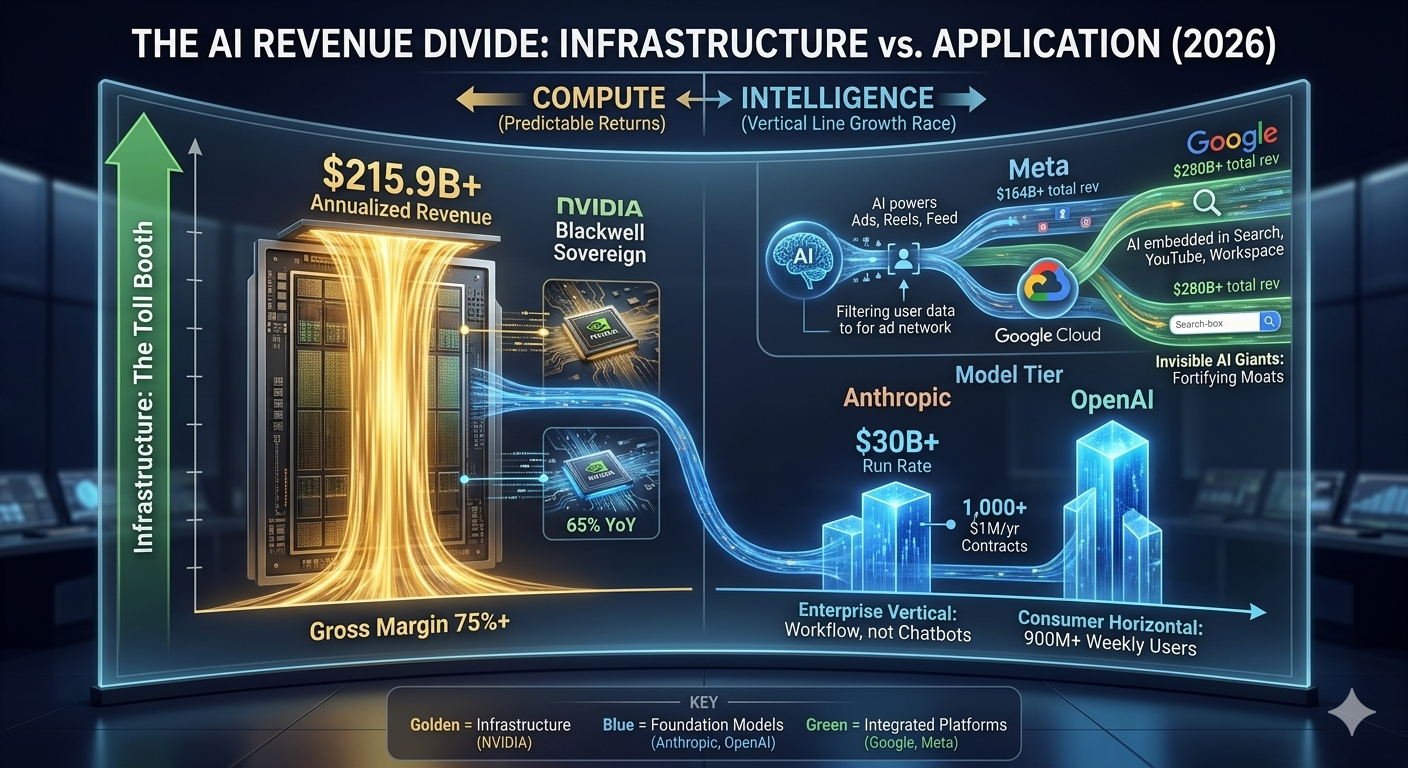
The artificial intelligence landscape in mid-2026 has solidified into a two-tiered economy where the "Picks and Shovels" providers are harvesting the vast majority of the industry's liquid capital. While consumer-facing giants like **OpenAI** and **Anthropic** have achieved historic growth—with Anthropic recently crossing a staggering **\$30 billion** annualized revenue run rate—their figures remain dwarfed by the infrastructure dominance of **NVIDIA**. NVIDIA’s fiscal 2026 results show a record **\$215.9 billion** in revenue, a 65% year-over-year increase driven by the relentless ramp of the **Blackwell** architecture. This underscores a critical market reality: while model builders are engaged in a high-stakes "vertical line" growth race for enterprise adoption, the hardware layer continues to function as the industry’s central toll booth. Meanwhile, legacy hyperscalers **Google** and **Meta** have successfully pivoted from "AI-curious" to "AI-integrated." Rather than relying on direct subscription revenue, these platforms have utilized AI to fortify their core moats. Google’s AI-driven Cloud outperformance and Meta’s \$164B+ revenue—powered by AI-optimized advertising algorithms—demonstrate that for established tech, AI is not a new product, but a revolutionary upgrade to the existing engine. As we move into the second half of 2026, the industry's focus is shifting from "who can build the best model" to "who can scale the most efficient inference," a transition that favors those owning the silicon and the data moats.
The Great Decoupling: Infrastructure vs. Intelligence
The attached data highlights the 2026 "Who Makes Money in AI" leaderboard, but the raw numbers tell only half the story. The real narrative of 2026 is the Great Decoupling: the widening gap between those selling the capability (Models) and those selling the capacity (Compute).
NVIDIA: The Sovereign of Silicon
NVIDIA’s position has evolved from a hardware vendor to an essential utility. Their $215.9 billion fiscal 2026 revenue is largely attributed to the Grace Blackwell series, which Jensen Huang recently described as the "factory powering the AI industrial revolution." With gross margins hovering near 75%, NVIDIA is not just making money; they are capturing the industry's R&D budgets. Every dollar an enterprise spends on a "Claude" or "ChatGPT" subscription eventually finds its way back to NVIDIA’s balance sheet via the cloud providers hosting those models.
Anthropic vs. OpenAI: The Enterprise Crossover
In a surprising shift, Anthropic has surpassed OpenAI in enterprise adoption. While OpenAI maintains a massive consumer lead with over 900 million weekly active users, Anthropic’s $30 billion run rate is fueled by a "vertical line" growth in Fortune 500 contracts. Their strategy—focusing on "workflow over chatbots"—has resonated with companies seeking to replace expensive human processes with reliable, steerable API calls. The data shows over 1,000 enterprise customers now spend more than $1 million annually on Claude, doubling that figure in just two months.
Google and Meta: The Invisible AI Giants
For Google and Meta, AI is a "hidden" revenue driver. Google’s total company revenue of $280B+ is increasingly inseparable from AI. Alphabet’s cloud revenue is growing at a 30.70% CAGR, outperforming Amazon and Microsoft, largely because of its vertical integration—using its own TPUs (Tensor Processing Units) to lower the cost of AI services.
Meta, conversely, represents the ultimate "platform lock-in." By using AI to power Ads, Reels, and Feed ranking, Meta turned a potential threat (declining engagement) into a $164B+ win. For Meta, AI isn't the product; it's the lubricant that makes the advertising machine $164B more efficient.
2026 Outlook: The Marginal Cost Crisis
As we look toward 2027, the industry faces a pivot. While NVIDIA’s revenues are predictable, the model-builders (OpenAI/Anthropic) face a "margin compression" challenge. 2026 estimates suggest AI product gross margins are settling around 52%, significantly lower than the 80%+ margins seen in traditional SaaS. The winners of the next phase will be those who can reduce the "cost-per-token" faster than their competitors. In this environment, the "Picks and Shovels" strategy remains the only sure bet in the AI gold rush.
1
0
0
0

Comments