¿Ves algo que mejorar? Propón un cambio.

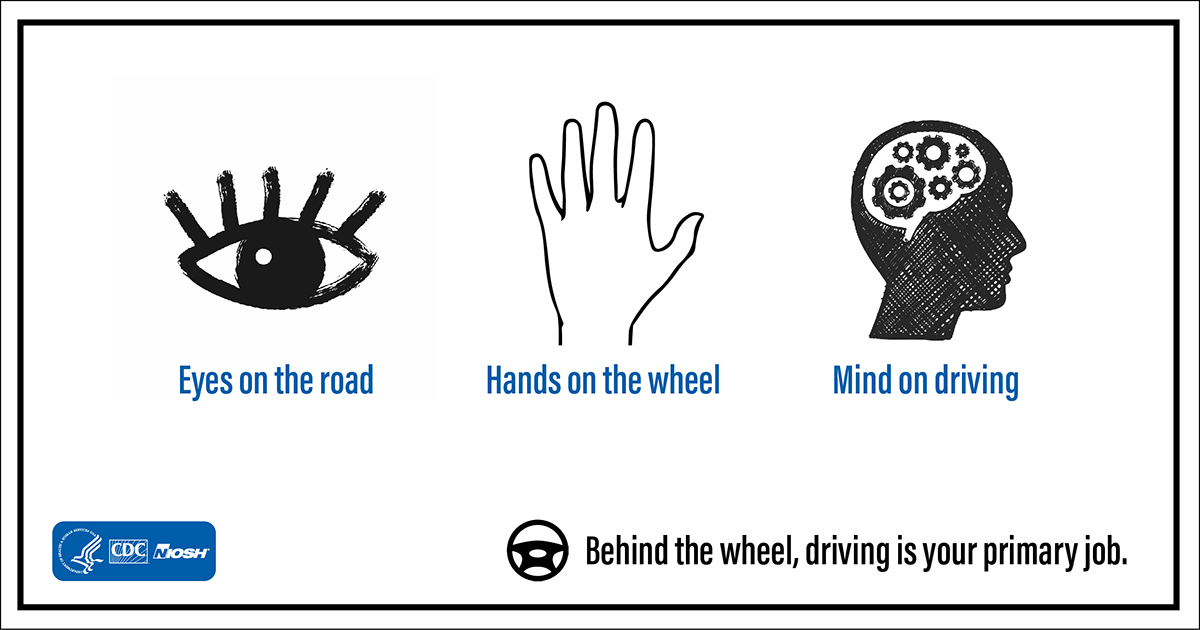
A distracted-driving graphic from the National Institute for Occupational Safety and Health (NIOSH).
What it is
Distracted driving is any time you take your eyes off the road, your hands off the wheel, or your mind off driving safely. Any non-driving activity raises your risk of a crash. Many workers spend all or part of their day on the road, and one study found that drivers at work were more likely than others to be in a hurry, thinking about work, tired or using a phone.
Three kinds of distraction
- Visual — eyes off the road: reading a text, looking up directions, rubbernecking at a crash.
- Manual — hands off the wheel: reaching for things, using a handheld device, adjusting the radio, eating or drinking.
- Cognitive — mind off driving: talking on the phone, arguing with a passenger, thinking about your next appointment. These can distract you even with your hands on the wheel and eyes on the road, and can be set off by people, objects, events — or just stray thoughts.
The numbers
- Drivers using phones may look at but not see up to 50% of what's around them.
- Distraction is present during 52% of normal driving.
- In 2020, 13% of U.S. traffic crashes involved distraction; 3,142 people died in crashes involving a distracted driver, 587 of them pedestrians, cyclists and others outside vehicles. At any moment, about 2.8% of drivers were visibly using a handheld device (2.9% in 2019).
- A non-fatal injury crash at work involving distraction costs the employer $100,310 on average.
Why phones are so distracting: the brain's attention is limited, and hands-free phones are just as distracting as handheld ones. A worker negotiating a deal by phone while driving gives neither task the attention it needs.

NIOSH graphic.
What employers can do
- Ban all phone use — texting, handheld and hands-free — while driving a company vehicle, and ban use of company phones while driving a personal vehicle.
- Require workers to pull over safely to look up directions, text, or make or take a call.
- Consider phone-blocking technology, and systems that detect and warn of distraction, such as cameras that notice when a driver's eyes leave the road.
- Prepare workers before rolling out policies: explain how to comply and what happens if they don't, and consider having them sign that they understand.
The law
Most states ban texting while driving, and more and more ban handheld devices (state laws). Drivers of commercial vehicles such as large trucks and buses may not text or use a handheld device while driving (federal rules).
What workers can do
- Don't use your phone while driving; pull over safely to use it.
- Set up your car — controls, directions — before you drive.
- Don't reach for things on the floor, open the glove box, or try to catch falling objects.
- Avoid emotional conversations with passengers, or pull over to continue them; ordinary conversation with an adult passenger can actually help keep you focused.
- Watch the vehicles, pedestrians, cyclists and events around you that may need a quick reaction.

NIOSH graphic.
Sources
Based on "Distracted Driving at Work," National Institute for Occupational Safety and Health, Centers for Disease Control and Prevention; a work of the United States government in the public domain. Its stock photograph is not reproduced; the graphics are available to download from NIOSH.
Licencia: CC0 1.0 (dominio público) · Adaptado de www.cdc.gov
1
0
0
0

Comentarios