
¿Quieres mejorar el contenido de la página? Propón un cambio.
To protect migratory birds, managers need to know how, where and when they travel, and how conditions along the way affect their survival and breeding. The National Park Service is working with the U.S. Geological Survey, the U.S. Fish and Wildlife Service, the Alaska Department of Fish and Game and Conservation Science Global, Inc., to track the year-round movements of Alaska's migratory golden eagles. One of them is Golden Eagle 1502.

U.S. Fish and Wildlife Service biologist Stephen Lewis with Golden Eagle 1502. Credit: National Park Service.
Tagging her
On March 24, 2015, the team caught 1502 near Big Grayling Lake on the southern slopes of the Mentasta Mountains in Wrangell–St. Elias National Park and Preserve. From her plumage they judged her about 2 years old. They fitted her with a 45-gram, solar-powered satellite transmitter on a light, durable harness. It reports her location every hour from about 7 a.m. to 7 p.m., every day of the year — though solar charging means little data arrives from November to late February, when she most likely stays in Alaska.
Across Alaska
Right after release she headed west across interior Alaska to the Seward Peninsula, including Bering Land Bridge National Preserve, between March 24 and June 1, 2015. She reached the eastern Seward Peninsula on April 11 and her summer range in early May.

Her spring 2015 route, March 24–June 1. Credit: National Park Service.
Summers on the Seward Peninsula
She spent summer 2015 on the far western Seward Peninsula, partly inside Bering Land Bridge National Preserve, until about October 13.
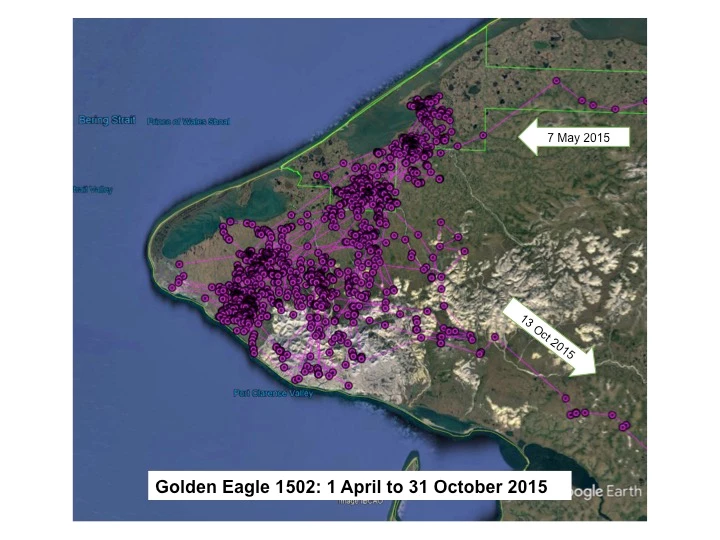
Her locations on the Seward Peninsula, April 1–October 31, 2015; the green line marks Bering Land Bridge National Preserve. Credit: National Park Service.
She returned each year. Judging by when she arrived in 2015 and 2016, and by how widely she roamed during the breeding seasons of 2015, 2016 and 2017, the researchers concluded she was not tending eggs or chicks those years.
| Year | Arrival on the summer range | Behavior |
|---|---|---|
| 2016 | May 9 | Wide-ranging |
| 2017 | Earlier than in 2015–2016 | Wide-ranging |
| 2018 | April 7 | Much more localized — suggesting she may have set up a nesting territory |
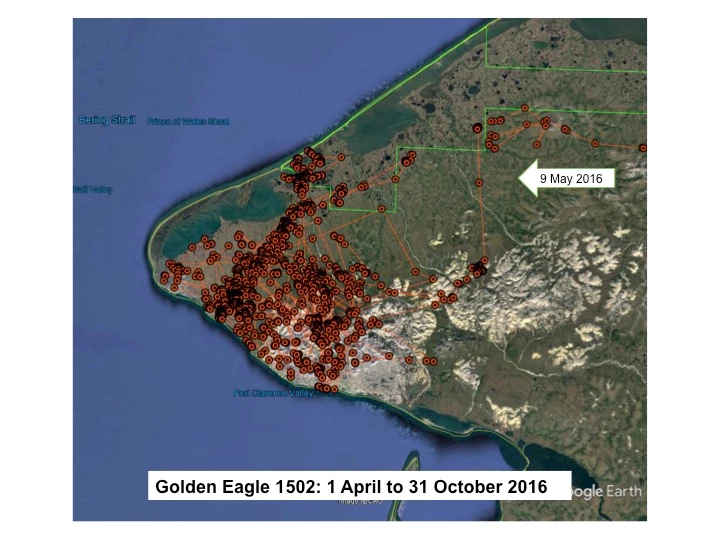
Her locations in 2016, April 1–October 31. Credit: National Park Service.

Her locations in 2018, April 1–October 31. Credit: National Park Service.
The team expected she might try to lay eggs and raise young in 2019.
Why it matters
Every tagged eagle tells its own story. Tracking studies like this are revealing how non-territorial golden eagles move around Alaska in the breeding season, filling gaps in what's known about the species and informing plans to manage and conserve it. The work is part of the Park Service's long-running study of migratory golden eagles, led by wildlife biologist Carol McIntyre.
Sources
Based on "Summer movements of female Golden Eagle 1502 at the northwestern edge of North America," National Park Service; a work of the United States government in the public domain.
En estas coleccionesDenali National Park & PreserveWrangell - St Elias National Park & PreserveBering Land Bridge National Preserve
Licencia: CC0 1.0 (dominio público) · Adaptado de www.nps.gov
1
0
0
0

Comentarios


