
¿Ves algo que mejorar? Propón un cambio.
U.S. Geological Survey and the California State Water Resources Control Board
Groundwater provides more than 40 percent of California’s drinking water. To protect this vital resource, the State of California created the Groundwater Ambient Monitoring and Assessment (GAMA) Program. The Priority Basin Project of the GAMA Program provides a comprehensive assessment of the State’s untreated groundwater quality and increases public access to groundwater-quality information. Selected groundwater basins in the Borrego Valley, Central Desert, and Low-Use Basins of the Mojave and Sonoran Deserts constitute one of the study units being evaluated.
The Borrego Valley, Central Desert, and Low-Use Basins of the Mojave and Sonoran Deserts Study Unit Overview of Water Quality

CONSTITUENT CONCENTRATIONS Low or not detected Values are a percentage of the area of the primary aquifer system with concentrations in the three specified categories. Values on pie chart may not equal 100 due to rounding of percentages. GAMA’s Priority Basin Project evalu-

CONSTITUENT CONCENTRATIONS High Moderate Values are a percentage of the area of the primary aquifer system with concentrations in the three specified categories. Values on pie chart may not equal 100 due to rounding of percentages. GAMA’s Priority Basin Project evalu-
GAMA’s Priority Basin Project evaluates the quality of untreated groundwater relative to human-health and aestheticbased benchmarks established for drinking-water quality. Benchmarks and definitions of high, moderate, and low concentrations are discussed in the inset box on page 3.
Inorganic constituents in groundwater commonly are derived from natural sources and processes but also can be affected by human activities. In the CLUB study unit, one or more inorganic constituents were present at high concentrations in about 48% of the primary aquifer system and at moderate concentrations in about 26%.
Human-made organic constituents can be found in products used in the home, business, industry, and agriculture, and can enter the environment through normal usage, spills, or improper disposal. In this study unit, organic constituents were not present at high concentrations in the primary aquifer system, and one or more organic constituents were present at moderate concentrations in about 5%.
RESULTS: Groundwater Quality in the Borrego Valley, Central Desert, and Low-Use Basins of the Mojave and Sonoran Deserts Study Unit
INORGANIC CONSTITUENTS
Trace and minor elements
Uranium and radioactive constituents
Nutrients
Total dissolved solids
Iron or manganese
SPECIAL-INTEREST CONSTITUENT Inorganic Constituents with Health-Based Benchmarks
Perchlorate
Trace and minor elements are naturally present in the minerals in rocks and soils, and in the water that comes into contact with those materials. In the CLUB study unit, trace and minor elements were detected at high concentrations in about 42% of the primary aquifer system, and at moderate concentrations in about 23% of the system. Fluoride, arsenic, molybdenum, boron, and vanadium were the elements that most frequently occurred at high and moderate concentrations. Chromium also was detected at high concentrations, but in less than 1% of the primary aquifer system.
Radioactivity is the release of energy or energetic particles during spontaneous decay of unstable atoms. Most of the radioactivity in groundwater comes from the decay of naturally occurring isotopes of uranium and thorium in minerals in the sediments of the aquifer. Uranium and (or) gross alpha radioactivity occurred at high levels in 12% of the primary aquifer system and at moderate levels in about 20% of the system.
Nutrients, such as nitrate and nitrite, are naturally present at low concentrations in groundwater. Elevated concentrations generally occur as a result of human activities, such as applying commercial fertilizer or animal waste to land used for crops. Livestock, when in concentrated numbers, and septic systems also produce nitrogenous waste that can leach into groundwater. Nitrate was present at high concentrations in about 3% of the primary aquifer system and at moderate concentrations in about 3%.
Inorganic Constituents with Non-Health Benchmarks
(Not included in water-quality overview charts shown on the front page)
Some constituents affect the aesthetic properties of water, such as taste, color, and odor, or may create nuisance problems, such as staining and scaling. The State of California has a recommended and an upper limit for total dissolved solids (TDS) in drinking water. Groundwater naturally contains TDS as a result of the weathering and dissolution of minerals in soils. In the CLUB study unit, TDS was present at high concentrations in about 11% of the primary aquifer system and at moderate concentrations (between the recommended and upper limit) in 39%.
Anoxic conditions (low amounts of dissolved oxygen) in groundwater may result in release of the naturally occurring elements manganese and iron from minerals into groundwater. Iron, or manganese, or both were present at high concentrations in about 3% of the primary aquifer system.
Constituent of Special Interest: Perchlorate
(Not included in water-quality overview charts shown on the front page)
Perchlorate is an inorganic constituent that has been regulated in California drinking water since 2007. It is an ingredient in rocket fuel, fireworks, safety flares and other products, may be present in some fertilizers, and also occurs at low concentrations under natural conditions in groundwater. Perchlorate was not detected at high concentrations, but was detected at moderate concentrations in about 32% of the primary aquifer system.
RESULTS: Groundwater Quality in the Borrego Valley, Central Desert, and Low-Use Basins of the Mojave and Sonoran Deserts Study Unit
ORGANIC CONSTITUENTS
Gasoline hydrocarbons
Solvents
Trihalomethanes
Herbicides and insecticides (including fumigants)
BENCHMARKS FOR EVALUATING GROUNDWATER QUALITY
GAMA’s Priority Basin Project uses benchmarks established for drinking water to provide context for evaluating the quality of untreated groundwater. After withdrawal, groundwater may be disinfected, filtered, mixed, and exposed to the atmosphere before being delivered to consumers. Federal and California regulatory benchmarks for protecting human health (Maximum Contaminant Level, MCL) were used for the evaluation when available. Otherwise, non-regulatory benchmarks for protecting aesthetic properties, such as taste and odor (Secondary Maximum Contaminant Level, SMCL), and non-regulatory benchmarks for protecting human health (Notification Level, NL, and lifetime Health Advisory Level, HAL) were used.
High, moderate, and low concentrations are defined relative to benchmarks
Concentrations are considered high if they are greater than a benchmark. For inorganic constituents (except perchlorate), concentrations are moderate if they are greater than one-half of a benchmark. For organic and special-interest constituents (including perchlorate), concentrations are moderate if they are greater than one-tenth of a benchmark; this lower threshold was used because organic constituents generally are less prevalent and have smaller concentrations relative to benchmarks than inorganic constituents. Low includes nondetections and values less than moderate concentrations. Methods for evaluating water quality are discussed in Parsons and others (2014).
Other VOCs Organic Constituents
The Priority Basin Project uses laboratory methods that can detect volatile organic compounds (VOCs) and pesticides at low concentrations far below human-health benchmarks. VOCs and pesticides detected at these low concentrations can be used to trace water from the landscape into the aquifer system.
Volatile Organic Compounds with Human-Health Benchmarks
VOCs are in many household, commercial, industrial, and agricultural products and are characterized by their tendency to volatilize (evaporate) into the air.
Gasoline hydrocarbons are a component of gasoline and may be used as additives to make gasoline burn more efficiently, improve emissions quality, and clean engine parts. In the CLUB study unit, gasoline hydrocarbons were not detected at high concentrations and were present at moderate concentrations in about 1% of the primary aquifer system.
Solvents are used for a number of purposes, including manufacturing and cleaning. Solvents were not detected at high concentrations and were present at moderate concentrations in about 1% of the primary aquifer system.
Trihalomethanes may form during disinfection of drinking-water supplies and may enter groundwater by the infiltration of landscape irrigation water or leakage from distribution systems. Trihalomethanes were not detected at high concentrations and were present at moderate concentrations in about 2% of the primary aquifer system.
Other volatile organic compounds, including organic synthesis reagents, were not detected at either high or moderate concentrations.
Pesticides with Human-Health Benchmarks
Pesticides, which include herbicides, fumigants, and insecticides, are applied to crops, gardens, lawns, around buildings, and along roads to help control unwanted vegetation (weeds), insects, fungi, and other pests. Insecticides were not detected at high concentrations in the primary aquifer system and were detected at moderate concentrations in about 1% of the primary aquifer system. Herbicides and fumigants were not detected at either high or moderate concentrations.

Priority Basin Assessments Trace and Minor Element Concentrations in the CLUB Study Unit
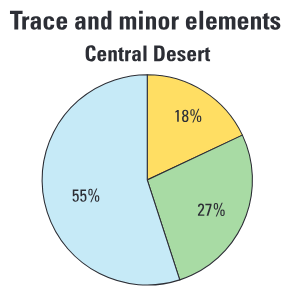
In the CLUB study unit, trace and minor elements were present at high concentrations in 42% of the primary aquifer system. The proportion of the primary aquifer system having high concentrations was greatest in the Low-Use Basins study area (48%) and lower in the Borrego Valley (29%) and Central Desert (18%) study areas. For comparison, the proportion of the primary aquifer system having high concentrations in the four other Mojave and Sonoran Desert areas ranged from 32% to 40% (Dawson and Belitz, 2012). The main contributors to high and moderate concentrations of trace and minor elements in the CLUB and other Mojave and Sonoran Desert study units were arsenic, boron, fluoride, molybdenum, and vanadium; however, different elements were important in different areas (Dawson and Belitz, 2012; Parsons and others, 2014). All five elements were present at high or moderate concentrations in the Low-Use Basins study area, whereas, three were present at high or moderate concentrations in the Borrego Valley study area (arsenic, fluoride, and vanadium), and three were present in the Central Desert study area (arsenic, fluoride, and molybdenum).


For more information

By Mary C. Parsons and Kenneth Belitz
Where this page came from
This page was imported from U.S. Geological Survey. Published by the U.S. Geological Survey and, as a work of the United States government, in the public domain.
Nobody has written it yet — it is the source material at a new address, which is why search engines are asked to skip it and why no one earns from it. It is up for grabs: take it on, and it is yours to rewrite and to earn from.
Licencia: CC0 1.0 (dominio público) · Adaptado de pubs.usgs.gov
1
0
0
0

Comentarios


