
¿Ves algo que mejorar? Propón un cambio.
Plains bison (Bison bison bison) once numbered in the tens of millions, roaming from northern Mexico to central Canada. By the end of the 1800s, commercial hunting, new diseases and habitat loss had pushed them to the edge of extinction. A handful of protected, federally managed herds set up in the early 1900s saved them in the wild.
Today the Department of the Interior (DOI) is the chief national steward of plains bison:
| Bison | about 11,000 |
| Herds | 19 |
| Land | 4.6 million acres in 12 states |
| Managed by | the National Park Service, U.S. Fish and Wildlife Service and Bureau of Land Management |
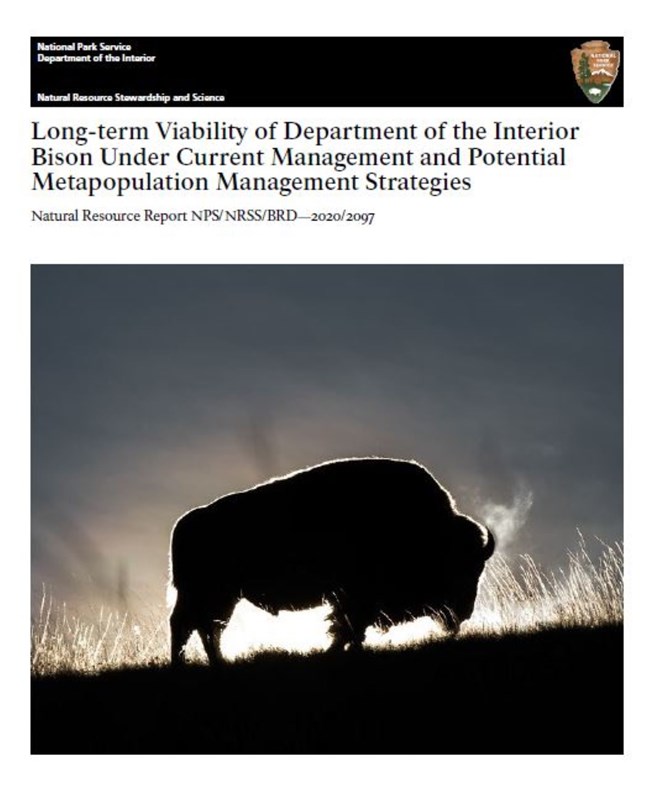
Image from the National Park Service's page on the study
The problem: small, fenced herds
Bison are no longer at risk of simply dying out. But most DOI herds are small and isolated — fenced in, and hemmed further by social and political limits on where they can roam. That leaves them exposed in two ways:
- Catastrophe: a disease outbreak or extreme weather can wipe out a small herd.
- Genetic drift: small herds lose genetic diversity faster than big ones, leading to inbreeding and less ability to adapt.
Researchers have proposed restoring gene flow — letting bison, or their gametes, move between herds, naturally or by translocation — and managing all DOI herds as one metapopulation.
The study
The National Park Service, the Wildlife Conservation Society and the U.S. Fish and Wildlife Service tested that idea, working with the Bureau of Land Management, state wildlife managers, non-governmental organizations and Canadian bison managers.
- They gathered genetic, population and management data on 16 DOI herds and two Parks Canada herds.
- They built computer simulations following each animal's genes to project each herd's future under current management.
- They tested alternative plans for moving bison between herds.
The goals, set by the partners:
- every herd has a 99% chance of surviving at its target size for 200 years;
- each herd keeps or gains genetic diversity;
- the metapopulation as a whole keeps its diversity;
- losing any one herd doesn't badly cut the diversity of the rest.
What they found
Herds differ a lot. Genetic diversity within herds varies widely, and herds are clearly distinct from one another — largely reflecting how each herd was founded and added to, plus drift. Three herds already have heterozygosity near 0.50, the level linked to inbreeding depression and set as the trigger for genetic augmentation.
Every herd loses diversity without gene flow. Over 200 years under current management:
| Herd size | Loss of genetic diversity |
|---|---|
| Large (over 500 bison) | 3–7% |
| Small (under 100) | 34–81%, with steep rises in inbreeding |
By then eight herds would fall below 0.50 heterozygosity, with inbreeding at levels other studies have tied to poorer reproduction and survival.
Most herds survive — a few may not. 15 of the 18 have a better than 99% chance of lasting 200 years without new gene flow; three of the smallest (under 100 bison) face a more than 10% chance of dying out at their current size.
Management choices help. Loss slows with bigger herds, and with culling that keeps sex ratios even, takes younger animals rather than adults, or removes the most genetically over-represented bison.
Moving bison between herds
The team ruled out herds that couldn't serve as donors or recipients for logistical, biological or political reasons, then modeled 25 scenarios, varying:
| Choice | Options |
|---|---|
| Which herd donates | the least related; a genetically similar one; rotating donors from least to most related; or the nearest |
| How many bison | 2 to 8 per move |
| How often | every 5, 8 or 10 years |
- Taking bison from the least-related herd gave the biggest gains for almost every herd.
- Rotating donors each time, least to most related, did almost as well — and needs far less genetic information.
- One rule for all herds could be small, infrequent moves — for example 2 bison every 10 years — from least-related or rotating donors, which lifts diversity in most herds while protecting the metapopulation's overall diversity.
- Better still, tailor it: small herds gain from more frequent moves, large herds need fewer, and herds with low diversity benefit from any move.
Recommendations
Isolation erodes diversity in every herd. Larger herds, smarter culling and moving modest numbers of bison between DOI herds from time to time can largely offset that — but donor herds and numbers must be chosen with care, and diversity must be monitored over the long term.
The authors recommend that the DOI Bison Working Group, chartered under the DOI Bison Conservation Initiative (2008), set up a technical task force to write a full metapopulation strategy covering genetics, wildlife health, cattle gene introgression, data management, local herd issues and partner engagement — informed as well by a DOI bison health report then being finished. Doing it will need new, sustained cooperation between DOI agencies and other bison conservation partners.
Read the full report on the NPS DataStore. Herds in the study include those at Badlands, Grand Canyon, Grand Teton, Theodore Roosevelt and Wind Cave National Parks and Tallgrass Prairie National Preserve.
Sources
Based on "Population Viability Analysis," the executive summary of the bison viability study, National Park Service; a work of the United States government in the public domain, prepared with the Wildlife Conservation Society; rewritten in hubnx's own words. The summary's example of moving "3 every 7 years" is left out because 7 years is not one of the intervals it says were modeled.
En estas publicacionesGrand Canyon National ParkGrand Teton National ParkTallgrass Prairie National PreserveBadlands National ParkWind Cave National Park
Licencia: CC0 1.0 (dominio público) · Adaptado de www.nps.gov
1
0
0
0

Comentarios


