
¿Ves algo que mejorar? Propón un cambio.
The opioid epidemic tripled U.S. drug overdose deaths from 1999 to 2015. Nationally, American Indians and Alaska Natives (AI/AN) saw bigger increases than any other racial or ethnic group — yet national statistics show white Americans with higher overdose death rates. Part of the reason is that AI/AN people are often recorded as another race on death certificates, which makes their death rates look lower than they are. Little was known about what the epidemic looked like regionally, in tribal and urban AI/AN communities.
Correcting the record
Researchers took Washington State death certificates for 1999–2015 and matched them against the Northwest Tribal Registry — a database of AI/AN patients seen at Indian Health Service (IHS), tribal and urban Indian clinics in Idaho, Oregon and Washington — using Social Security number, date of birth, name and sex, with two staff members reviewing every possible match. Anyone with AI/AN background recorded anywhere on the certificate, or matched in the registry, was counted as AI/AN. They were compared with non-Hispanic whites, the state's majority population.
What they found
- In 1999–2001, AI/AN and white Washingtonians had similar overdose death rates. Rates rose significantly for both afterward — but much faster among AI/AN.
- In 2013–2015, there were 184 drug overdose deaths among AI/AN in Washington, 126 (68.5%) involving opioids.
| Overdose deaths, 2013–2015 | AI/AN rate compared with whites |
|---|---|
| All drugs | 2.7 times |
| Opioid-involved | 2.7 times |
| Heroin-involved | 4.1 times |
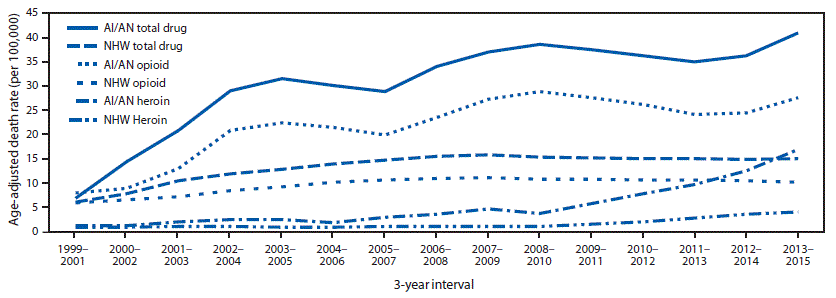
Age-adjusted overdose death rates among AI/AN and non-Hispanic white Washingtonians, 1999–2015, from death records corrected through linkage with the Northwest Tribal Registry. CDC
Among AI/AN in Washington:
- Men's drug overdose death rate was 1.7 times women's.
- People aged 25–54 had higher rates than younger or older people.
- At each age, rates were almost twice those of whites.
- Most deaths, for both groups, were among people living in urban counties. Urban AI/AN had a rate 1.4 times that of rural AI/AN, though the difference was not statistically significant; among whites, urban and rural rates were similar.
- Opioid and heroin deaths followed much the same patterns.
The undercount
Using national CDC WONDER data, uncorrected for misclassified race, AI/AN in the United States had lower overdose death rates than whites in 2013–2015. Even uncorrected, AI/AN in Washington had higher rates than both white Washingtonians and AI/AN nationally. And compared with the corrected Washington records, the uncorrected data undercounted AI/AN overdose deaths and rates by about 40%.
Misclassification can hide how common a problem really is, and can make numbers so small that statistics are suppressed — undermining state and federal programs' ability to send resources where they are needed.
Why, and what's being done
AI/AN communities face high rates of physical, emotional and historical trauma and deep socioeconomic disparities, which may contribute to drug use. They also face barriers to good medical and behavioral health care, partly from long-standing underfunding of IHS, tribal and urban Indian clinics, and partly from the stigma some communities attach to seeking behavioral health care.
Work against the epidemic in AI/AN communities depends on partnerships among tribal governments, regional Indian health boards, IHS and other federal agencies, tribal epidemiology centers and state and local governments. With the Bureau of Indian Affairs, IHS has introduced new prescribing policies, provider education, and wider access to medication-assisted treatment and to naloxone for first responders. More is needed: community-based surveillance, treatment and prevention that fit the different risks, cultures, resources and priorities of tribal and urban AI/AN communities.
Limits
- AI/AN people who never use IHS, tribal or urban Indian clinics aren't in the registry — and the registry underrepresents urban residents — so the true toll may be higher still.
- Human error in matching records could have missed or wrongly added some people.
- The population estimates used inflate the Hispanic AI/AN population, which lowers AI/AN rates that include Hispanic AI/AN.
- Changes in toxicology testing over time may explain some of the rise, and some heroin deaths may have been recorded as morphine deaths.
- The findings come from one state.
Sources
Based on Joshi S, Weiser T, Warren-Mears V, "Drug, Opioid-Involved, and Heroin-Involved Overdose Deaths Among American Indians and Alaska Natives — Washington, 1999–2015," MMWR volume 67, number 50, Centers for Disease Control and Prevention; a work of the United States government in the public domain.
Licencia: CC0 1.0 (dominio público) · Adaptado de www.cdc.gov
1
0
0
0

Comentarios


