
¿Quieres mejorar el contenido del nodo? Intente realizar una solicitud de edición.
Artificial Intelligence is undergoing a profound structural transition, moving away from purely digital frameworks toward capital-intensive physical infrastructure. Today's most critical technological shift is defined by a dual reality: the sweeping financial repricing of the United States energy grid due to massive data center demands, and the introduction of decentralized sovereign edge computing environments designed to bypass traditional cloud limitations. Recent market analyses indicate that AI infrastructure has initiated a massive $700 billion energy reallocation across the global power sector. This computing-dense energy grab is fundamentally altering utility valuations, forcing hyperscalers to lock down captive power supply chains and negotiate directly with localized grids. The traditional software architecture, which relied on infinite, cheap cloud elasticity, is colliding with the hard limits of electrical transmission, transforming physical grid connectivity into the primary variable for technological growth. Simultaneously, the deployment of next-generation edge frameworks—such as the Commonwealth Scientific and Industrial Research Organisation’s (CSIRO) newly launched Vetra architecture—signals a strategic departure from remote hyper-scale data centers. By processing complex analytical workflows and machine-learning models directly at the source of physical data generation, these localized systems remove latency, lower transmission overhead, and significantly mitigate the extreme water and carbon footprints of centralized infrastructure. This transformation marks the end of the unconstrained digital scaling era. The geopolitical and macroeconomic race is no longer fought solely through algorithmic design or software optimization, but through physical location, grid capacity, and localized compute sovereignty. Companies and regulatory bodies are adjusting to a reality where physical infrastructure limits dictate software capabilities.
The Realignment of the Digital Frontier
For over two decades, the technology sector operated on an assumption of digital abstraction. Software, cloud computing, and algorithmic development were treated as entities detached from geographic constraints or physical resources. The emergence of foundational artificial intelligence models initially mirrored this pattern, scaling rapidly via remote hyper-scale data centers. However, a major structural inflection point has arrived. Artificial intelligence is forcing a deep re-evaluation of the relationship between computational workflows and physical reality.
The ongoing expansion of generative artificial intelligence, multi-modal systems, and autonomous industrial agents has transformed software development from an optimization challenge into a resource extraction endeavor. The primary constraints on technological advancement are no longer compiler efficiency or raw transistor density; they are electrical grid capacity, cooling infrastructure, and localized processing latency. This shift has initiated a massive reallocation of capital toward the physical layer of the technology stack, changing how corporations value utilities, deploy localized systems, and secure energy assets.
This development manifests in two parallel trends. At the macro level, tech conglomerates are engaging in an unprecedented $700 billion acquisition and development campaign targeting global power assets, causing an asymmetrical repricing of the energy sector. At the micro level, research organizations and industrial operators are rolling out localized edge-compute architectures to bypass the network congestion, high latency, and environmental overhead of traditional data centers. Together, these factors signal a fundamental transition: the digital economy is now entirely dependent on physical infrastructure constraints.
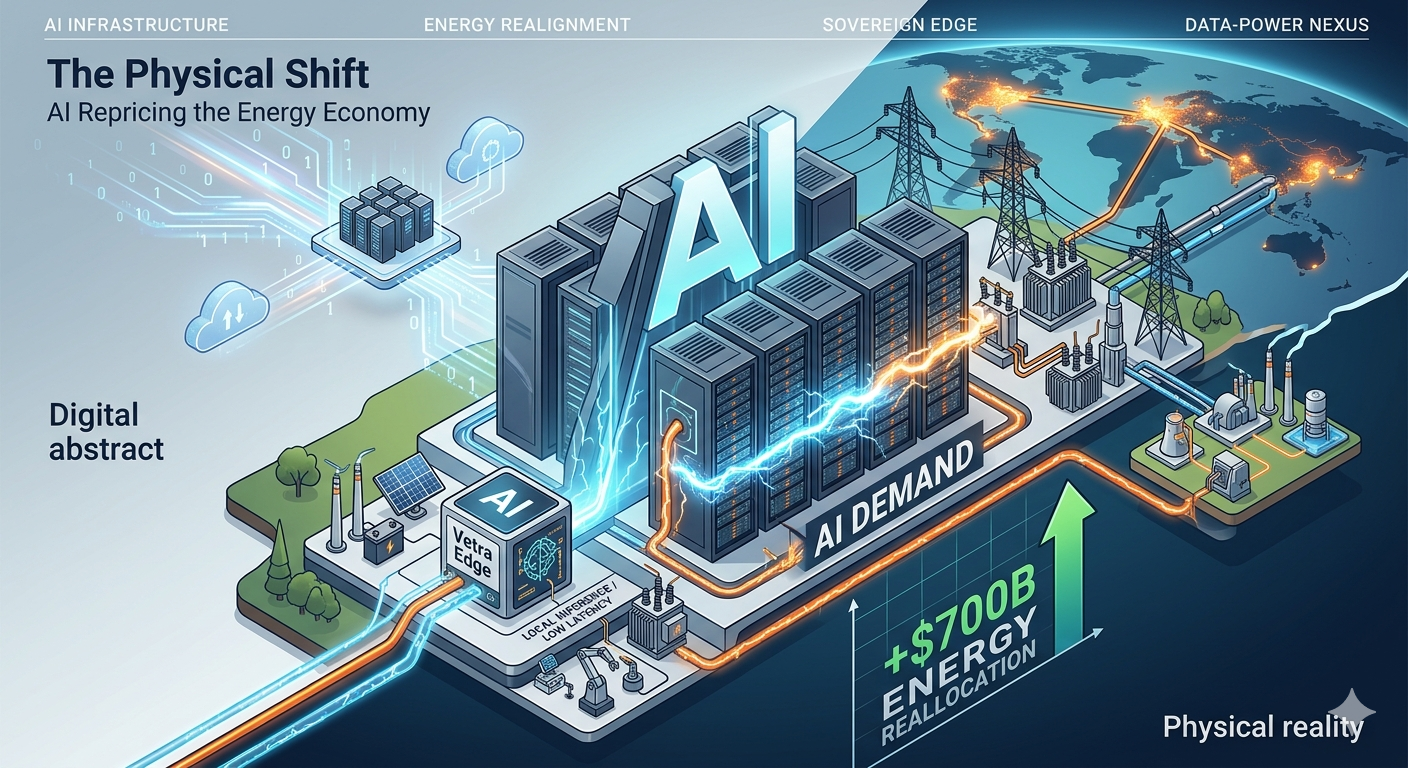
The $700 Billion AI Power Grab
The scale of the energy demands required to sustain modern artificial intelligence infrastructure has broken the historical models used by utility providers and grid operators. What began as an incremental uptick in data center power consumption has evolved into an aggressive competition for electrical baseload capacity. Financial and industrial sectors are undergoing an structural repricing as computing requirements cluster tightly around regional energy grids.
The Economics of Dense Computing
The financial realities of running large language models (LLMs) and dense inference pipelines at scale have shifted the cost structure of software companies. Historically, a software enterprise benefited from near-zero marginal costs of distribution. However, when every query requires intensive graphical processing unit (GPU) calculations, the marginal cost of distribution becomes tightly bound to the marginal cost of a kilowatt-hour.
This dynamic is splitting the software industry into two camps:
- Enterprises with captive, vertically integrated supply chains and long-term power purchase agreements (PPAs).
- Non-integrated developers running inference on third-party cloud infrastructure, whose pricing models have not yet adjusted to rising underlying energy costs.
As a result, computing density is no longer an abstract performance metric; it functions as an economic force. Data centers are evolving from standard real estate investments into complex industrial energy hubs. The valuation of technology companies is increasingly determined by their physical proximity to reliable, low-cost power generation rather than their software features alone.
Grid Repricing Mechanics
The influx of compute-dense infrastructure is putting severe pressure on regional electrical grids. In regions where data center development is concentrated—such as Northern Virginia, parts of Texas, and the Pacific Northwest—the sudden demand has outpaced the construction of new generation and transmission assets. This has caused a localized repricing of electricity, creating a ripple effect through regional economies.
[Tech Hyperscalers] ──(700B Capital Outlay)──> [Power Sector & Utilities]
                                                       │
                                        ┌──────────────┴──────────────┐
                                        ▼                             ▼
                          [Captive Infrastructure]      [Localized Grid Pressure]
                          • Long-term PPAs              • Higher base tariffs
                          • Co-located nuclear/hydro    • Transmission bottlenecks
                          • Supply chain security       • Asset repricing
When an industrial data center facility secures a substantial allocation of grid capacity, it alters the cost dynamics for all other entities tied to that infrastructure. Industrial manufacturers, commercial real estate developers, and consumer residential areas in AI-dense grid regions find themselves competing with technology giants that possess much larger capital reserves and a willingness to pay a premium for uninterrupted power. This has forced regulatory commissions and utility providers to rethink traditional allocation models, often implementing temporary construction pauses or demand-response penalties to protect local infrastructure.
Physical Infrastructure vs. Software Optimization
For years, the software industry relied on architectural optimization to lower costs. Developers assumed that code refactoring, model quantization, and efficient caching could offset infrastructure limitations. While these techniques remain relevant, they are hitting diminishing returns when measured against the sheer volume of global inference demands.
No amount of software optimization can eliminate the basic physics of data centers: converting electricity into binary states and managing the resulting heat. Consequently, investment strategies have pivoted toward physical components. The strategic focus has moved from software design to infrastructure assets: contracted power capacity, dedicated supply lines, cooling systems, and specialized physical hardware. The primary competitive advantage has shifted from writing the most efficient algorithm to securing the physical space and energy required to run it.
Sovereign Edge Infrastructure: The Case of Vetra
As centralized data centers hit physical and regulatory limits, a parallel architectural shift is occurring at the edge of the network. This development is defined by a move toward decentralized, localized computing designed to process data directly at its source. The launch of the Vetra AI infrastructure by the Commonwealth Scientific and Industrial Research Organisation (CSIRO) serves as a clear blueprint for this transition.
Decentralization and Real-Time Autonomous Learning
Traditional artificial intelligence applications rely heavily on a round-trip data path: data is collected by an on-site sensor, transmitted across wide-area networks to a centralized cloud data center, processed by a large-scale model, and then the resulting command is sent back to the physical device. While functional for non-time-sensitive applications like content recommendations, this model fails in safety-critical, real-time physical environments.
Autonomous robotics, industrial automated manufacturing, smart infrastructure, and remote sensing systems require sub-millisecond response times. Cloud routing introduces unacceptable latency and exposes operations to network disruptions. The Vetra infrastructure addresses this by bringing 48 high-performance, specialized graphics processing units directly to the physical research site at the Queensland Centre for Advanced Technologies (QCAT) in Pullenvale.
By performing complex mathematical operations on-site, the architecture enables robots and machines to process environmental data and update their internal machine learning models in real time. Rather than relying on static datasets or remote cloud servers, these physical systems adapt directly to their immediate surroundings. This localized approach allows edge devices to operate continuously and safely in complex, changing environments, even when completely disconnected from external networks.
Environmental and Resource Mitigations
Centralized hyper-scale data centers face intense criticism for their environmental impacts, particularly their massive consumption of water for evaporative cooling systems and their heavy carbon footprints. Placing massive compute clusters in areas with stressed utility grids exacerbates local ecological challenges.
Modular, edge-focused architectures like Vetra offer a more sustainable deployment model. By matching the scale of the compute infrastructure directly to local operational needs, these systems avoid the massive idle capacity and immense, single-point cooling demands of hyper-scale facilities. Vetra’s compact footprint utilizes advanced, closed-loop cooling configurations that drastically reduce water consumption and carbon emissions compared to standard cloud facilities. This decentralized design distributes the thermal and electrical load, allowing for integration with localized renewable energy microgrids, such as on-site solar or wind installations.
The Sovereign AI Framework
Beyond operational efficiency and environmental factors, the shift toward localized edge infrastructure is driven by a broader geopolitical push for sovereign computing capabilities. When data must cross international borders or reside on third-party cloud platforms owned by foreign conglomerates, enterprises and governments face significant regulatory, privacy, and security risks.
Centralized Cloud Model:
[Physical Sensors] ──(High-Latency Network)──> [Global Hyper-scale Data Center] ──> [Delayed Action]

Sovereign Edge Model (Vetra):
[Physical Sensors] ──(On-site High-Speed Processing / 48 GPUs)──> [Instant Local Action & Continuous Learning]
Sovereign AI infrastructure models physical location as a core component of the system's security and capabilities. By keeping data processing within a physically secure, locally controlled facility, organizations maintain complete ownership over their intellectual property and operational workflows. This model proves vital for defense applications, critical infrastructure management, and sensitive research sectors. It establishes a repeatable framework where computational power is treated as a national asset tied to specific geographical coordinates.
Macroeconomic and Geopolitical Implications
The intersection of massive energy reallocations and localized sovereign compute architectures is reshaping global technology supply chains, corporate strategies, and geopolitical relations. The physical requirements of artificial intelligence have transformed it from an enterprise software market into a key element of national industrial policy.
Supply Chain Bottlenecks
The tech sector's massive push for physical infrastructure has exposed deep vulnerabilities across global supply chains, extending far beyond the well-documented shortages of semiconductor foundry capacity. The bottlenecks now lie in heavy industrial equipment: high-voltage transformers, power distribution units, specialized copper cabling, and industrial liquid-cooling chillers.
Lead times for high-voltage grid transformers have stretched from months to years, creating a major lag in data center deployments. Consequently, technology companies are directly intervening in industrial manufacturing supply chains, acquiring component suppliers or issuing massive advance capital allocations to secure production capacity. This dynamic has driven up procurement costs across the board, impacting traditional utility providers and public infrastructure projects that must compete for the same industrial machinery.
National Infrastructure Strategies
Governments worldwide are beginning to recognize that computational capacity is directly linked to industrial output and national security. Relying on an international patchwork of commercial cloud platforms presents an unacceptable single point of failure during geopolitical conflicts or supply chain disruptions.
As a result, national infrastructure policies are being updated to incentivize domestic data center construction, grid modernization, and localized compute deployments. Sovereign nations are passing legislation that links data residency mandates with local energy production, forcing hyperscalers to invest directly in new green energy infrastructure rather than drawing down existing public grid capacity. This shift has turned energy policy into a core element of technology policy, where a country’s ability to generate clean, stable power directly determines its capacity for digital innovation.
The Corporate Shift
For corporate leadership, the physical requirements of artificial intelligence have altered the nature of IT procurement and strategic planning. The historical trend of outsourcing computing infrastructure to cloud providers is being replaced by a hybrid approach that emphasizes physical asset ownership and geographic diversification.
| Attribute | Centralized Hyper-scale Cloud | Decentralized Sovereign Edge |
|---|---|---|
| Primary Resource Constraint | Grid baseload capacity & transmission lines | Local thermal efficiency & spatial footprint |
| Data Flow Pattern | Centralized aggregation via wide-area networks | In-situ processing at point of generation |
| Economic Vulnerability | Fluctuating grid tariffs & regulatory caps | Initial capital expenditure & hardware lifecycle |
| Operational Resilience | Vulnerable to network & transit disruptions | High autonomy; independent of external links |
Enterprises are realizing that relying exclusively on centralized cloud vendors exposes them to escalating compute tariffs driven by underlying energy costs. Large organizations are shifting back to building proprietary, localized data centers co-located with dedicated power sources, or deploying modular edge nodes like Vetra for industrial operations. This shift protects corporations from market volatility in the utility sector and ensures that critical automated workflows remain operational regardless of broader cloud availability.
Looking Ahead: The Physicality of the Tech Landscape
The technology sector is undergoing an undeniable physical realignment. The era of treating software as an infinite resource detached from physical limits is drawing to a close. As artificial intelligence models scale up and integrate deeply into physical workflows, the industry must operate within the realities of material constraints, electrical grid caps, and regional resource availability.
The ongoing $700 billion reallocation of capital within the energy sector demonstrates that future technological dominance will belong to entities that control physical assets: power generation, transmission infrastructure, and specialized hardware. Simultaneously, the deployment of modular, sovereign edge frameworks like Vetra highlights how localized architectures can circumvent the latency, resource strain, and security vulnerabilities inherent in centralized cloud ecosystems.
For engineers, investors, and policymakers, this means tech analysis must look beyond software features and algorithmic performance. The future of technology is being decided on the factory floor, within utility substations, and inside localized edge nodes where computing meets the physical world. Success will be determined by how efficiently organizations can generate power, manage thermal output, and secure computational sovereignty within a resource-constrained environment.
1
0
0
0

Comentarios