
¿Ves algo que mejorar? Propón un cambio.
Lymphatic filariasis is a debilitating, disfiguring parasitic disease spread by mosquitoes. Under its Global Programme to Eliminate Lymphatic Filariasis, the World Health Organization recommends at least five rounds of yearly mass drug administration (MDA) — treating whole communities — where the disease is endemic. Transmission is expected to stop once community prevalence falls below 1%.
American Samoa, in the southern Pacific, is the only U.S. territory with evidence of ongoing transmission.
A rebound, then a new regimen
| Year | What happened |
|---|---|
| 2000–2006 | Seven years of mass treatment cut the share of people with filarial antigen in their blood (a sign of infection) from 16.5% to 2.3%, and treatment stopped |
| 2016 | A household survey of 2,507 people found prevalence had rebounded to 6.2%, with transmission widespread across the territory |
| 2018 | Mass treatment resumed with a newer three-drug regimen — ivermectin, diethylcarbamazine and albendazole |
| 2019 | A survey measured the campaign's effect |
The three-drug combination clears filarial larvae from the blood more effectively than the standard two-drug treatments (albendazole with either diethylcarbamazine or ivermectin). WHO recommends it and expects it to speed progress toward global elimination — though only where no other filarial infections rule out diethylcarbamazine (onchocerciasis) or ivermectin (loiasis).
The 2019 survey
From July 11 to August 17, 2019, the American Samoa Department of Health, with CDC and the Pacific Island Health Officers' Association, sampled households at random from all 68 villages on the main islands of Tutuila and Aunu'u. Children aged 5–9 and villages known for high transmission were oversampled. Consenting household members aged 5 and older answered a questionnaire and gave a blood sample for a rapid antigen test strip; everyone who tested positive was offered treatment.
Results
- The team visited 1,865 households and enrolled 2,081 people; 47 tested positive.
- Cases were scattered across the islands, with many along Tutuila's western coast.
| Group | Result |
|---|---|
| Children 5–9 (test positivity) | 1.1% |
| Ages 10 and older (test positivity) | 2.9% |
| Estimated overall prevalence (adjusted for age and location) | 2.7% |
| Males (adjusted) | 4.8% |
| Females (adjusted) | 1.0% |
Males had higher prevalence than females in every age group.
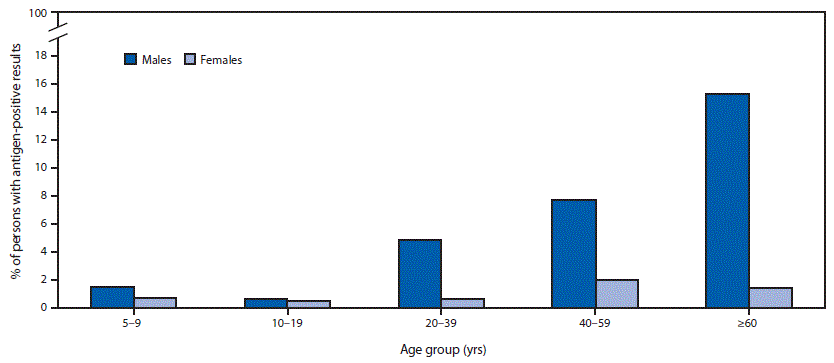
Filarial antigen prevalence by age group and sex, American Samoa, 2019. From CDC's MMWR.
What it means
Infection has fallen since 2016 but remains above WHO's 1% threshold in every age group, so transmission is still going on. The authors recommend that American Samoa follow WHO guidance: keep up yearly three-drug mass treatment, monitor progress until elimination targets are met, and make sure high-prevalence groups — especially adult men — are reached.
Sources
Based on Hast MA, Tufa A, Brant TA, et al., "Notes from the Field: Impact of a Mass Drug Administration Campaign Using a Novel Three-Drug Regimen on Lymphatic Filariasis Antigenemia — American Samoa, 2019," Morbidity and Mortality Weekly Report 69(21), CDC; a work of the United States government in the public domain.
Licencia: CC0 1.0 (dominio público) · Adaptado de www.cdc.gov
1
0
0
0

Comentarios


