
¿Quieres mejorar el contenido del nodo? Intente realizar una solicitud de edición.
The biggest technology story today is not a flashy new AI model, another chatbot launch, or a billionaire promising artificial general intelligence by next Thursday. The real story is far more important: the AI industry is running into hard physical limits. Demand for AI compute is growing faster than the world can build data centers, power infrastructure, advanced chips, and cooling systems. Every major player—OpenAI, Anthropic, Google, Microsoft, Meta, Amazon, and Nvidia—is now competing in a race constrained by energy, silicon, and infrastructure. This is the moment AI stopped being just a software story and became an infrastructure story. The industry spent the past three years convincing everyone that AI would change everything. Now it must solve a harder problem: where exactly all that intelligence will run. The result is a new power hierarchy in tech. The winners may not be the companies with the smartest models. They may be the companies with the most electricity, the most GPUs, and the deepest wallets.
The technology industry loves abstraction.
Cloud computing abstracted servers.
Software abstracted business processes.
AI is now abstracting human cognitive work.
But underneath every elegant AI demo is a very ugly reality: enormous buildings filled with racks of power-hungry machines that consume absurd amounts of electricity and generate enough heat to make a volcano nervous.
That is the real story of AI in 2026.
Not prompts.
Not copilots.
Not “agentic workflows.”
Not founders posting vague tweets about “something big coming.”
The story is compute.
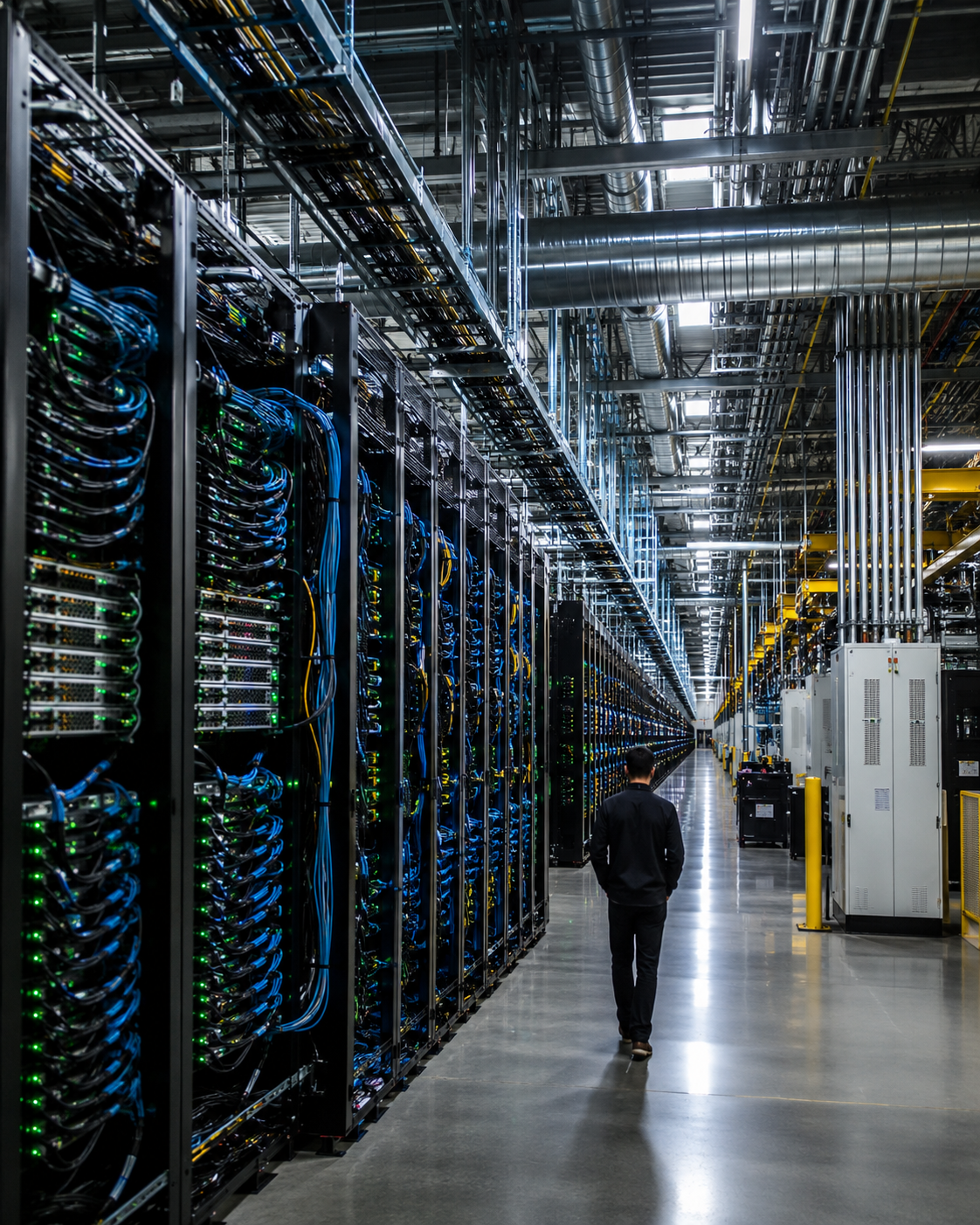
The entire AI economy is running into the same brutal constraint: there is not enough infrastructure to satisfy demand.
That shortage is reshaping everything.
Why Compute Became the New Oil
Every major AI breakthrough of the last decade follows the same pattern.
More data.
More compute.
Bigger models.
Better performance.
This has been remarkably consistent.
When large language models started improving at astonishing speed, the lesson the industry absorbed was simple: scale works.
If you train bigger systems with more compute, performance improves.
That sounds obvious now, but its consequences are massive.
Once scaling laws became industry doctrine, AI labs stopped thinking like software companies.
They started thinking like industrial empires.
Suddenly the competitive advantage wasn’t just better researchers or cleaner code.
It became:
Who can secure the most GPUs?
Who can build the biggest clusters?
Who can get the most power?
Who can cool all of it?
That shift changed everything.
AI is no longer just about algorithms.
It is about infrastructure at national scale.
The Core Bottleneck: GPUs
At the center of this crisis is one device.
The GPU.
Originally built for gaming graphics, GPUs became the engine of modern AI because they excel at parallel computation.
Training large AI models requires vast numbers of mathematical operations happening simultaneously.
GPUs are extraordinarily good at this.
Nvidia understood this earlier than almost anyone.
That foresight transformed the company into the most strategically important hardware company in the world.
For years, GPUs were simply high-performance chips for gaming, research, and specialized workloads.
Then generative AI exploded.
Suddenly every major tech company wanted hundreds of thousands of GPUs.
Then millions.
That demand shock broke the normal supply chain.
Now GPUs are effectively the gold bars of the AI economy.
Everyone wants them.
Not everyone gets them.
This created an extraordinary imbalance.
AI labs need compute.
Cloud providers supply compute.
Chipmakers manufacture compute.
Who controls the supply controls the market.
That explains Nvidia’s dominance.
Nvidia is not just selling chips.
It is selling access to intelligence production.
That sounds dramatic, but it is not wrong.
Without chips, no training.
Without training, no frontier models.
Without frontier models, no AI leadership.
Simple.
Why More Chips Alone Won’t Solve It
People often assume the problem is simply manufacturing more chips.
It isn’t that simple.
Even if chip output doubles, other bottlenecks remain.
Data center construction.
Electric grid capacity.
Cooling systems.
Networking.
Memory bandwidth.
Fiber infrastructure.
AI infrastructure is an interconnected stack.
If one layer breaks, everything slows.
Think of it like building a Formula 1 car.
Adding a stronger engine helps.
But if tires fail, brakes fail, or fuel runs out, the car still loses.
AI infrastructure works the same way.
The GPU shortage gets headlines because it is easy to understand.
But the deeper constraint is system-level capacity.
You need everything working together.
And everything is expensive.
Very expensive.
The New Arms Race: Data Centers
Data centers used to be important but boring.
They were physical necessities.
Nobody bragged about them.
That has changed.
Now data centers are strategic weapons.
The AI industry needs enormous compute clusters to train and serve increasingly complex models.
Inference—the process of running AI models for real users—is becoming just as expensive as training.
This surprises many people.
Training gets attention because it sounds dramatic.
But inference is where the recurring cost lives.
Every chatbot query, every generated image, every AI coding request burns compute.
Millions of users generating billions of requests means compute demand never stops.
The consequence is staggering.
The infrastructure requirement for serving AI at global scale may exceed training requirements over time.
That changes how companies allocate capital.
Instead of asking:
How do we build a smarter model?
Executives increasingly ask:
How do we scale inference cheaply?
That question may decide the next generation of AI winners.
Power Is Becoming the Ultimate Constraint
The most important input for AI may not be chips.
It may be electricity.
That sounds absurd until you look at modern AI clusters.
They consume extraordinary amounts of power.
Some large AI facilities consume as much electricity as small cities.
That introduces a major problem.
You cannot instantly add more electricity to the grid.
Power infrastructure moves slowly.
Permits.
Transmission lines.
Substations.
Generation capacity.
These projects take years.
Tech companies move in quarters.
Power infrastructure moves in decades.
That mismatch creates friction.
The AI boom is colliding with physical reality.
Electricity is finite.
Grid expansion is slow.
Demand is exploding.
This creates a brutal constraint.
The next AI leader may be determined less by software innovation and more by access to energy.
Read that again.
The future of artificial intelligence may depend heavily on power plants.
Somewhere, an electrical engineer is having the most unexpected career glow-up in history.
The Cloud Giants Hold Massive Advantage
This is where the market gets interesting.
Not every AI company has equal odds.
Cloud providers hold enormous structural advantages.
Amazon.
Microsoft.
Google.
These companies already operate massive infrastructure.
They understand:
Power procurement
Data center operations
Networking
Capacity planning
Global scaling
That matters enormously.
AI startups can build excellent models.
But unless they own infrastructure or secure privileged access, they remain dependent.
Dependency creates vulnerability.
Cloud providers are in a powerful position because they own the rails.
Owning infrastructure gives leverage.
It lowers costs.
Improves margins.
Speeds deployment.
Protects supply.
This is why partnerships between AI labs and hyperscalers became so important.
Infrastructure access determines survival.
The Shift from Model Wars to Economics Wars
The first phase of AI competition focused on capability.
Which model is smartest?
Which model writes better?
Which model reasons better?
Those questions still matter.
But they are no longer enough.
The second phase of AI competition is economic.
Which company can deliver intelligence profitably?
This is much harder.
A model can be brilliant and financially terrible.
In fact, many are.
The dirty secret of frontier AI is that many products remain economically challenging.
Revenue is growing fast.
Costs are growing fast too.
Training costs are enormous.
Inference costs remain high.
Infrastructure costs are exploding.
This creates a brutal challenge.
Can companies scale intelligence profitably before infrastructure costs crush margins?
That is the trillion-dollar question.
Consumers love AI.
Investors love AI.
Accountants remain unconvinced.
As usual, accountants eventually get their turn.
Why Smaller Models Matter More Than People Think
One major industry response is optimization.
Instead of making models infinitely bigger, companies are focusing on efficiency.
Smaller, better-optimized models are becoming strategically important.
Why?
Because compute efficiency improves economics.
If a model delivers 95% of the performance at 20% of the cost, that can be transformational.
This is especially important for inference.
Not every use case needs a giant frontier model.
Many tasks need:
Fast response
Low latency
Low cost
Good-enough intelligence
This creates opportunity.
Companies that optimize for efficiency—not just raw intelligence—may outperform.
That is not as glamorous as giant models.
But it may be more profitable.
The market increasingly rewards useful intelligence, not just impressive intelligence.
There is a difference.
A superhuman model that costs too much can lose to a slightly weaker model that scales economically.
That is capitalism’s favorite punchline.
Cool technology still has to make money.
The AI Agent Explosion Makes Infrastructure Worse
Now enter AI agents.
The latest industry obsession.
Everyone wants agents.
Investors love agents.
Founders pitch agents.
Executives demand agent strategies.
The idea is compelling.
Instead of answering questions, AI systems perform multi-step tasks autonomously.
Research.
Planning.
Execution.
Iteration.
Useful? Yes.
Cheap? Absolutely not.
Agents dramatically increase compute usage.
Why?
Because one simple user request can trigger dozens or hundreds of internal model calls.
A chatbot answer might require one inference.
An agent workflow may require:
Planning pass
Tool selection
Execution loop
Validation loop
Retry loop
Final synthesis
That is many model calls.
Multiply this across millions of users.
Infrastructure demand skyrockets.
This is why the AI agent boom intensifies the compute crisis.
The more capable systems become, the more infrastructure they consume.
Convenient.
We built intelligence so powerful it requires industrial-scale electricity to answer emails.
Human productivity has never looked so expensive.
The Hidden Winners of the AI Boom
Everyone talks about AI labs.
But the biggest winners may be elsewhere.
Semiconductors.
Energy.
Utilities.
Cooling.
Networking.
Data center construction.
These sectors suddenly became central to AI.
The AI boom created second-order winners.
Power companies now matter more to AI than many software companies.
Cooling specialists became strategically relevant.
Fiber network operators gained importance.
Chip supply chain firms became critical.
This is what mature technological revolutions look like.
Early winners are often flashy.
Later winners are infrastructure providers.
During the internet boom, browsers got attention.
The real giants emerged from infrastructure and platforms.
AI may follow a similar pattern.
Infrastructure is becoming the foundation of value creation.
The Geopolitical Dimension
This is no longer just a business story.
It is geopolitical.
AI leadership increasingly intersects with national power.
Countries now understand that compute capacity influences economic and strategic strength.
That changes incentives.
Governments are becoming more involved.
Semiconductor policy.
Export controls.
Energy strategy.
Data sovereignty.
Infrastructure investment.
All are increasingly tied to AI.
The reason is obvious.
Advanced AI capability may shape:
Economic competitiveness
Military capability
Cybersecurity
Scientific progress
That raises the stakes dramatically.
Compute is becoming a strategic national resource.
This intensifies competition between global powers.
The AI race is partly a software race.
But increasingly, it is a supply chain race.
Who can secure chips?
Who can secure energy?
Who can build infrastructure fastest?
Those questions matter enormously.
The Great Market Correction Coming
The AI market currently contains extraordinary optimism.
Much of that optimism is justified.
AI is genuinely transformative.
But hype remains abundant.
Some expectations are unrealistic.
Not every AI company will survive.
Not every AI product will succeed.
Not every AI valuation will hold.
Eventually markets demand discipline.
That discipline usually arrives in the form of economics.
Revenue must justify spending.
Margins must improve.
Capital efficiency must matter.
That transition is coming.
Some companies will adapt.
Others will struggle.
The winners will likely combine three traits:
Strong models
Efficient economics
Infrastructure advantage
Missing one becomes dangerous.
Missing two becomes fatal.
The Consumer Experience Is Still Early
Despite massive spending, consumer AI remains early.
Most people still interact with AI through:
Chatbots
Image generation
Coding tools
Search augmentation
Useful, yes.
Revolutionary for everyone? Not yet.
That is important.
The infrastructure race is happening ahead of mass adoption.
Tech companies are investing based on expected future demand.
That demand may arrive.
It may also evolve differently than expected.
This creates risk.
If adoption exceeds expectations, infrastructure remains constrained.
If adoption disappoints, overinvestment becomes a problem.
Either scenario matters.
This makes capital allocation critical.
The industry is effectively betting hundreds of billions on AI becoming foundational.
That is a large bet.
History suggests large bets create both giants and casualties.
What Happens Next
The next 24 months will define the AI industry.
Several shifts are likely.
Compute efficiency will become a primary competitive advantage.
Infrastructure ownership will matter more.
Energy strategy will become central to AI planning.
Smaller optimized models will gain importance.
Inference economics will dominate executive conversations.
This represents a major maturation of AI.
The industry is moving beyond novelty.
The question is no longer:
Can AI do impressive things?
We know it can.
The real question is:
Can AI scale sustainably and profitably?
That is much harder.
And much more interesting.
The Big Truth Nobody Can Ignore
Technology loves narratives about intelligence.
Smarter models.
Better reasoning.
More capability.
Those stories are exciting.
But underneath all of it is an unavoidable truth.
AI runs on physical systems.
Silicon.
Electricity.
Cooling.
Infrastructure.
This matters because physical constraints eventually discipline software ambition.
You can dream infinitely.
You cannot deploy infinitely.
At least not without enough power.
That is the defining story of technology today.
AI is no longer limited primarily by ideas.
It is limited by infrastructure.
That changes everything.
The winners of the next decade may not simply be the companies with the smartest AI.
They may be the companies best able to industrialize intelligence.
That means building systems that are:
Scalable
Affordable
Reliable
Efficient
This is where the AI story gets real.
Not in product demos.
Not in keynote presentations.
Not in carefully scripted launch videos.
In power contracts.
In chip supply agreements.
In data center construction schedules.
Not sexy.
Very important.
The future of AI may ultimately depend on who can secure enough electricity to keep the machines running.
Which is both hilarious and deeply revealing.
After years of promising a software-defined future, the technology industry has rediscovered something ancient.
Progress still depends on physical resources.
The AI revolution is real.
But like every industrial revolution before it, it eventually runs into concrete, steel, and power grids.
Turns out intelligence at scale is less magical than advertised.
It is still infrastructure.
Just very expensive infrastructure with a chatbot interface.
1
0
0
0

Comentarios