¿Ves algo que mejorar? Propón un cambio.
Esta página es pública.
| 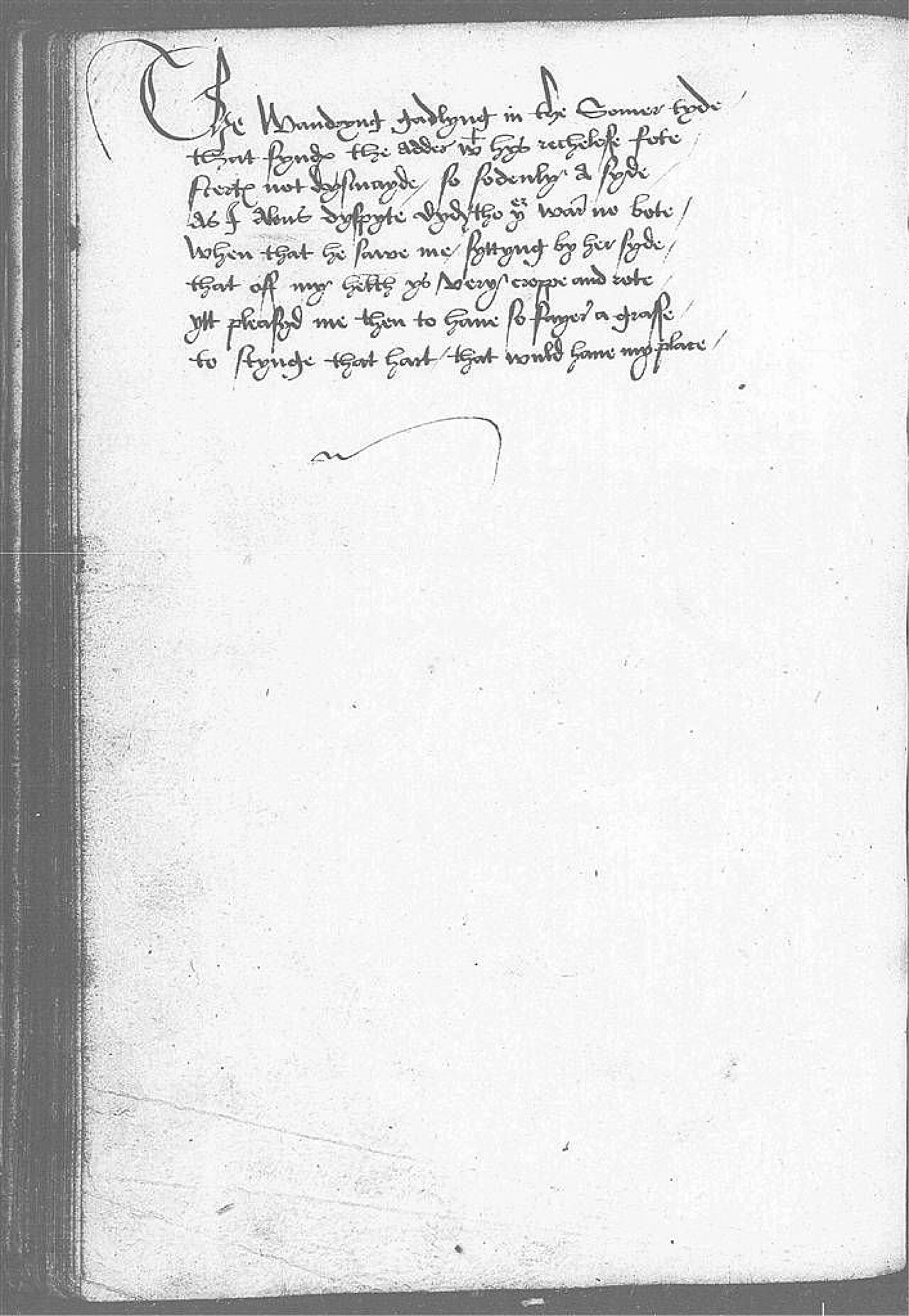
The Devonshire Manuscript facsimile 35v (Image: DMSEG, CC BY-SA 3.0) |
| --- |
| 
The Devonshire Manuscript facsimile 35r (Image: DMSEG, CC BY-SA 3.0) |
| |
f. [35r]
f. [35v]
1 The Wandryng gadlyng in the somer tyde /
2 {w+t+}{es} that fyndes the Adder with hys rechelesse fote /
3 stertes{es} not dysmayde / so sodenly A syde /
4 {r'}{{th}+er+} jealous As I Alous dyspyte dyd / tho there ware1 no bote /
5 When that he sawe me / syttyng by her syde /
6 that off my helth ys very croppe and rote /
7 ytt pleasyd me then to haue so fayer a grasse /
8 to stynge that hart / that wuld haue my place /
W2
Notes & Glosses
- This particular abbreviation, a connected apostrophe that follows a consonant, is not included in the Renaissance English Text codes, but indicates an omitted e.[1]
- This initial may refer to Sir Thomas Wyatt.
Commentary
Attributed to Sir Thomas Wyatt by internal evidence and by R. A. Rebholz,2] this epigram was entered by [H4. While epigrams are classical in origin, Wyatt bases his model on Serafino d'Aquilano's strambotti, which feature the eight-line stanza rhyming pattern abababcc (ottava rima).[3] A. K. Foxwell notes that Wyatt may have written epigrams bcause they were in vogue at the French court between 1528-32.[4] The poem overturns the classical image of a man who encounters a snake, which was commonplace iconography in the early Tudor court.
The poem also appears in Tottel's Miscellany as “Of the Ielous man that loued the same woman and espied this other sitting with her” (item 55).[5]
Works Cited
- ↑ See Anthony G. Petti. English Literary Hands from Chaucer to Dryden. Cambridge, MA: Harvard UP, 1977. 22-3.
- ↑ R.A. Rebholz, ed. Sir Thomas Wyatt: The Complete Poems. London: Penguin, 1978. 91.
- ↑ Rebholz, 364.
- ↑ Agnes K. Foxwell, ed. The Poems of Sir Thomas Wiat. New York: Russell and Russell, 1913.
- ↑ Tottel's Miscellany: Songes and Sonettes. Richard Tottel, 1557; rpt. Exeter: Shearsman, 2010. 49.
Textual Notes
Texts Collated
STC13860_29, L36529_05, LEge38
Collation
1 The] THe STC_13860_29 Wandryng] wandring L36529_05 STC_13860_29 wandering LEge38 gadlyng] gadling L36529_05 galdynggadlyng LEge38 gadling, STC_13860_29 somer] sommer LEge38 STC_13860_29 tyde /] tyde L36529_05 tyde, STC_13860_29
2 that] That STC_13860_29 fyndes] findes STC_13860_29 Adder] adder L36529_05 Adder / LEge38 hys] his L36529_05 LEge38 STC_13860_29 rechelesse] retchles L36529_05 recheles LEge38 rechlesse STC_13860_29 fote /] fote L36529_05 foote STC_13860_29
3 stertes] startes L36529_05 LEge38 Startes STC_13860_29 dysmayde /] dysmayde L36529_05 dismayde, LEge38 dismaid STC_13860_29 sodenly] soudenly LEge38 sodeinly STC_13860_29 A syde /] a syde L36529_05 a side / LEge38 aside, STC_13860_29
4 As] as L36529_05 LEge38 I AlousIalous dyspyte dyd /] did gelosy L36529_05 Ialous dispite did : LEge38 iealous despite did, STC_13860_29 tho] though STC_13860_29 there] ther L36529_05 ware] were L36529_05 STC_13860_29 bote /] boote L36529_05 boote, STC_13860_29
5 When] when L36529_05 LEge38 sawe] saw L36529_05 STC_13860_29 me /] me L36529_05 STC_13860_29 me : LEge38 syttyng] sitting L36529_05 LEge38 STC_13860_29 syde /] side L36529_05 LEge38 syde, STC_13860_29
6 that] That STC_13860_29 off] of L36529_05 LEge38 STC_13860_29 helth] health L36529_05 STC_13860_29 helth / LEge38 ys] is LEge38 STC_13860_29 croppe] cropp L36529_05 crop, STC_13860_29 and] & LEge38 rote /] roote L36529_05 rote. LEge38 roote. STC_13860_29
7 ytt] yt L36529_05 it LEge38 It STC_13860_29 pleasyd] pleased L36529_05 LEge38 STC_13860_29 then] L36529_05 haue] have L36529_05 LEge38 fayer] faire L36529_05 fair LEge38 fayre STC_13860_29 grasse /] grace L36529_05 grace / LEge38 grace, STC_13860_29
8 to] To STC_13860_29 stynge] styng L36529_05 LEge38 STC_13860_29 that] the L36529_05 STC_13860_29 hart /] wight L36529_05 hert LEge38 hart, STC_13860_29 wuld] wold L36529_05 would LEge38 STC_13860_29 haue my] have had my L36529_05 have my LEge38 haue had my STC_13860_29 place /] place. L36529_05 LEge38 STC_13860_29
Where this page came from
This page was imported from Wikibooks. From “The Devonshire Manuscript” on Wikibooks, by its contributors, under CC BY-SA 4.0. Changed here: set as a page; navigation and edit links left out; each image under its own licence, credited in its caption.
Nobody has written it yet — it is the source material at a new address, which is why search engines are asked to skip it and why no one earns from it. It is up for grabs: take it on, and it is yours to rewrite and to earn from.
En estas publicacionesThe Devonshire Manuscript
Licencia: CC BY-SA 4.0 · Adaptado de en.wikibooks.org
Comentarios