
Quelque chose à améliorer ? Proposez une modification.
On Sunday, March 19, 1865, the 30,000 men of the Left Wing of Major General William T. Sherman's Union army marched through central North Carolina to the hymn "Old Hundred," thinking of home and of a war that seemed nearly over. Near the farming village of Bentonville, 20,000 ragged Confederates — what was left of a once-powerful army — attacked them.
The battle
After taking Atlanta on September 2, 1864, Sherman's 60,000 soldiers had marched more than 1,000 miles through the South. By March 1865 they were heading north through North Carolina to join Lieutenant General Ulysses S. Grant, whose army was besieging Richmond just 75 miles away. To defend Richmond and Petersburg, General Robert E. Lee sent General Joseph E. Johnston to stop Sherman.
| Date | |
|---|---|
| March 19 | Johnston struck Sherman's Left Wing, which had fallen half a day behind the Right. The attack made real progress, but Union troops held that afternoon |
| March 20 | the rest of Sherman's army arrived |
| Night of March 21 | Johnston withdrew |
The fighting spread over nearly 6,000 acres and caused more than 4,000 casualties. It came just three weeks before Lee's surrender at Appomattox Court House, and was the only major attempt to stop Sherman after Atlanta — and the last Confederate offensive.

Sherman's march. Image from the NPS lesson on Bentonville
1861: chaos at First Manassas
Four years earlier, men like these might have lain untreated on the field for days. At the First Battle of Manassas (Bull Run) on July 21, 1861, many Union surgeons refused to treat men from other regiments, civilian ambulance drivers fled at the first gunfire, and some wounded lay on the field for three or four days. Assistant Surgeon John W. Foye of the Eleventh Massachusetts saw nearly all the surgeons at his field hospital leave in mid-afternoon and its last ambulance captured:
"I estimate the number left at one hundred and eighty. All of them fell into the hands of the enemy."
The Letterman Plan
The disaster pushed the U.S. Army Medical Department to organize. Surgeon Jonathan Letterman, Medical Director of the Army of the Potomac, supplied much of the answer, including his Field Hospital Order of October 30, 1862:
- before a battle, each corps sets up a hospital for each division, sited by the corps' medical director, with three medical officers as its operating staff;
- the other regimental medical officers set up temporary depots a safe distance behind their regiments to give immediate aid;
- an ambulance corps removes the wounded "carefully and with dispatch";
- hospitals go near the best roads, behind the center of the line, out of ordinary range of enemy guns, with suitable ground, good water and plenty of fuel.
The Letterman Plan began in the East and became a key part of the North's improving logistics. The South set up its own "infirmary corps" in 1862, but, as historian James McPherson has written, it lacked the men, medicines and ambulances to match the Union's; he estimates that 14% of wounded Union soldiers died, against 18% of wounded Confederates. Still untried in the western armies when Sherman began his Atlanta Campaign in spring 1864, the plan was working well — and had been refined — by the time of his March to the Sea that November.
1865: the system at work
Surgeon John H. Moore, one of Sherman's medical officers, reported on Bentonville:
- hospitals were set up about half a mile behind the line; on the 19th they came under fire and had to be moved;
- after a two-month march without resupply, nothing essential for the wounded was lacking;
- worn-out ambulances were short, so army wagons carried most of the wounded of the 19th about 25 miles to the Neuse River, opposite Goldsboro;
- the division hospital system and the new ambulance organization "worked well," and no medical officer had seriously neglected his duty;
- wounds were unusually grave, much of the firing at short range: of 1,368 wounded brought to the hospitals, 131 died within 48 hours, and there were 88 capital amputations among men from the battles of March 16 and 19.

Bentonville on March 19, 1865: arrows show troop movements, solid lines the positions troops held. Image from the NPS lesson on Bentonville
One wounded officer
Lieutenant M. W. Bates of the 21st Michigan Infantry, in Colonel George P. Buell's brigade of the Fourteenth Army Corps, saw a field hospital by a creek forced back by falling bullets — and Dr. Avery draw his revolver to keep a panicking ambulance driver at work. That afternoon Confederates overran the brigade; Bates fell, was carried to a fence corner, and woke the next morning in a tent full of wounded men, the man beside him dead. He later wrote:
"I heard some of them saying they would have to leave me there and I remember recording a vow that I would not fill a North Carolina grave then, and I think that resolution saved me."
The corps surgeon had judged that nothing more could be done for him. Bates survived a brutal 20-mile ambulance ride over broken log roads to Goldsboro, then went by rail to Morehead City and by boat to New York.
The Harper family
John and Amy Harper farmed near Bentonville: about 100 of their 825 acres in corn, peas, beans and sweet potatoes, with forest worked for turpentine. John was also a county court clerk, and a relative of the Robert Harper whose ferry and mill grew into Harpers Ferry. The family belonged to the Disciples of Christ and gave land for the Mill Creek Christian Church. Between 1855 and 1859 John built a two-story frame house for their nine children. Their son Martin joined the Confederate army at 16 in 1861 and was wounded at South Mountain in 1862.
On March 19, 1865, the battle broke out barely a mile from their door. Surgeons of the Fourteenth Army Corps took the house as a field hospital — a mile from the front, just as the Letterman Plan prescribed. The Harpers and the six children still at home moved upstairs while surgeons operated below; a Union commander described surgeons at rough benches amputating limbs and throwing them out of the windows. With no antibiotics, amputation was the only defense against gangrene. Over March 19 and 20, surgeons at the Harper House treated 554 men, Union and Confederate — and the family refused to leave.
When the Union army moved on, it left 45 wounded Confederates in the Harpers' care. Their son John Jr., a minister, later recalled that his parents served as nurses, surgeons, suppliers, chaplains and undertakers — his mother feeding the men, washing their wounds and helping bury the dead. 26 were eventually taken away by Confederate surgeons; 19 died and were buried by the family.
A week after the battle, Lieutenant Colonel J. W. Griffith of the 1st Kentucky Cavalry reported the men's plight to Johnston's headquarters:
"They are in a suffering condition for the want of proper supplies, and there is no surgeon to attend them. Mr. Harper and family are doing all their limited means will allow for the sufferers."
Pictures of field medicine
No photographers traveled with Sherman's army, but the Civil War was the first war whose battlefields, field hospitals included, were widely photographed.
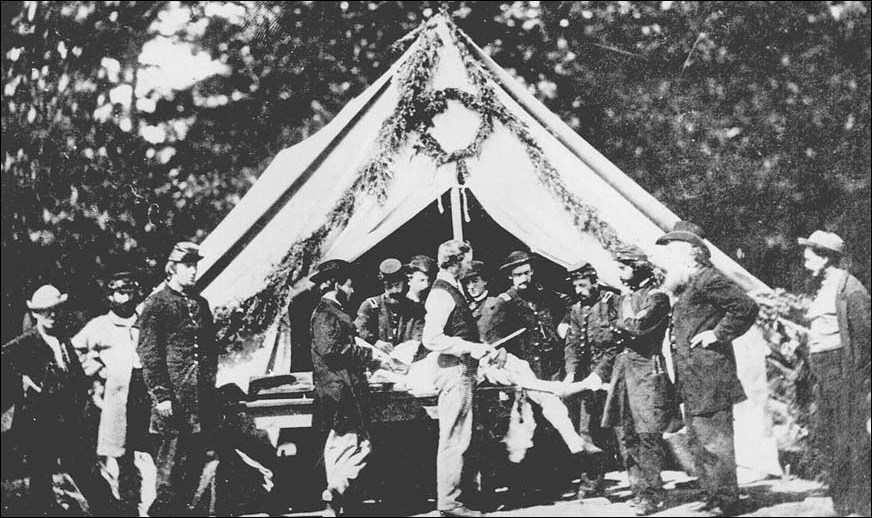
An amputation in a hospital tent, Gettysburg, July 1863. National Archives and Records Administration

Field hospital after the battle, Savage Station, Virginia, 1862. Library of Congress, Prints & Photographs Division, LC-B811-0491
Legacy
The war killed more than 620,000 Americans — more would have died without the new ways of getting the wounded to care. The systems built then became the basis of army field medicine: the medical "Collecting and Clearing" units U.S. forces deployed in Operation Desert Storm in 1991 trace back to Civil War precedents such as the hospital in the Harper House.
Today 120 of the battle's roughly 6,000 acres are preserved as Bentonville Battleground State Historic Site, run by the North Carolina Department of Cultural Resources and listed in the National Register of Historic Places.
More: Teaching with Historic Places · National Register file for Bentonville Battleground · Library of Congress Civil War photographs
Sources
Based on "The Battle of Bentonville: Caring for Casualties of the Civil War (Teaching with Historic Places)," National Park Service, drawn from the National Register file for Bentonville Battleground State Historic Site, with excerpts from Louis C. Duncan's The Medical Department of the United States Army in the Civil War, The Medical and Surgical History of the War of the Rebellion (1883), the Official Records, M. W. Bates's paper in Glimpses of the Nation's Struggle (1903), and the Harper House research report of the North Carolina Division of Archives and History; a work of the United States government in the public domain. The lesson's questions and classroom activities are left out, and a photograph of the Harper House credited to the state historic site is not reproduced.
Licence : CC0 1.0 (domaine public) · Adapté de www.nps.gov
1
0
0
0

commentaires


