
Vous souhaitez améliorer le contenu du nœud ? Essayez de faire une demande de modification.
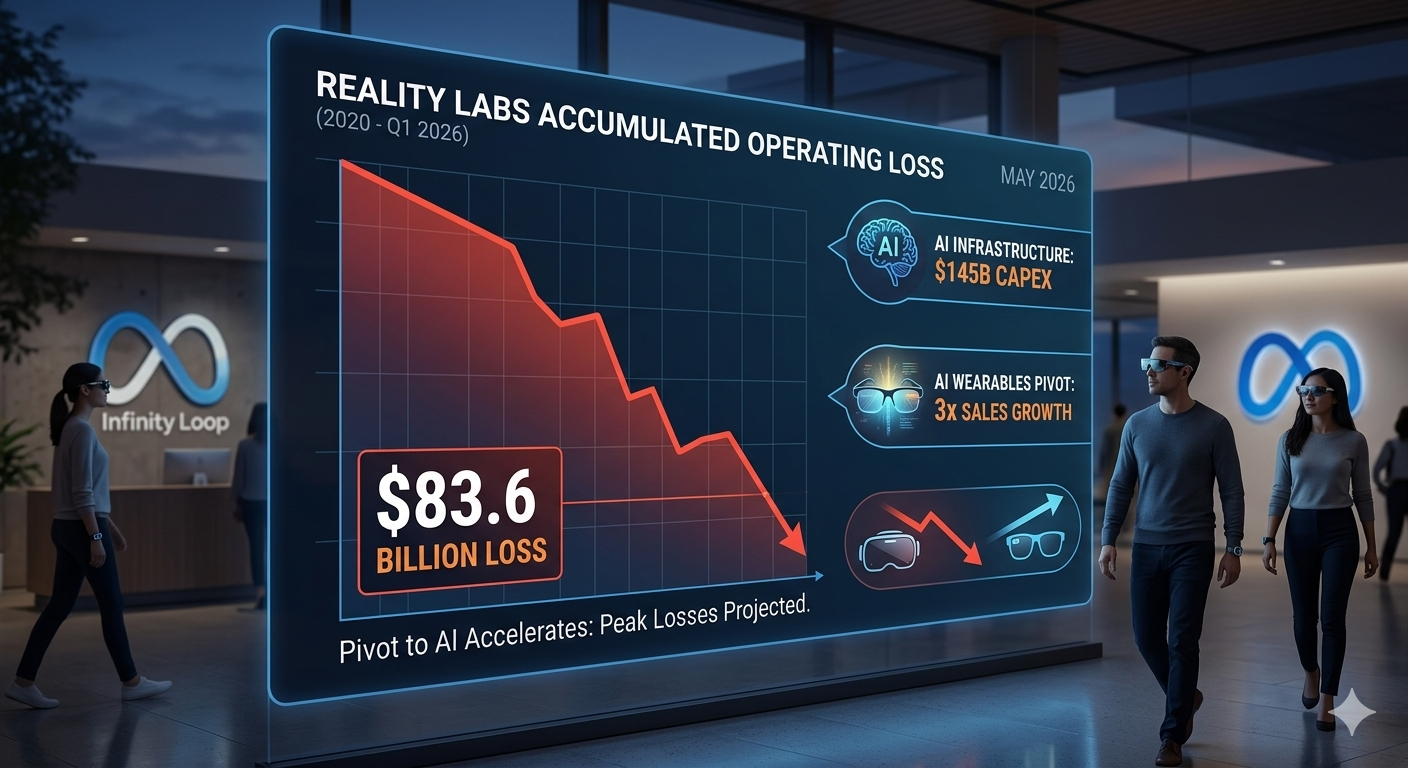
Reality Labs, the division within Meta responsible for augmented and virtual reality (AR/VR) development, has recorded a total cumulative operating loss of $83.6 billion from 2020 through the first quarter of 2026. The financial milestone was reached following a reported $4.03 billion operating loss in Q1 2026, roughly matching the quarterly burn rate seen throughout 2025. Despite these sustained losses, Meta’s overall financial position remains robust, with record revenue driven by AI-enhanced advertising tools. The current fiscal year marks a strategic turning point for the company. While the "metaverse" was once the primary focus, Meta has significantly shifted its capital allocation toward AI infrastructure, with projected 2026 capital expenditures reaching up to $145 billion. CFO Susan Li and CEO Mark Zuckerberg have signaled that 2026 will likely be the "peak" for Reality Labs losses, with spending gradually refocusing on AI-integrated wearables and mobile versions of the Horizon platform.
Strategic Realignment: From Immersive Worlds to AI Wearables
Meta’s pursuit of the metaverse has proven to be the most expensive gamble in modern consumer technology history. Since the company’s rebrand in October 2021, Reality Labs has struggled with limited consumer adoption and high research costs.
- Financial Trajectory: Reality Labs lost $19.1 billion in 2025, an increase from $17.7 billion in 2024.The Q1 2026 loss of $4.03 billion suggests a flatline in spending rather than an immediate reduction.
- Operational Shifts: In January 2026, Meta eliminated roughly 1,000 positions within Reality Labs, targeting Quest software and platform teams.Key flagship projects like Horizon Workrooms were retired in February 2026, and Horizon Worlds is being transitioned into a mobile-first product.
- Hardware Pivot: Most future investment is now directed toward glasses and wearables rather than traditional VR headsets. Smart glasses sales tripled in 2025, providing a clearer path to profitability compared to the immersive VR ecosystem.
- AI Dominance: AI has replaced the metaverse as Meta’s central narrative.The company's massive 2026 budget is now dedicated to building out "Superintelligence" and a large-scale compute footprint, which investors have largely cheered as a more pragmatic use of capital.
- Platform Viability: Despite the "Silicon Wall" of semiconductor shortages, Meta continues to leverage its scale to optimize AI-powered ad targeting, ensuring the core business remains profitable enough to sustain Reality Labs' ongoing research until the wearable market matures.
While the $83.6 billion spent so far underscores a massive structural failure of the original "metaverse-first" vision, the pivot toward AI wearables suggests Meta is attempting to salvage its hardware ambitions by integrating them with the broader industry shift toward generative AI.
1
0
0
0

commentaires