
Envie d’améliorer le contenu de la page ? Proposez une modification.
In the fall of 1942, the National Park Service was pressed to hand its historic cannon and statues over to the scrap-metal drive; a bill in the House would even have required it. Director Newton B. Drury refused to give them up until the nation's stock of useless, non-historic metal was exhausted. A bronze cannon captured at Yorktown or Saratoga and the original of a fine statue, he wrote to the War Production Board, "can never be duplicated at any price." The Park Service ended up contributing more than 8.5 million pounds of metal to the scrap drives — and kept its cannon.
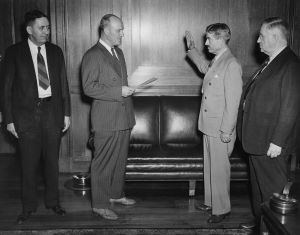
Newton B. Drury (second from right) is sworn in as NPS director, August 20, 1940. Credit: NPS History Collection.
A "last resort" rule
The NPS was only 26 years old when the United States entered the war. Drury, director from August 20, 1940, expected requests to use park resources for defense, and on November 27, 1940, he set out criteria for superintendents. A request had to show that park land was necessary, that the use would not cause irreparable damage, that other areas and resources had been considered and exhausted, what permit conditions would protect the park, and whether the applicant would pay for repairs and restoration afterward. Convenience or expediency were not reasons. The "last resort" test usually turned up resources outside the parks instead.
A service stripped down
| Before the war | During or after | |
|---|---|---|
| Permanent full-time positions | 5,145 (June 30, 1941) | 1,577 four years later |
| Budget | $9.3 million (1941) | about $4.5 million (1944) |
| Civilian Conservation Corps workers | 2,539 | all gone by the end of 1942 |
The NPS asked for no draft exemptions for its staff. It did not replace its men with women, as industry did; a few women became "substitute rangers," called in as needed. A handful of parks used conscientious objectors from Civilian Public Service camps — no more than five at a time, averaging 115 men — for forest protection, firefighting and maintenance at Blue Ridge Parkway, Shenandoah, Great Smoky Mountains, Glacier and Sequoia-Kings Canyon.
Even the headquarters moved. To free space in Washington, the NPS was sent to the 11th floor of Chicago's Merchandise Mart in 1942; 146 employees went, many others quit, and a small liaison group under Associate Director Arthur E. Demaray stayed behind. The Advisory Board protested twice, calling the move "an ill-conceived, unrealistic measure, extravagantly uneconomical." Headquarters returned only in 1947.
Giving, but not giving everything
Drury resisted calls to cut hardwood forests, slaughter wildlife, scrap historic metal and mine the parks — but he took care not to look unpatriotic, and he found compromises:
- Timber. He fought logging Olympic National Park's trees for airplanes, but in 1943 sold wind-thrown Douglas firs — two million board feet for the war, less fire fuel for the park. Dead chestnuts in Shenandoah, Great Smoky Mountains and Blue Ridge Parkway went to tannin makers.
- Grazing. World War I had shown that park grazing added little food and did lasting damage. Drury allowed a limited, formula-bound increase; requests came to only 20.9 percent against the 28 percent permitted, and during the 1944 drought an independent review found enough range elsewhere.
- Meat. He banned hunting, but normal herd reductions fed people: 172,750 pounds of elk from Yellowstone in the winter of 1942–43, and 160,000 of bison the next year, plus venison from Zion and Rocky Mountain.
- Metal. A War Production Board survey counted 984.8 tons of non-ferrous metal in park cannon, statues and objects. It eventually agreed that cannon older than 1865 and artistic or historic objects would not be scrapped.
- Land. Over the war the NPS issued 2,396 permits for war uses, more than half for short exercises and transport, and permanently transferred 9,580 acres to the Army and Navy. Bandelier housed families from the Los Alamos atomic project; Fort Jefferson became a Navy radar station; the Ahwahnee Hotel in Yosemite became a Navy convalescent hospital in June 1943. Farm leases at Gettysburg, Saratoga and Colonial restored historic fields and orchards while growing food.
Parks for soldiers
The Park Service's wartime answer to its own purpose was that parks were where soldiers and civilians could "retire to restore shattered nerves." Uniformed service members got in free, and military visits soared to 1.65 million in fiscal 1943, more than three times the year before. The NPS handed out over 200,000 "Welcome" pamphlets to service members and more than 150,000 free park circulars to service libraries, USO lounges, overseas information libraries and prisoner-of-war camps. It housed 22,353 British and French sailors from American shipyards, and helped the Army build 33 rest camps. At Mount McKinley (now Denali), the Army ran a recreation camp in the park hotel — rooms $1.05 a day for officers, $0.55 for enlisted men — until March 1, 1945.
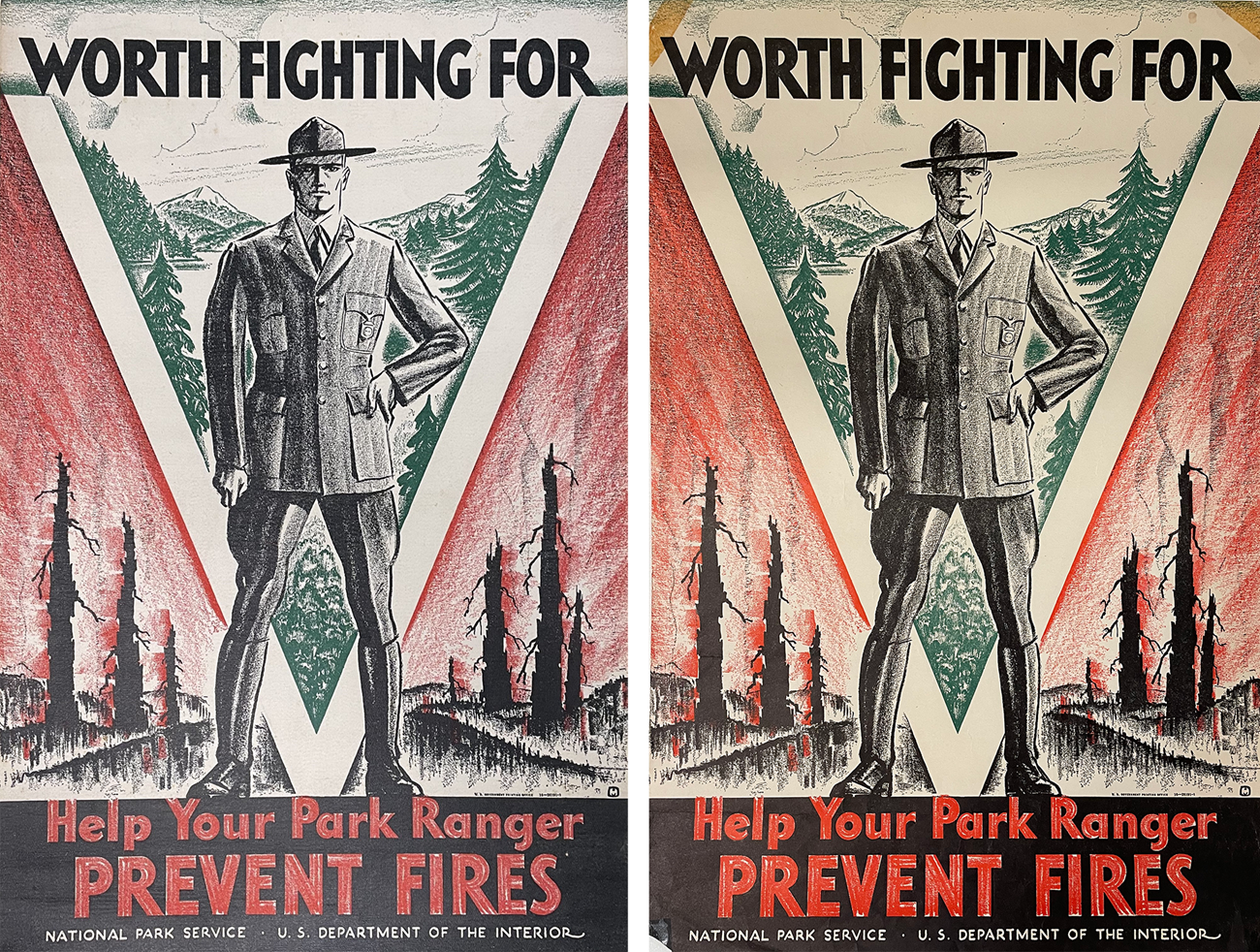
"Worth Fighting For" fire prevention posters, about 1944, printed by the Government Printing Office — one on canvas, one on paper. Credit: NPS History Collection.
After the war
When travel restrictions lifted after V-J Day, "the floodgates of travel opened," Drury wrote. In 1946 a record 21.6 million people visited — with 1,795 permanent employees and 1,524 summer temporaries, a 40-hour week instead of 1938's 48, and no CCC. The Service reached its 30th anniversary on August 25, 1946, short of money, staff and repairs; real relief waited for the Mission 66 program a decade later.
Sources
Based on "50 Nifty Finds #45: Holding the Line" from the National Park Service History Collection, a work of the United States government in the public domain, drawing on the Service's annual reports for 1942–1946 and its report National Park Service War Work.
Dans ces collectionsBandelier National MonumentBlue Ridge ParkwayCabrillo National MonumentCarlsbad Caverns National ParkColonial National Historical ParkCastillo de San Marcos National Monument
Licence : CC0 1.0 (domaine public) · Adapté de www.nps.gov
1
0
0
0

commentaires
À lire ensuite


