
Envie d’améliorer le contenu de la page ? Proposez une modification.
When Yasuhei Nagashima was released from internment in November 1945 and went home to Los Angeles, he asked the War Relocation Authority (WRA) to send him the furniture and clothing he had left in its warehouse at the Tule Lake Segregation Center. He filled out the forms it asked for. Nothing happened. Then, through no fault of his, the WRA shipped his belongings to its San Francisco warehouse, and they were sold at public auction. He never knew about the sale and received none of the money.
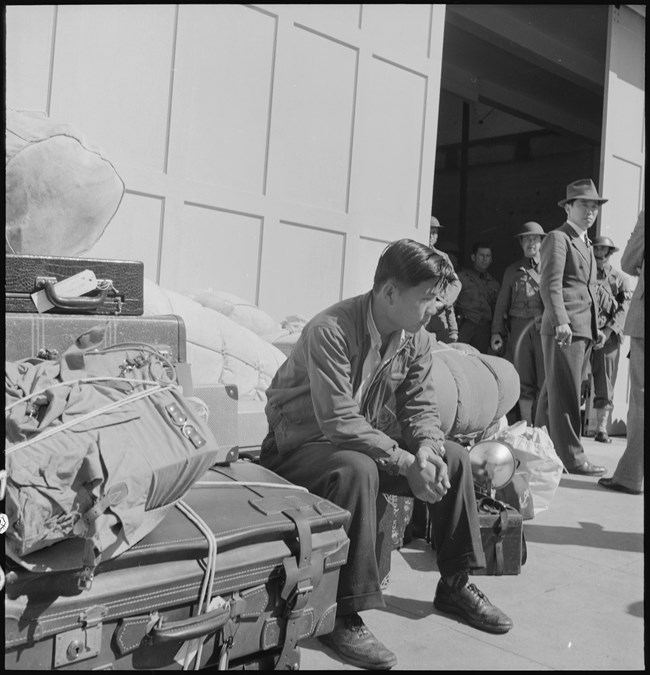
A Japanese American man waits with his luggage for the bus to an assembly center; each person could bring only what they could carry. Credit: Dorothea Lange, National Archives and Records Administration.
From Los Angeles to Crystal City
Nagashima was born in Japan to Japanese parents and had not been to Japan since December 7, 1941. He was unmarried and lived at 236 East Second Street in Los Angeles.
| Date | |
|---|---|
| May 9, 1942 | Removed under military orders issued under Executive Order 9066 to the Santa Anita Assembly Center. He drives his furniture and clothes there in his 1936 Chevrolet 1½-ton truck, and hands the truck over to representatives of the Federal Reserve Bank of San Francisco, who sell it to the Army |
| Later | Transferred to the Heart Mountain Relocation Center, then to Tule Lake; the WRA ships his belongings with him each time |
| November 1944 | Goes to the Crystal City Internment Camp in Texas as a voluntary internee, to be with his brother, who was interned there awaiting deportation to Japan. Crystal City has no storage, so he leaves his things in the WRA warehouse at Tule Lake |
| November 13, 1945 | Released as a voluntary internee; returns to Los Angeles |
| December 4, 1945 | The WRA's Los Angeles office asks Tule Lake to forward his property |
| December 19, 1945 | Tule Lake replies that his goods are in its warehouse, but he must fill out special forms |
| January 8, 1946 | His completed forms are mailed to Tule Lake. They are received, but nothing is done, despite his continued appeals |
| April 1, 1946 | By mistake, Tule Lake sends his property to the San Francisco warehouse, where it is auctioned |
The claim
Nagashima first claimed his loss from the Department of the Interior under a 1922 law. When the Act of July 2, 1948, was passed, his undecided claim was sent to the Attorney General, and he filed a new claim form, received on December 16, 1949. It claimed $807.75. After a hearing on April 14, 1950, the Attorney General decided the case (No. 146-35-8) on December 29, 1950.
The property: repaid. The fair value of what was sold was found to be $308.75, and none of it had been covered by insurance or otherwise. The Act expressly covers "damage to or loss of personal property bailed to or in the custody of the Government," and Nagashima had been diligent and had done nothing to cause the loss, so reimbursement was clear. Items he first named at the hearing were also covered, because they belonged to the same transaction.
The truck: too late. At the hearing, Nagashima said:
"When I made my original claim, I didn't claim anything for the truck because at that time I didn't know you could claim for anything after you sold it, no matter how little you got. I sold the truck at Santa Anita to the Army [and] I consider that I had a loss. I suppose it is too late now to claim for that loss."
It was. The Act barred claims not filed within eighteen months of its passage. An amendment that only adds detail to an existing claim "relates back" to the original filing, but the truck sale had nothing to do with the WRA's mistake — it was a new claim, and so it was barred.
"An act of grace"
The Japanese American Citizens League, filing as a friend of the court, argued that the real basis of every claim was the removal and exclusion itself, and that the federal rules on amending pleadings should let the truck claim in. The decision rejected both points. Under an earlier ruling, it said, the Act did not treat the removal as a legal wrong in itself; it was "an act of grace," and recovery was limited to specific property damaged or lost in specific events. Amendments should be allowed generously — but not ones that state an entirely new claim.
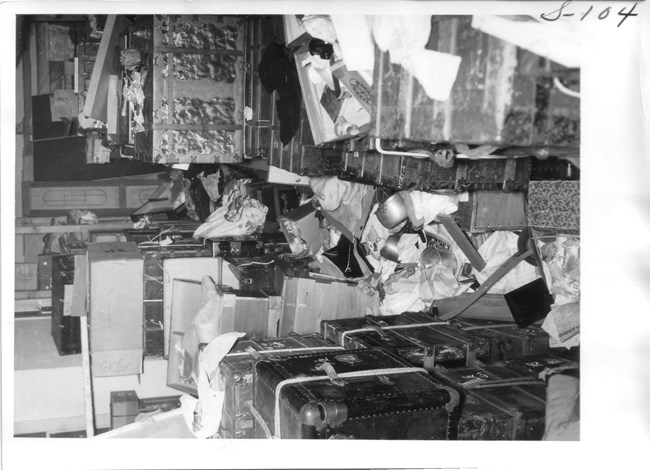
Some Japanese Americans stored belongings in community buildings or with neighbors instead of government warehouses. No option was safe: property was often stolen, lost, sold or destroyed. Vandals broke into this storage area in the basement of the Tacoma Buddhist Church in Tacoma, Washington. Credit: National Archives and Records Administration.
Sources
Based on "Property Claim of Yasuhei Nagashima," Tule Lake National Monument, National Park Service, which reproduces the Attorney General's decision of December 29, 1950; a work of the United States government in the public domain.
Dans ces collectionsTule Lake National Monument
Licence : CC0 1.0 (domaine public) · Adapté de www.nps.gov
1
0
0
0

commentaires


