
Envie d’améliorer le contenu de la page ? Proposez une modification.
In chapter 17 of Katherine Paterson's novel Lyddie, Lyddie's little sister Rachel wants to work in the mill as a doffer. Lyddie helps her get the job, and Rachel's work makes her stay at the boardinghouse legitimate. Real doffers were the youngest workers in the Lowell mills.
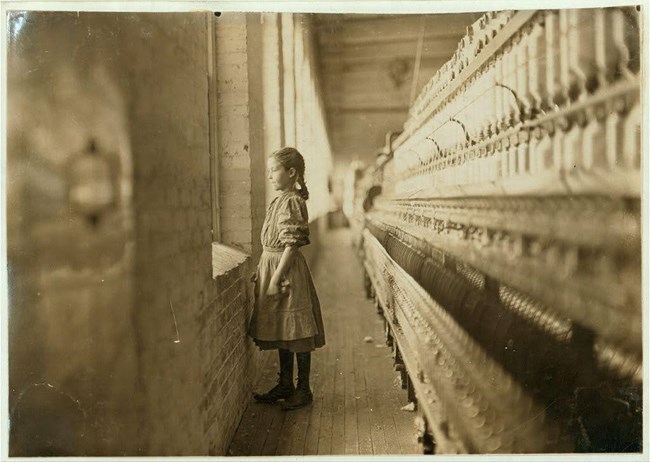
A young spinner at the Rhodes Manufacturing Company, Lincolnton, North Carolina, November 1908. Lewis W. Hine; Library of Congress.
What happens in the chapter
- Two weeks on, the doctor still won't let Lyddie work. With time to think, she wonders why her brother Charlie hasn't written, and writes again. When her friend Diana visits, Lyddie, afraid for her job, asks whether the overseer, Mr. Marsden, has mentioned her. Diana laughs when she hears what Lyddie did, and assures her she still has a job.
- No word comes from Charlie, but Quaker Stevens writes that he will ask Judah directly about the sale of the family farm.
- The mill doubts the age Rachel claims, but hires her. Lyddie fights exhaustion at the looms and is stronger by week's end. A phrenologist comes to the boardinghouse to "read" heads; Rachel wants a reading, and Lyddie thinks it a silly waste of money.
- Then Lyddie wakes to a terrible cough — not Betsy's this time, but Rachel's. She cannot keep Rachel in Lowell, cannot send her to the farm, where there is no food, and will not send her to Mistress Cutler's tavern. A surprise visitor changes everything.
Was it real?
Yes. Most mill workers were at least 15 and counted as adults, but some jobs, doffing among them, went to younger children, who were paid less. A doffer took full bobbins of yarn off the spinning frames and put empty ones on. They generally worked about 15 minutes in every hour and could play in a corner in between.
- Harriet Hanson Robinson, in Loom and Spindle (1898), went into the mill at about ten, at her own urging, because she wanted to earn money like the other little girls. The doffers, she wrote, "were the very youngest girls," and she remembered racing down the aisle between the frames "carrying in front of me a bobbin-box bigger than I was."
- Lucy Larcom, in A New England Girlhood (1889), found the work easy at first — changing bobbins every three-quarters of an hour or so with half a dozen other little girls. But doing the same thing a hundred times a day was dull, and mill work "was not, and could not be, the right sort of life for a child."
- The historian Thomas Dublin (Women at Work) points out the difference from adult work: children worked a full twelve-hour day, but in short bursts of intense effort broken by rest, which made their work less monotonous — a chance to get away from it that the adult operatives never had.
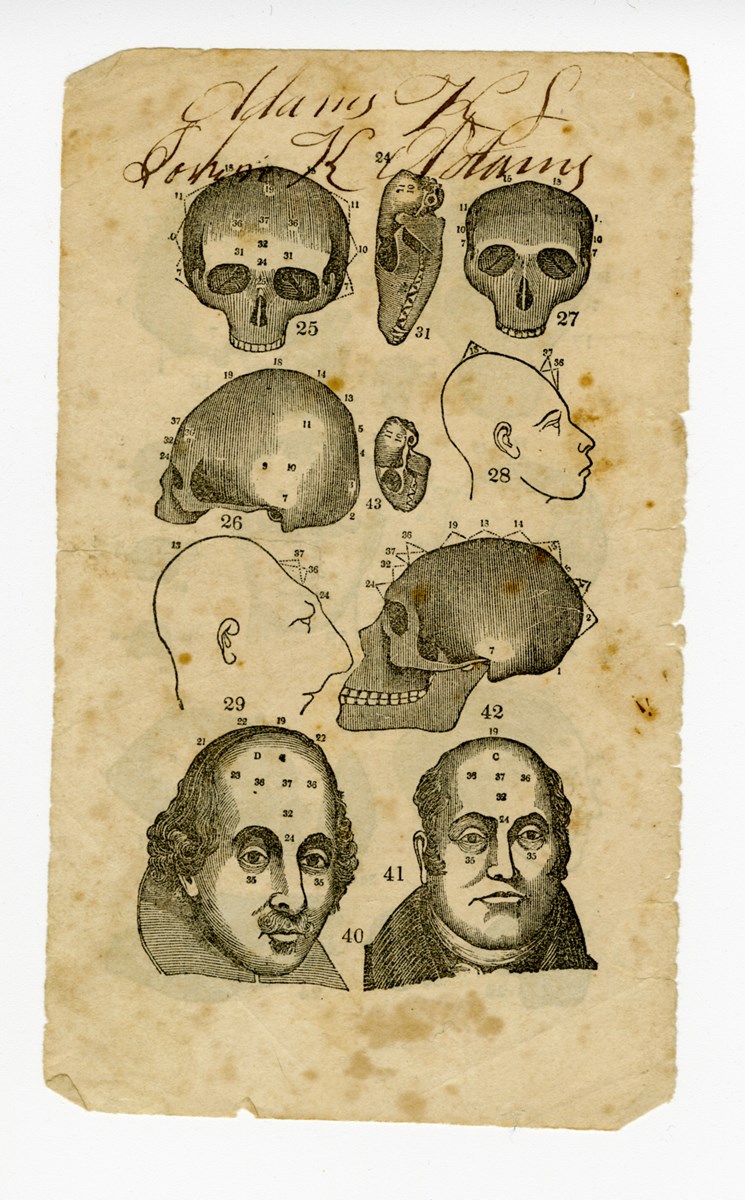
A phrenology chart. Phrenologists claimed to read personality from the bumps on a person's head, and often came to the boardinghouses hoping mill girls would pay. Lowell National Historical Park.
Questions to write about
- Rachel begs to work as a doffer. What are Lyddie's reasons for not wanting her to? Use evidence from the story.
- Imagine you are Rachel. Write a letter to Charlie about your first day as a doffer at the Concord Corporation, using concrete, sensory detail.
- How do you and your classmates help each other? If you made the classroom rules, what would you put in place so everyone helped out — and why?
See it yourself
Spinning frames like the ones doffers worked are on view at Slater Mill, in Blackstone River Valley National Historical Park.
Sources
Based on "Lyddie: Chapter 17 - Doffer," from the National Park Service Books to Parks series (Lowell National Historical Park), a work of the United States government in the public domain. It cites Harriet Hanson Robinson's Loom and Spindle (1898), Lucy Larcom's A New England Girlhood (1889) and Thomas Dublin's Women at Work. Lyddie is a novel by Katherine Paterson; this page summarizes it and does not reproduce it.
Dans ces collectionsLowell National Historical ParkLyddie - Books to Parks
Licence : CC0 1.0 (domaine public) · Adapté de www.nps.gov
1
0
0
0

commentaires


