Quelque chose à améliorer ? Proposez une modification.
Cette page est publique.
Introduction
On March 26, 2024, the container ship Dali impacted a critical pier of the Francis Scott Key Bridge while traveling at 8 knots[1]. The force delivered by the impact was between 27 and 52 million pounds-force[2] and caused complete structural failure of the middle spans of the bridge. Six Maryland Department of Transportation workers on the bridge lost their lives; two others were rescued from the river below [3]. The wreckage of the bridge blocked the deepwater channel into the port of Baltimore, halting commercial traffic for 11 weeks[4].
Background and Construction of the Bridge
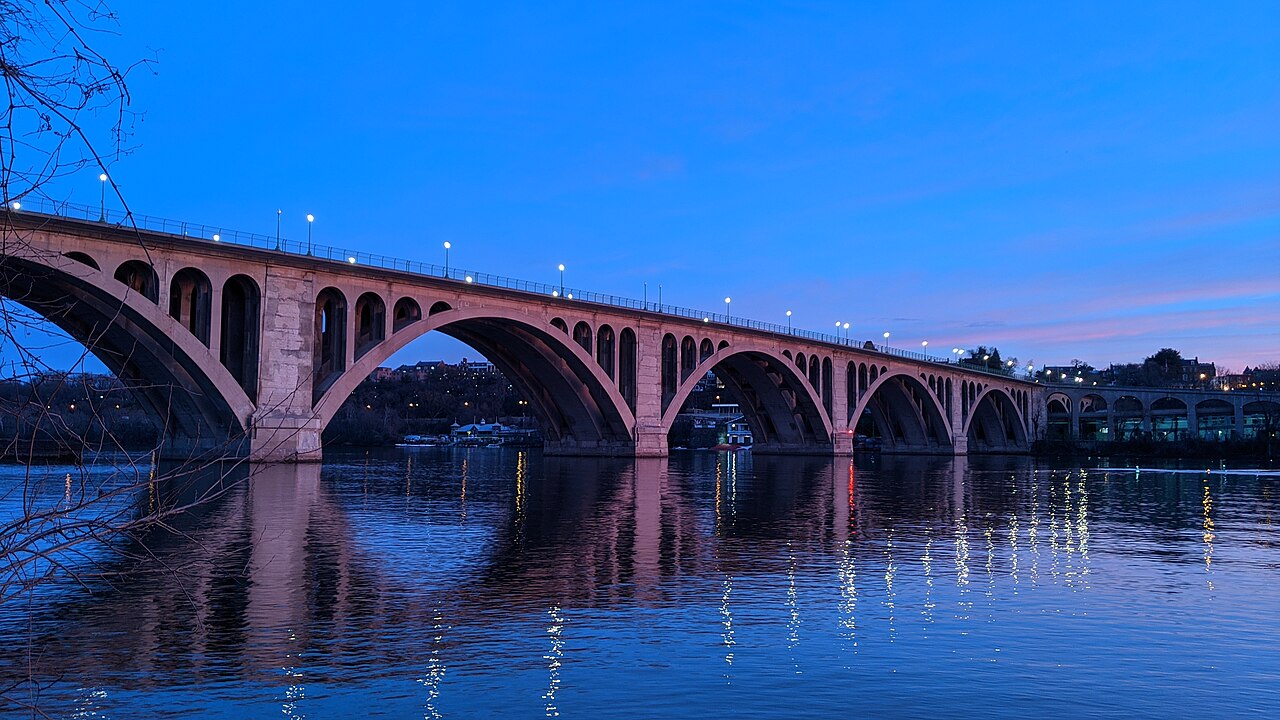
Francis Scott Key bridge before collapse (Image: Mdy66, CC BY-SA 4.0)
The Francis Scott Key Bridge was opened across the Patapsco River outside the Port of Baltimore on March 23, 1977. It was constructed to fill Baltimore's need for additional transportation capacity across the harbor. J.E. Greiner Company served as the primary engineering firm, with support from New York City's Singstad, Kehart, November & Hurka in joint venture with Baltimore Transportation Associates, Inc. Pittsburgh-Des Moines Steel Company provided the materials for the John F. Beasley Construction Company to build the bridge.
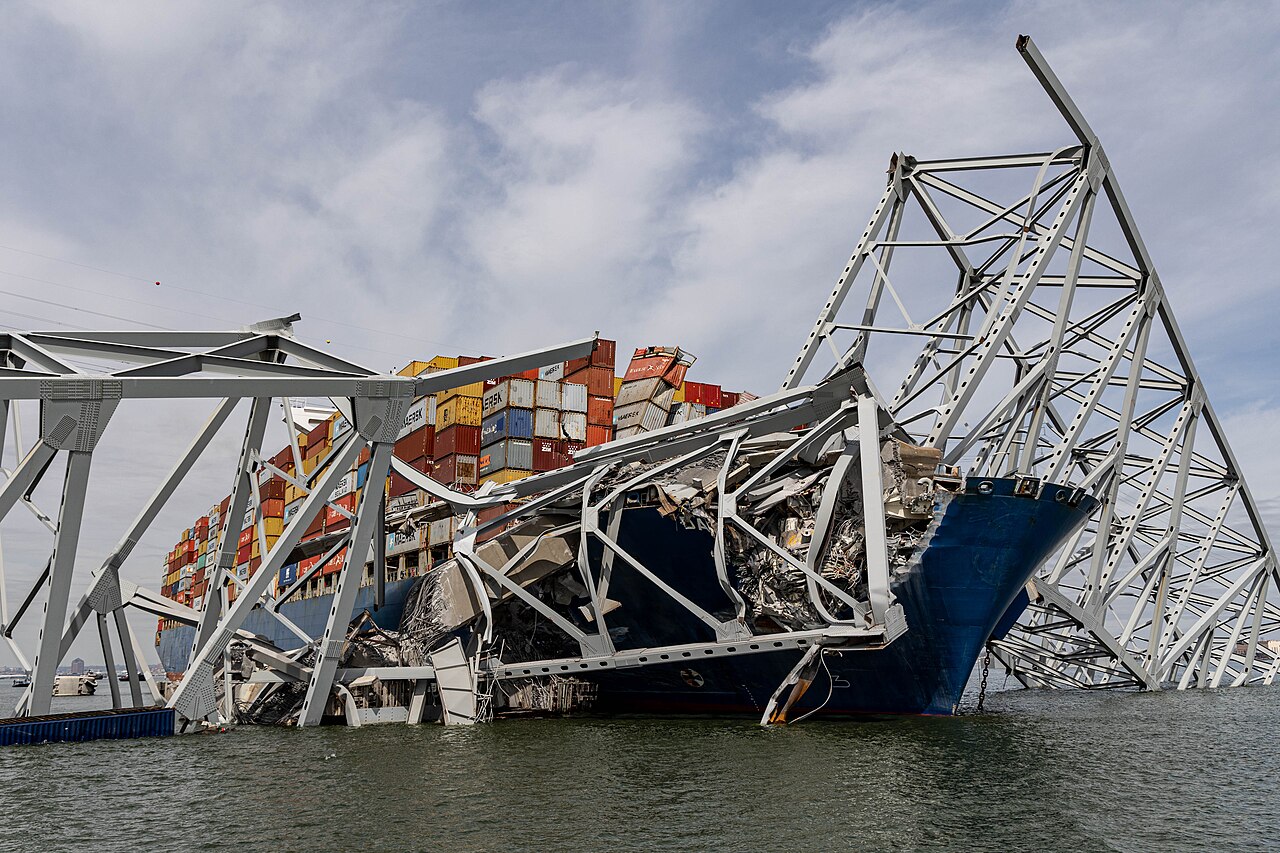
Wreckage from Key Bridge Collapse (Image: David Adams / U.S. Army Corps of Engineers, Baltimore District, Public domain)
The bridge was constructed according to the federal regulatory standards of the 1970s. The bridge's main piers were protected by artificial "dolphin" islands both upstream and downstream of the bridge. These piers also had a 17-foot fender system consisting of crushable thin-walled concrete boxes measuring 100 feet by 84.5 feet, clad with timber members and steel plate at the base[5]. A 1980 impact by a cargo vessel resulted in no structural damage[6]. The contemporary shipping vessels during the construction of the Francis Scott Key Bridge could hold 2,000-3,000 Twenty Foot Equivalent-Units (TEU). Today's super-transporters (enabled by the expansion of the Panama Canal) routinely approach 14,000 TEUs[7]. No intervening studies were performed to examine the impact of the expanded vessels on the bridge's protective systems[8].
The Dali
The MV Dali is a 947-foot Singapore-flagged container ship which was constructed in 2015. It was operated by Synergy Marine Group and owned by Grace Ocean Private Ltd at the time of impact. The Dali had been on a multi-port voyage in the time leading up to the bridge impact. It arrived in New York on March 19, 2024[9], before sailing into the Virginia International Gateway in Portsmouth, VA on March 22[10]. On March 23, it arrived in Baltimore Harbor[10]. While in Baltimore Harbor, the Dali underwent routine engine maintenance and experienced at least two electrical blackouts during maintenance activities on March 25 (the day before its departure from Baltimore). One was caused when a crew member inadvertently closed an exhaust damper that blocked engine output; another was related to insufficient fuel pressure causing a generator to slow and trip[11].
Timeline of Events
Pre-Departure: March 25, 2024
The day before departure, March 25, 2024, Dali experienced two electrical blackouts while docked in Baltimore Harbor[12]. The second in-port blackout was caused by the flushing pump failing to restart after a loss of power, which supplied insufficient fuel pressure to the diesel generators. This same issue would later cause a blackout on March 26, shortly before collision.
Departure and Electrical Failures: March 26, 2024
12:44 a.m.: Dali departs Baltimore Harbor, with two harbor pilots aboard[13].
1:24 a.m.: While approaching the Key Bridge, Dali experiences its first underway electrical blackout, resulting in a loss of propulsion and steering. The blackout was caused by an electrical failure in the vessel’s high-voltage switchboard, which interrupted power to critical systems. Emergency backup systems restore some electrical capacity, but propulsion was not restored[12].
1:26 a.m.: After partial power recovery, Dali experiences a second blackout caused by insufficient fuel pressure to the diesel generators, the same issue identified during the in-port blackout on March 25[12]. Propulsion and steering were not restored, and the vessel continued to drift toward the bridge.
1:29 a.m.: Collision. Dali strikes a main support pier of the Francis Scott Key Bridge, causing the collapse of the bridge span and multiple fatalities.
Regulatory Response
The collapse triggered a massive multi-agency response led by a Unified Command, which successfully cleared 50,000 tons of debris and reopened the Fort McHenry Federal Channel by June 10, 2024, just 11 weeks after the incident [14][15]. Simultaneously, the National Transportation Safety Board (NTSB) launched a broad investigation, issuing a preliminary report in May 2024 that highlighted the inadequacy of the bridge's pier protections against modern vessels[16]. By March 2025, the NTSB extended these concerns nationwide, recommending urgent vulnerability assessments for 68 other major bridges across 19 states that lacked structural defenses for "New Panamax" class ships[17].
Legal accountability centered on the Limitation of Liability Act of 1851, which the ship's owners used to attempt to cap liability at roughly $43.7 million[18]. However, the U.S. Department of Justice intervened, citing "jury-rigged" electrical systems, and secured a $102 million settlement in October 2024 to cover federal cleanup costs[19][20]. Looking forward, the federal government committed to covering 100% of the estimated $1.7 to $1.9 billion reconstruction cost, with a replacement bridge featuring modern defensive systems expected to open by late 2028 or 2030[21][22].
Involved Parties & Accountability
While public discourse often focuses on immediate "human error," a deeper investigation reveals a complex web of responsibility involving ship managers, manufacturers, and regulators. The "Problem of Many Hands" often obscures blame, but specific individuals and specific decisions can be identified.
Synergy Marine Group (Ship Management)
The Department of Justice (DOJ) and National Transportation Safety Board (NTSB) investigations have highlighted reckless operational decisions by the ship’s management, Synergy Marine Group.
- The "Jury-Rigged" Fix: In a civil claim filed in September 2024, the U.S. DOJ alleged that managers authorized a makeshift repair to dampen vibrations that were cracking equipment. The filing detailed that a metal cargo hook was welded between a transformer and a steel beam to limit vibration. This modification, explicitly described as "jury-rigged" by prosecutors, suggests a culture of prioritizing schedule over seaworthiness.[23][24]
- Maintenance Culture: The ship was allowed to leave port despite known electrical instabilities. This included a blackout roughly 10 hours prior to departure, which the NTSB's preliminary report confirmed was caused by a crew member inadvertently closing an inline engine exhaust damper during maintenance.[25][26]
The Crew & The "Loose Wire" (Individual Action)
While the pilots were initially scrutinized, the catastrophic loss of power was traced to a specific mechanical failure triggered by a manufacturing defect and maintenance oversight.
- Node 381: The NTSB investigation identified a single loose wire in the switchboard, technically referred to in legal filings and reports as "Node 381" (or Wire 1 within the terminal block), as the physical cause of the blackout.[27]
- The Error: Investigators found that the wire was not fully inserted into the terminal block because a "wire-label band" was placed too close to the connection point, preventing a secure fit. This minor physical error, left uncorrected due to a lack of thermal imaging inspections, disabled the ship's ability to recover power in time to avert disaster.[28][29]
Maryland Transportation Authority (Regulatory Oversight)
Accountability extends beyond the ship to the owners of the bridge, the Maryland Transportation Authority (MDTA), who were aware of the risks for decades.
- The 2004 Warning: According to meeting minutes recovered by the Washington Post, Captain Joe Smith, a senior representative of the Association of Maryland Pilots, explicitly warned MDTA officials in 2004 that the bridge was vulnerable to a ship strike.[30][31]
- Inaction: Despite this specific expert warning—and the knowledge that ship sizes were increasing—no physical upgrades (such as larger dolphins or fender systems) were undertaken between 2004 and 2024. Critics argue this decision to ignore long-standing warnings represents a failure of institutional stewardship.[32]
Hyundai Heavy Industries (Design Liability)
The ship’s owner, Grace Ocean Private Ltd, has directed legal claims against the shipbuilder, Hyundai Heavy Industries.
- Design Defect: In a lawsuit filed in August 2025, Grace Ocean and Synergy Marine alleged that the switchboard was defectively designed and manufactured. They argue that the placement of the wire label that caused the "Node 381" failure was a systemic manufacturing defect rather than a one-time maintenance error, claiming the vessel was "unreasonably dangerous" when it left the shipyard.[33][34]
Interpretation: The Ethics of Aging Infrastructure
The Dilemma of "Grandfathering"
The Key Bridge met all federal standards upon opening in 1977. However, following the 1980 Sunshine Skyway collapse, the American Association of State Highway and Transportation Officials (AASHTO) updated its guidelines to require robust vessel collision protection for new bridges. Because it was already built, the Key Bridge was "grandfathered" in, effectively exempting it from retroactive upgrades [35][36]. This creates a conflict between strict legal compliance and the professional ethical obligation to "hold paramount the safety, health, and welfare of the public" (ASCE Code of Ethics, Canon 1)[37]. While legally compliant, the refusal to upgrade highlights the dangerous gap between meeting the minimum "code" versus the professional "standard of care."
The "Moving Goalpost" and Technical Debt
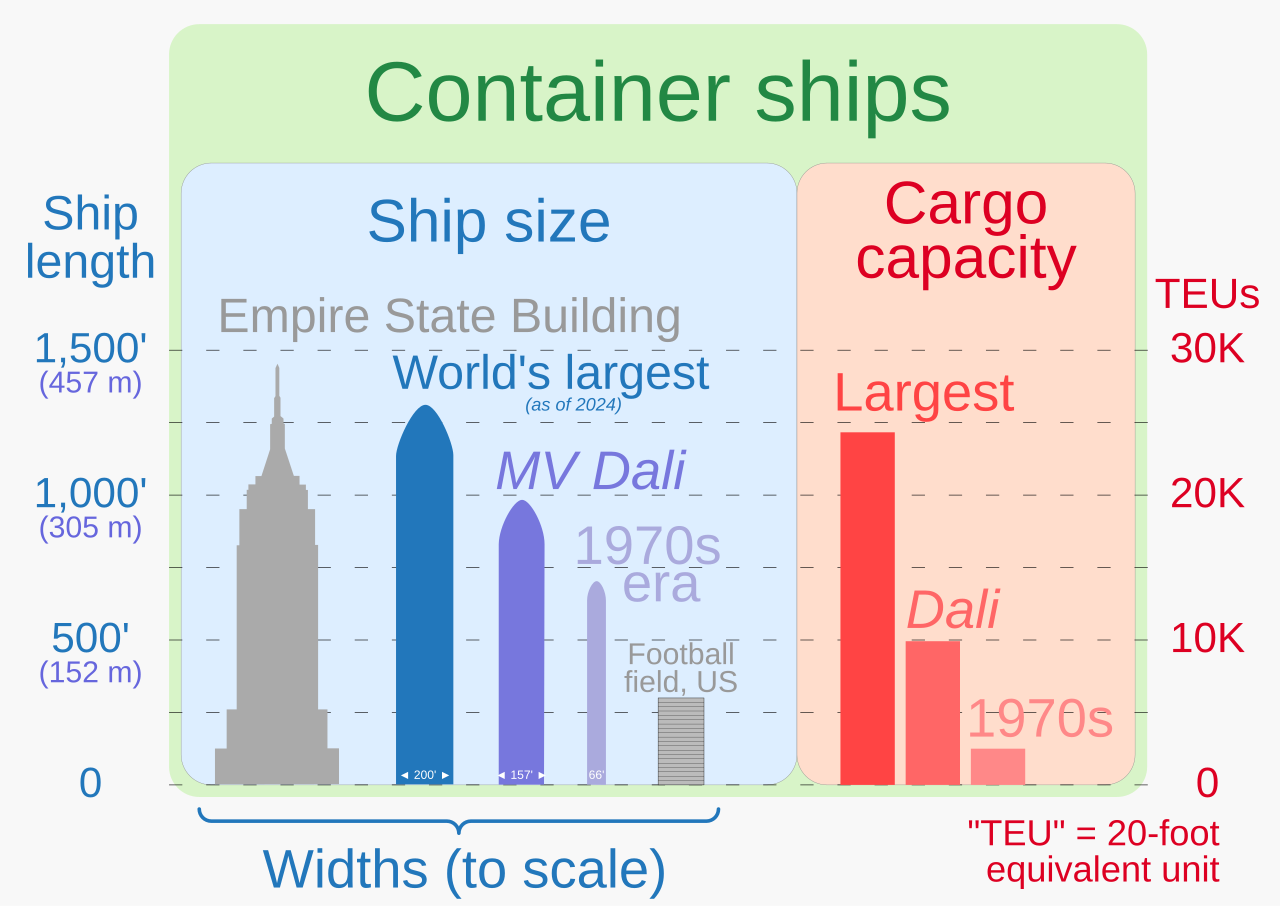
Container ship size and capacity comparison. (Image: RCraig09, CC BY-SA 4.0)
A major ethical challenge is the disparity between static infrastructure and evolving technology. In the 1970s, typical container ships carried approximately 2,500 TEUs; today, "New Panamax" vessels like the Dali can carry over 14,000 TEUs, and the largest ships exceed 24,000 TEUs [38][39]. This situation parallels "technical debt" in software engineering: just as legacy code needs patches to defend against new viruses, legacy bridges need physical "patches" (such as larger fenders or dolphins) to defend against larger ships. Failing to retrofit the bridge prioritizes short-term financial savings over long-term resilience, allowing the gap between safety and reality to widen over decades.
Systemic Accountability vs. The "Villain"
Public discourse often seeks a "villain," blaming pilots or crew for the crash. This ignores the ethical "Problem of Many Hands," where responsibility is diffused across a large organization or system [40]. While the Dali had specific defects (such as the "Node 381" loose wire), focusing solely on the crew obscures systemic failures[41]. Regulators allowed a "fracture critical" bridge—meaning it lacked structural redundancy—to service mega-ships without adequate protection[42]. Furthermore, MDTA officials reportedly ignored specific warnings from pilots in 2004 regarding the bridge's vulnerability to ship strikes[43]. The true ethical failure lies in a regulatory environment that accepted catastrophic risk without public consent.
Are Laws Written in Blood? (Pragmatism)
Engineering ethics is often reactive. The Sunshine Skyway disaster changed codes for new bridges, but the Key Bridge collapse exposes a "tombstone mentality"—waiting for a disaster to justify the cost of retrofitting old ones. This was confirmed post-collapse when the NTSB identified 68 other major bridges across 19 states that remain vulnerable to "New Panamax" strikes[44][45]. This finding confirms that current frameworks prioritize funding for future projects over rectifying existing, known dangers.
Generalizable Conclusions
This case demonstrates that engineering ethics is not a one-time approval but an act of ongoing stewardship. Although the Francis Scott Key Bridge complied with all applicable standards at the time of its construction, changes in vessel size and operational risks significantly changed the safety environment in which the bridge operated. The practice of “grandfathering” aging infrastructure into modern systems may satisfy legal requirements, but it does not necessarily ensure continued public safety as surrounding technologies evolve.
The Key Bridge collapse also highlights the gap between meeting code requirements and ensuring adequate safety in practice. Engineering standards reflect the assumptions and conditions in place at the time of development, which becomes outdated as technology evolves. In this case, the Key Bridge's protective systems were designed for 1970s-era relatively small cargo ships. These were insufficient to withstand the modern "New Panamax" ships. While this failure led to tragic loss of life, the subsequent NTSB recommendations and nationwide vulnerability assessments demonstrate a proactive effort to address similar risks before additional incidents occur, illustrating the importance of continuous oversight and adaptation in infrastructure safety.
Finally, this case reveals the challenges of systemic accountability. Responsibility was spread across many parties (ship operators, manufacturers, regulators), making it hard to assign blame to any one party. This “Problem of Many Hands” shows that failures often come from organizational or regulatory gaps rather than individual errors. The incident underscores the need for coordinated oversight, clear communication, and proactive risk management to prevent disasters, especially in systems that are constantly changing.
- ↑ Baraniuk, Chris. "Why the Baltimore Bridge Collapsed So Quickly" (in en-US). Wired. ISSN 1059-1028. https://www.wired.com/story/baltimore-francis-scott-key-bridge-collapse-dali-boat-collision-emergency-mass-casualty-event/.
- ↑ Bhatia, Aatish; Paris, Francesca (2024-03-28). "Force of Ship Impact Was on the Scale of a Rocket Launch" (in en-US). The New York Times. ISSN 0362-4331. https://www.nytimes.com/interactive/2024/03/28/upshot/baltimore-bridge-ship-force.html.
- ↑ "Body of sixth and final victim recovered from Key Bridge wreckage Tuesday". Baltimore Sun. 2024-05-07. Retrieved 2025-12-13.
- ↑ "11 weeks after Key Bridge collapse, main shipping channel to Port of Baltimore open to commercial ships - CBS Baltimore". www.cbsnews.com. 2024-06-11. Retrieved 2025-12-15.
- ↑ "DCA24MM031.aspx". www.ntsb.gov. Retrieved 2025-12-13.
- ↑ Rose, Joel (2024-03-26). "Questions arise amid the collapse of the Key bridge in Baltimore" (in en). NPR. https://www.npr.org/2024/03/26/1241022473/questions-arise-amid-the-collapse-of-the-key-bridge-in-baltimore.
- ↑ Paris, Brian McGill, Peter Champelli and Costas (2024-03-31). "Ships Have Become Supersized Since Baltimore Bridge Was Built". The Wall Street Journal. Retrieved 2025-12-13.{{cite web}}: CS1 maint: multiple names: authors list (link)
- ↑ "Officials studied Baltimore bridge risks but didn’t prepare for ship strike" (in en). Washington Post. 2024-03-29. https://www.washingtonpost.com/dc-md-va/2024/03/29/baltimore-bridge-collapse-inspections-minneapolis-tampa/.
- ↑ "The Dali was just starting a 27-day voyage." (in en). 2024-03-26. https://www.nytimes.com/2024/03/26/us/dali-ship-baltimore-bridge.html.
- ↑ a b "Port of Virginia 'working with ocean carriers' due for Baltimore following Key Bridge collapse". 13newsnow.com. 2024-03-26. Retrieved 2025-12-13.
- ↑ •. "Power outages and an urgent warning: NTSB details Dali crew's scramble before Key Bridge collapse". Stars and Stripes. Retrieved 2025-12-13. {{cite web}}: |last= has numeric name (help)
- ↑ a b c "Contact of Containership Dali with Francis Scott Key Bridge and Subsequent Bridge Collapse" (PDF). National Transportation Safety Board. November 18, 2025.
- ↑ "Rescuers searching river after Baltimore bridge collapse" (in en-GB). BBC News. https://www.bbc.co.uk/news/live/world-us-canada-68663071.
- ↑ Press, Associated (2024-06-11). "Baltimore shipping channel fully reopens after Key Bridge collapse" (in en-GB). The Guardian. ISSN 0261-3077. https://www.theguardian.com/us-news/article/2024/jun/11/baltimore-port-key-bridge-reopen.
- ↑ Kilcarr, Sean (2024-06-21). "AASHTO Journal - Baltimore Port Reopens after Bridge Debris Cleared". AASHTO Journal. Retrieved 2025-12-15.
- ↑ "DCA24MM031.aspx". www.ntsb.gov. Retrieved 2025-12-15.
- ↑ "NTSB Recommends Evaluation of 68 Bridges for Risk of Collapse from Vessel Strike | SupplyChainBrain". www.supplychainbrain.com. Retrieved 2025-12-15.
- ↑ "The "Titanic Law" Has Been Invoked After The Key Bridge Collapse: What Does It Mean When A Limitation Of Liability Petition Is Filed? | Latti Associates LLC". www.lattiassociates.com. 2024-04-10. Retrieved 2025-12-15.
- ↑ "Office of Public Affairs | Justice Department Files Lawsuit Against Owner and Operator of the Vessel that Destroyed the Francis Scott Key Bridge | United States Department of Justice". www.justice.gov. 2024-09-18. Retrieved 2025-12-15.
- ↑ "Owners of ship that slammed into Key Bridge settle with DOJ for $102M | Legal Dive". www.constructiondive.com. Retrieved 2025-12-15.
- ↑ Press, Associated (2024-06-11). "Baltimore shipping channel fully reopens after Key Bridge collapse" (in en-GB). The Guardian. ISSN 0261-3077. https://www.theguardian.com/us-news/article/2024/jun/11/baltimore-port-key-bridge-reopen.
- ↑ "Van Hollen, Cardin Announce Full Federal Funding for Francis Scott Key Bridge Replacement | U.S. Senator Chris Van Hollen of Maryland". www.vanhollen.senate.gov. 2024-12-17. Retrieved 2025-12-15.
- ↑ "District of Maryland | U.S. Reaches Settlement For Over $100m In Civil Lawsuit Against Owner And Operator Of The Vessel That Destroyed The Francis Scott Key Bridge | United States Department of Justice". www.justice.gov. 2024-10-24. Retrieved 2025-12-15.
- ↑ "US Files $103M Claim Saying Dali was "Unseaworthy" and "Jury-Rigged"". The Maritime Executive. Retrieved 2025-12-15.
- ↑ "DCA24MM031.aspx". www.ntsb.gov. Retrieved 2025-12-15.
- ↑ "Dali had power blackout during maintenance 10 hours before crashing into Key Bridge". The Independent. 2024-05-14. Retrieved 2025-12-15.
- ↑ "Loose wire on ship may have led to Baltimore Key Bridge collision and collapse, NTSB finds - CBS Baltimore". www.cbsnews.com. 2025-12-10. Retrieved 2025-12-15.
- ↑ "NTSB: Finding Loose Wire in Dali's Switchboard Took a Month". The Maritime Executive. Retrieved 2025-12-15.
- ↑ "Loose Wire on Containership Dali Leads to Blackouts and Contact with Baltimore's Francis Scott Key Bridge". www.ntsb.gov. Retrieved 2025-12-15.
- ↑ "Senior Maryland Pilot Warned Officials of Risk of Bridge Strike". The Maritime Executive. Retrieved 2025-12-15.
- ↑ Magazine, Maritime (2024-05-24). "Veteran Maryland pilot raised risks from potential Baltimore bridge strike nearly two decades ago – Washington Post report". Maritime Magazine. Retrieved 2025-12-15.
- ↑ "Senior Maryland Pilot Warned Officials of Risk of Bridge Strike". The Maritime Executive. Retrieved 2025-12-15.
- ↑ "Lawsuit blames Dali shipbuilder for power failure that led to collision with Baltimore's Key Bridge - CBS Baltimore". www.cbsnews.com. 2025-08-05. Retrieved 2025-12-15.
- ↑ Chambers, Sam (2025-08-04). "HD Hyundai sued over alleged defective switchboard on the Dali". Splash247. Retrieved 2025-12-15.
- ↑ Francis Scott Key Bridge collapse.
- ↑ Structural, B. E. (2024-04-22). "The Francis Scott Key Bridge Collapse". Be Structural. Retrieved 2025-12-15.
- ↑ "Code of Ethics". www.asce.org. Retrieved 2025-12-15.
- ↑ "The Largest Available Containership, 1970-2024 (in TEUs) | Port Economics, Management and Policy". 2020-11-10. Retrieved 2025-12-15.
- ↑ List of largest container ships
- ↑ "The many-hands and many-causes problems". www.refsmmat.com. Retrieved 2025-12-15.
- ↑ "Loose Wire on Containership Dali Leads to Blackouts and Contact with Baltimore's Francis Scott Key Bridge". www.ntsb.gov. Retrieved 2025-12-15.
- ↑ Structural, B. E. (2024-04-22). "The Francis Scott Key Bridge Collapse". Be Structural. Retrieved 2025-12-15.
- ↑ Francis Scott Key Bridge collapse.
- ↑ "Loose Wire on Containership Dali Leads to Blackouts and Contact with Baltimore's Francis Scott Key Bridge". www.ntsb.gov. Retrieved 2025-12-15.
- ↑ "NTSB Recommends Evaluation of 68 Bridges for Risk of Collapse from Vessel Strike | SupplyChainBrain". www.supplychainbrain.com. Retrieved 2025-12-15.
Where this page came from
This page was imported from Wikibooks. From “Professionalism” on Wikibooks, by its contributors, under CC BY-SA 4.0. Changed here: set as a page; navigation and edit links left out; each image under its own licence, credited in its caption.
Nobody has written it yet — it is the source material at a new address, which is why search engines are asked to skip it and why no one earns from it. It is up for grabs: take it on, and it is yours to rewrite and to earn from.
Dans ces publicationsProfessionalism
Licence : CC BY-SA 4.0 · Adapté de en.wikibooks.org
commentaires