
Envie d’améliorer le contenu de la page ? Proposez une modification.
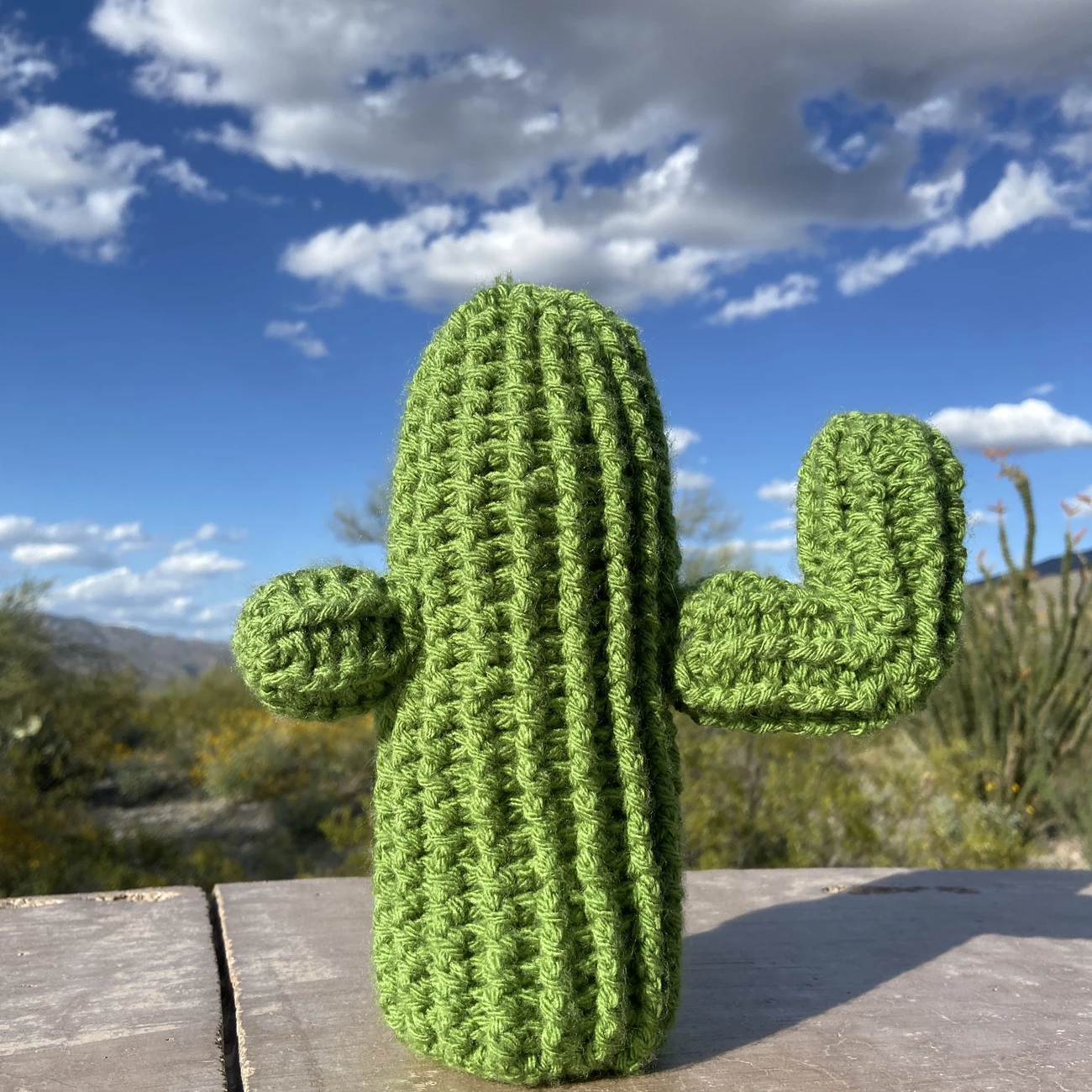
Crochet your own cactus! NPS/M Starr
The saguaro (Carnegiea gigantea) has been a symbol of the American southwest for ages that people from all over the world come to see. It is known as the giant cactus due to its impressive height, sometimes reaching over 50 feet tall. Though these towering giants seem robust, they need a perfect of heat and rainfal to thrive and will only be found in the Sonoran Desert. Life in the desert can be very slow growing, with saguaros taking 10 years to reach only a few inches in height and living up to 200 years old. The giant saguaro continues to catch our attention and captivate our imagination as it has done for hundreds of years.
Bring a little desert to your home by creating your very own saguaro, and watch it grow in only mere minutes!
Materials
- Yarn: Green in color and preferably a stiffer yarn will help with standing up, but any yarn will work.
- Crochet hook: Use recommended size for your chosen yarn
- Filling (could be fiber fill or scap yarn)
- Sewing needle
- Scissors
Example shown used half a value skein of a medium/worsted weight yarn (roughly 150 yards), and used a hook US H-8 (5mm) to be a height of 9 inches.
Abbreviations
Ch – Chain
yo – yarn over
sc – single crochet
dc – double crochet
fpdc – front post double crochet
bpdc – back post double crochet
sl st – slip stitch
dc2tog – double crochet two stitches together
Special Stitches
Fpdc: Yo, insert hook front to back through your work (hook will be infront of the post). Yo and pull though (there will be 3 loops on your hook). Yo and pull through 2 loops, yo and pull through remaining 2 loops.
Bpdc: Yo, insert hook back to front through your work (hook will be behind of the post). Yo and pull though (there will be 3 loops on your hook). Yo and pull through 2 loops, yo and pull through remaining 2 loops.
Dc2tog: Yo, insert hook in next st, yo and pull 1 loop through (yo, pull through two loops). Repeat in next st, 3 loops on hook. Yo, pull yarn through 3 loops on hook. Yo, pull through last 2 loops on hook.
Main stem
Rnd1: Create a magic ring work 6 sc into magic ring, sl to join OR ch 4, sl st into 1st st, and work 6 sc into center of ring, sl st to join (6 st)
Rnd2: 2 sc in each st (12 st)
Rnd3: 1 sc, 2 sc (18 st)
Rnd4: 1 sc, 2 sc, 1 sc (24 st)
Rnd5: 1sc, 2sc, 1sc, 1sc (30 st)
Rnd6: 1sc, 2sc, 1sc, 1sc, 1sc (36 st)
Rnd7: Dc in each st in the round (36 st)
Rnd8: fpdc in first st, bpdc into next, repeat in each stitch across the round (36 st)
Rnd9: Repeat round 8 until desired height of saguaro.
Note: Sample pictured was made by repeating round 8, 24 times. Next step will begin tapering the main stem.
Rnd10: Dc2tog using the front posts only, bpdc into next, fpdc in next st, bpdc into next
Rnd11: repeat row 10 until you only have a small opening left, just big enough to add filling to the saguaro.
Rnd12: Repeat row 10 until closed, fasten off and weave in any loose ends.
###
Arms
Creating arms is much like working on main stem, but on a smaller scale and they can be altered to your preference.
For a bent arm:
Note: You will do the next steps twice, to create two segments of an arm that you will attach to make it bent.
Rnd1: Create a magic ring work 6 sc into magic ring, sl to join OR ch 4, sl st into 1st st, and work 6 sc into center of ring, sl st to join (6 st)
Rnd2: 2 sc in each st (12 st)
Rnd3: 1 sc, 2 sc (18 st)
Rnd4: Dc in each st in the round (18 st)
Rnd5: fpdc in first st, bpdc into next, repeat in each stitch across the round (18 st)
Rnds6,7,8: repeat round 5 (18 st)
Rnd9: Sc, for the next 15 stitches alternate between bpdc and fpdc, sc and turn (17 st)
Rnd10: Skip 1st stitch, 2nd sc, then for the next 13 stitches alternate fpdc and bpds, sc and turn (15 st)
Rnd11: Skip 1st stitch, 2nd sc, then for the next 11 stitches alternate bpdc and fpdc, sc and turn (13 st)
Rnd12: Skip 1st stitch, 2nd sc, then for the next 9 stitches alternate fpdc and bpdc, sc and turn (11 st)
Rnd13: Skip 1st stitch, 2nd sc, then for the next 7 stitches alternate bpdc and fpdc, sc and turn (9 st)
Rnd14: Skip 1st stitch, 2nd sc, then for the next 5 stitches alternate fpdc and bpdc, sc and fasten loose ends. (7 st)
Repeat rnds 1-14 again. Take the two pieces, matching the openings together and sew together using a tapestry needle. Leave enough of an opening that you can add filling. Then, fasten off and weave in any loose ends.
Using yarn and a tapestry needle, attach arm to the side of the saguaro body.
For a small arm:
Rnd1: Create a magic ring work 6 sc into magic ring, sl to join OR ch 4, sl st into 1st st, and work 6 sc into center of ring, sl st to join (6 st)
Rnd2: 2 sc in each st (12 st)
Rnd3: 1 sc, 2 sc (18 st)
Rnd4: Dc in each st in the round (18 st)
Rnd5: fpdc in first st, bpdc into next, repeat in each stitch across the round (18 st)
Rnd6,7,8: repeat round 5 (18 st)
Rnd9: Dc2tog using the front posts only, bpdc into next, fpdc in next st, bpdc into next
Rnd10: repeat row 10 until you only have a small opening left, just big enough to add filling to the saguaro.
Rnd11: Repeat row 10 until until you only have a small opening left, just big enough to add filling. Then, close, fasten and hide any loose ends.
Using yarn and a tapestry needle, attach arm to the side of the saguaro body.
One of a kind
Saguaros come in all different shapes and sizes. Add as many arms as you want to your saguaro. Remember, there is no perfect way to make a saguaro. Embrace any imperfections and adjust the pattern as needed, because that is what makes your saguaro unique and special!
Where this belongs
- Saguaro National Park
Where this page came from
This page was imported from National Park Service. Produced by the U.S. National Park Service and, as a work of the United States government, in the public domain.
Nobody has written it yet — it is the source material at a new address, which is why search engines are asked to skip it and why no one earns from it. It is up for grabs: take it on, and it is yours to rewrite and to earn from.
Dans ces collectionsSaguaro National Park
Licence : CC0 1.0 (domaine public) · Adapté de www.nps.gov
1
0
0
0

commentaires
À lire ensuite


