
Envie d’améliorer le contenu de la page ? Proposez une modification.
Created in Collaboration with the Hard History Project
Grade Level
This activity is designed for students in sixth through eighth grade (ages 11-14)
Objectives
Students will:
- recognize unfairness on the individual level (e.g., speech) and injustice at the institutional or systemic level (e.g., discrimination.)
- identify figures, groups, events, and a variety of philosophies relevant to history around the world.
- make principled decisions about when and how to take a stand in their everyday lives and will do so despite negative peer or group pressure
- plan and carry out collective action and evaluate what strategies are most effective.
Guiding Question
What actions should you take when you recognize the need for change?
Votes for Women! But How?
After the Fifteenth Amendment left women out in 1870, and the Supreme Court ruled in 1874 that the Fourteenth Amendment did not guarantee women the right to vote, Susan B. Anthony believed that the only path to suffrage was to amend the U.S. Constitution again. She and Elizabeth Cady Stanton, leaders of the National Woman Suffrage Association, were successful in getting the amendment introduced in Congress in 1878, but it only came up for a vote once in 1887. It failed. Lucy Stone and other leaders of the American Woman Suffrage Association thought that the way forward was to win women the vote through state legislation. In 1890, the two groups united as the National American Woman Suffrage Association (NAWSA.) Although the new organization supported woman suffrage through federal amendment, NAWSA leaders concentrated on state suffrage. There were a few victories, but more defeats.
In 1916, NAWSA adopted Carrie Chapman Catt's "Winning Plan," which focused on winning full suffrage for women in key states like New York while also lobbying for the federal amendment. This flier, printed by NAWSA's publishing company, presents an argument for the amendment using a numbered list. It reads:
###
WOMAN SUFFRAGE BY FEDERAL AMENDMENT. WHY? SIX REASONS
- Keeping up with other countries demands it.
Suffrage for men and suffrage for women in **other **countries with few and minor exceptions has been granted by parliamentary act and not by parliamentary referenda. Shall American women be penalized for being American?
- Equal Rights demands it.
Men of this country have been enfranchised by various extensions of the voting privilege but in **no single instance **were they compelled to an electorate containing groups of unnaturalized foreigners, Negroes, Indians, and illiterates. Shall American women be denied by the Federal Government which freely gives the vote to foreigners?
- Relief from unjust State Constitutional obstructions demands it.
Many State Constitutions have made amendment so difficult that they either have **never **been amended or have not been amended when the subject is in the least controversial. Women of these States can **only **be enfranchised through Federal action.
- Protection from inadequate Election Laws demands it.
The election laws of all States make inadequate provisions for safeguarding the vote on constitutional amendments. There are vague uncertain laws for contesting fraudulent elections in most States and no laws at all for redress in twenty-four States.
5.** Equal status of men and women voters demands it**.
Men's right to vote is protected by the Federal Constitution while the State by State enfranchisement of women would not give this protection to women since a woman who changes her residence from an Equal Suffrage state to a male suffrage state thereby becomes disfranchised.
- The national significance of the question demands national action.
If women voters help elect a President of the **Nation **and choose a National administration, while women of the other States are denied this voting privilege, do not these political inequalities render our government unrepublican, un-democratic, and unfair?
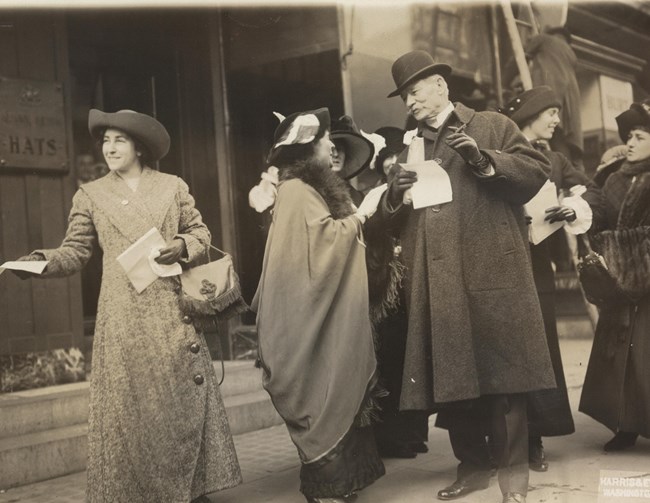
Suffragists distributing hand bills advertising March 3, 1913, suffrage parade Harris & Ewing, photographers. National Woman's Party collection, The Library of Congress
Vocabulary
**amendment: **a change or addition, especially to a document like the Constitution
electorate: all the people in an area or country who are entitled to vote in an election
enfranchise: to give the right to vote to a person or group
fraudulent: dishonest; intending to fool or deceive others
illiterate: unable to read and write
parliamentary: having to do with an elected and representative system of government
redress: to make right; the action taken or money given to correct for a wrong
referendum: a vote by the people to decide on a question or law
suffrage: the right to vote
suffragist: someone who works for the right to vote, especially for women
If you find other words that you aren't sure about, write them down and look up the definition.
Think About It
- Read through the document and notice which words are emphasized through **bold text **or repetition. Why do you think the suffragists decided to highlight those words or phrases?
- Pick one of the six reasons and summarize it. Are there words or ideas that are difficult for you to understand? Do you have an idea about how to say it more clearly?
- Read #2 again: **Equal Rights Demands It. **What do you think the suffragsits are saying? Are they calling for equal rights for everyone? Which groups of people are they implying are less deserving of rights?
- Which argument do you think is the most effective?
Extension Activity
Choose a cause that is important to you. Pick one thing that you think should change. Make a flier listing reasons that this change should happen. Although the Six Reasons flier is only text, you can include images and other eye-catching features for your flier.
Additional Resources
NPS Links
People pages: Susan B. Anthony, Carrie Chapman Catt, Elizabeth Cady Stanton, Lucy Stone
Suffrage in 60 Seconds: NAWSA vs NWP
Other links
"Native Youth Think Globally, Act Locally," Jasmine Evans, Learning for Justice (formerly Teaching Tolerance), Summer 2014.
Elizabeth Key: Crash Course Black American History #3
Part of a series of articles titled
Teaching Suffrage.
Previous:
Teaching Suffrage: She's Good Enough
Next:
Teaching Suffrage: Frenemies
Where this belongs
- Belmont-Paul Women's Equality National Monument
- National Mall and Memorial Parks
Where this page came from
This page was imported from National Park Service. Produced by the U.S. National Park Service and, as a work of the United States government, in the public domain.
Nobody has written it yet — it is the source material at a new address, which is why search engines are asked to skip it and why no one earns from it. It is up for grabs: take it on, and it is yours to rewrite and to earn from.
Dans ces collectionsNational Mall and Memorial ParksBelmont-Paul Women's Equality National MonumentTeaching Suffrage
Licence : CC0 1.0 (domaine public) · Adapté de www.nps.gov
1
0
0
0

commentaires
À lire ensuite


