Quelque chose à améliorer ? Proposez une modification.
Cette page est publique.
Lord Ampthill (Oliver Arthur Villiers Russell)
“O.U.B.C.” (Spy), March 21, 1891
(Image: Leslie Ward, Public domain)
Oliver Arthur Villiers Russell, the second Baron Ampthill, whose father was that eminent diplomatist who will always be remembered by the name Lord Odo Russell, was born in Rome two-and-twenty years ago. Naturally he went to Eton, where he became Captain of the Boats, President of “Pop,” and President of the Literary Society. He was also second Oppidan in the School, but failed to rise above mediocrity in any physical line save rowing. From Eton he went to New College, and to-day he will row his third University Boat Race; having been once beaten by Cambridge and having once succeeded in defeating them by a few yards after the best race on record since the Dead Heat of 1877. He has often been beaten at Henley; but last year, in the stout companionship of Mr. Guy Nickalls, he won the Silver Goblets; and he has occasionally won other races. At Oxford he has begun his school career over again, having been chosen President of the University Boat Club and of the Union Society; for which last office he beat an Archbishop’s son by six votes.
He is a very tall, very agreeable, and good-looking young man, with a long, strong back, which is worth much in a boat. He is a Freemason and a Liberal Unionist, though he has not yet become famous in the House of Lords. He intends to devote himself to the management of Foreign Affairs. He can shoot.
He has many friends who call him “Dick.”
Like Freddie Smith and most anyone else, Lord Ampthill (1869-1935) usually won when Guy Nickalls was in the boat and fared worse when he was not. Wins with Nickalls were the 1888-89 University Pairs, the 1890-91 Boat Races and Goblets, and the 1891 Grand; losses without him were the 1887-88 Ladies’ and the 1889-90 Grand. Three rare losses with Nickalls were the 1886 Ladies’, the 1889 Boat Race, and the 1889 Goblets, and two wins without him were the 1888 and 1890 University Fours. So much for statistics.
Guy and Lord Ampthill were lifelong friends. Their travails in the Silver Goblets give some indication why, as recounted by Nickalls:
(Image: Public domain)
(Image: Unknown author Unknown author, Public domain)
At Oxford, Lord Ampthill was “a remarkably handsome, tall young man of splendid physique and great personal charm,” while in maturity he “was stout, and his strong, resonant voice and dignified manner made him a ‘master of assemblies.’”[4] With these qualities plus a “simple, straightforward character and unassuming friendliness”[5] he collected presidencies, both athletic and non, to a degree rivalled only by W.H. Grenfell among the rowers of Vanity Fair: Captain of Boats and President of the Eton Society (1887-88), President of the O.U.B.C. (1891, succeeding Nickalls), President of the Union Society (1891), President of the London R.C. (1893-1935), and Pro Grand Master (1908-35, the number two spot in English Freemasonry). Guy Nickalls made him godfather to son Gully, who recalled that Lord Ampthill “noticed that one of his chores was to take me to hear sermons. I am somewhat relieved to think that he never carried this into effect, though through the years he showed me a great many acts of kindness and affection.”[6]
Professionally, Lord Ampthill did indeed devote himself to the management of Foreign Affairs. He became Assistant Private Secretary to Joseph Chamberlain in the Colonial Office in 1895, Private Secretary in 1897, and Governor of Madras in 1900 at age thirty-one, and pro tem Viceroy in 1904 on the retirement of Lord Curzon, who said that in matters of administration Lord Ampthill had an old head on young shoulders. That last position never became permanent, as he found himself increasingly allied with Indian nationals both in South and East Africa as well as their native country, and at odds with the British Government. During the 1914-18 war, Lord Ampthill commanded a battalion of the Leicestershire Regiment and two of the Bedfordshire Regiment in France.
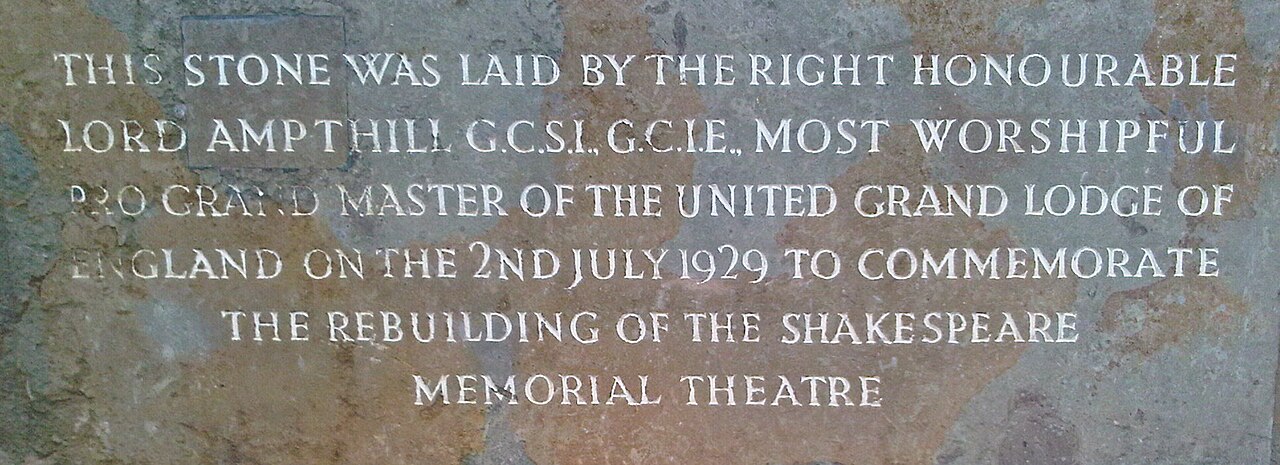
Royal Shakespeare Theatre, Stratford-upon-Avon (Image: Wat Bradford, CC BY-SA 3.0)
He died of pneumonia July 7, 1935, a day before Nickalls, prompting the following anonymous epigram among the various tributes in the Times:
Oarsmen they lived, and silver goblets mark
The well-timed prowess of their trusty blades:
In death their rhythm kept, they now embark
To row their long last course among the Shades.[7]
The 1890 Boat Race, Part II: Tom Nickalls’ Insider Trading
Tom Nickalls, Guy’s father, co-founded the London Rowing Club in 1856. In 1895, he presented the Nickalls’ Challenge Cup to go with the Silver Goblets, in honor of one or the other of his sons (Guy and Vivian) having won the event from 1890 to 1894. A wealthy stockbroker, Tom knew the value of a hot tip and, as the father of the 1890 O.U.B.C. President, put that paternal access to good use before the Boat Race. Guy’s version:
[W]e did an enormous amount of long hard rowing and the crew were undoubtedly very fit, but about a week before the race, which was rowed on a Wednesday, we began to show signs of staleness. On the Thursday my father came down to see us row, and it was quite palpable that we were off colour. My father said:
“Why don’t you take the crew away for a change?”
I said: “The O.U.B.C. have no money and cannot afford it.”
My father, I may say, had taken the odds of 7-2 on Cambridge very heavily. He stood to take £7,000 off Paxton alone.
He telegraphed to the Grand Hotel at Brighton, booked rooms for us, and stood the crew a treat for a very long week-end, and away we went next day. On Saturday morning, for a joke, we ordered eight bath-chairs and were pulled up and down the front. Word was immediately telegraphed to London that all the crew were invalids, and it looked as if the race would not take place. The weather was lovely, and we stayed at Brighton until Tuesday morning and went for a short paddle and a minute’s row in the afternoon. A preliminary next morning, and then the race. . . .
Vanity Fair’s post-mortem (March 29, 1890):
The sudden revulsion at the last in the betting, which installed Cambridge as hot favourites vice Oxford, arose thus. Cambridge did a “record” time on the 20th which read A.1 on paper, -- though we discounted it somewhat in our comments last week. Following this Cantab feat, Oxford went weak and amiss on Friday and Saturday; and if the race had been rowed on the last-named day, Cambridge must have won. Even outsiders could see that Oxford were to pieces on Saturday. So there was on Wednesday morning a reaction and a hurried “getting out” on the part of many early backers of Oxford. Then the public rushed in, like sheep to a gap, and forced the odds up still more on Cambridge. Meantime, a Sunday at Brighton had set the Oxonians up again, and on Monday they were as good as ever they had been. Nothing could have been better than their form in surf that day; but only a few followed and watched them in the rain that afternoon. So they never regained public favour, and started at a considerable discount.
References
- ^ G. Nickalls, Life’s a Pudding, pp. 74-75.
- ^ |Ibid., pp. 82-83.
- ^ Ibid., pp. -.
- ^ The Times, July 8, 1935, p. 16b.
- ^ Ibid.
- ^ G.O. Nickalls, A Rainbow in the Sky, p. 144.
- ^ The Times, July 17, 1935, p. 16d.
- ^ G. Nickalls, pp. 79-81.
Where this page came from
This page was imported from Wikibooks. From “The Rowers of Vanity Fair” on Wikibooks, by its contributors, under CC BY-SA 4.0. Changed here: set as a page; navigation and edit links left out; each image under its own licence, credited in its caption.
Nobody has written it yet — it is the source material at a new address, which is why search engines are asked to skip it and why no one earns from it. It is up for grabs: take it on, and it is yours to rewrite and to earn from.
Dans ces publicationsThe Rowers of Vanity Fair
Licence : CC BY-SA 4.0 · Adapté de en.wikibooks.org
commentaires