
Envie d’améliorer le contenu de la page ? Proposez une modification.
For decades, national parks have learned who their visitors are by handing out questionnaires. At Richmond National Battlefield Park and Maggie L. Walker National Historic Site in Virginia, a study using anonymous mobile-device location data told a very different story — and changed how the parks work.

A cannon demonstration at Richmond National Battlefield Park. NPS
Why the parks needed to know
The two parks are a scattered set of Civil War and Reconstruction-era sites across the City of Richmond and Henrico, Hanover and Chesterfield counties — with no entrance gates, where a surveyor could meet every visitor. With fewer staff over the last decade, visitor centers closed seasonally or for good. After the Park Service's 2016 centennial, staff noticed more people using the battlefield green spaces for recreation; the pandemic and the NPS mobile app (2021) drew still more people away from visitor centers. A "Roving Ranger" program sent staff out to places like Malvern Hill, Drewry's Bluff and the Shelton House — but was it reaching people? Should the Tredegar Visitor Center stay open?
What mobility data is
"Mobility data" is location information that phones record when people allow apps to use their location. Data warehouses collect it from over 250,000 apps, and researchers can buy it anonymized, for chosen places and dates. Unlike a questionnaire, it needs no federal Paperwork Reduction Act approval.
The Park Service's Social Science Program bought more than 133 million records — from over 400,000 devices between January 2022 and August 2023 — and had a contractor clean out duplicates, aircraft and GPS errors.
| Question | How it was estimated |
|---|---|
| Where visitors live | a device seen at a location in the evening for three or more months a year was taken as home — deliberately blurred by privacy rules, but reliable at city and county scale |
| Which sites people combine | each device has an anonymous id, so trips across sites could be followed through a day or a year |
| Age and race | the least precise: the make-up of each visitor's home census block (about 4,000 people) applied proportionally |
What it found — and how a survey compared
| 2023 mobility data | 2010 questionnaire | |
|---|---|---|
| Local visitors (Richmond and the three counties) | 80% | 33% |
| Aged about 44 and under | 64% | 47% (45 and under) |
| Likely African American | 37% | 5% |
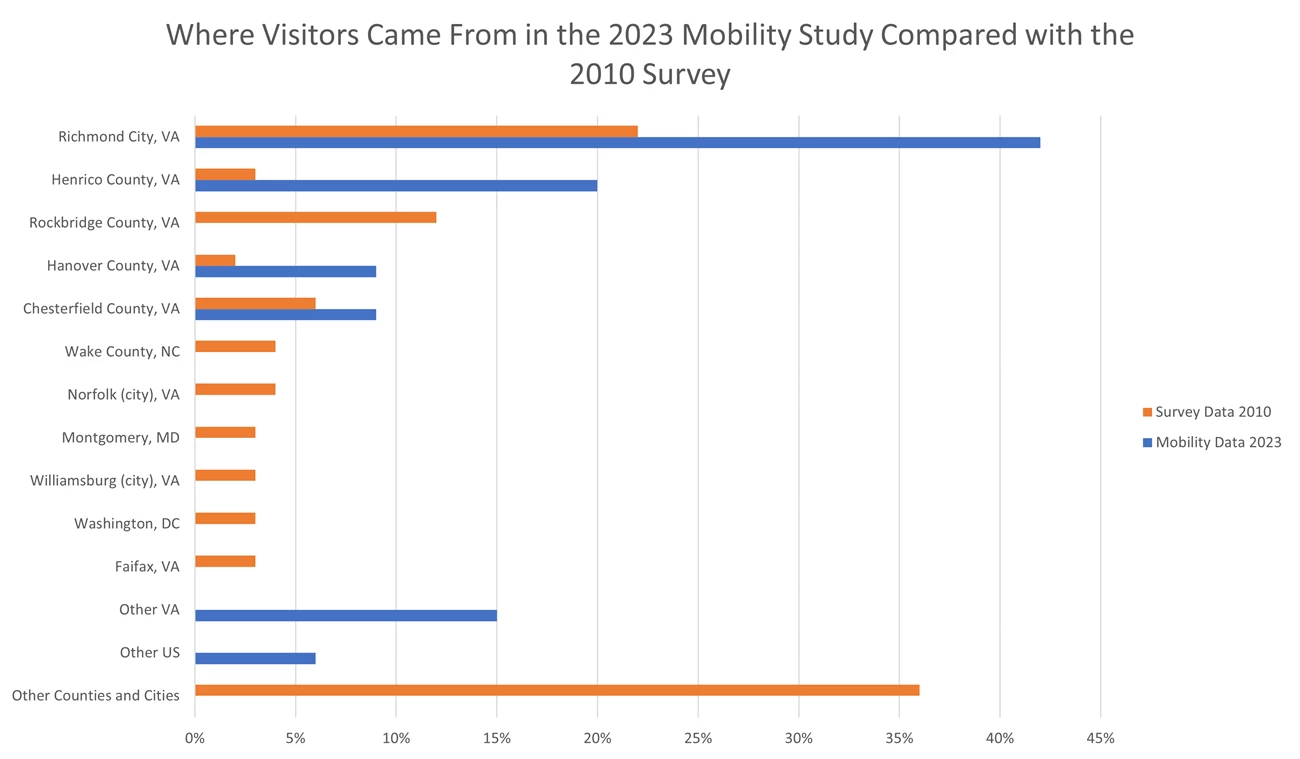
Where visitors came from: 2023 mobility data against the 2010 survey. NPS / D. Pettebone
Other findings: 94% of visitors came from Virginia. Chickahominy Bluff, in a residential area, was 94% local. The Jackson Ward area downtown had the most people visiting more than one site; 40% of visitors to the Garthright House also went to Cold Harbor the same day, and visitors from outside the area were likelier to combine sites.

Visitor ages, 2023 against 2010. NPS / D. Pettebone
Why they differ
The two studies were done 13 years apart with different designs, so they cannot be compared statistically — the phone data is not a random sample. But the likely reasons are clear:
- In 2010, visitors were told to start at a visitor center, so that is where questionnaires were handed out — mostly at Cold Harbor and Tredegar, which the phone data shows had relatively few African American visitors, and which locals rarely start from.
- Younger people were less likely to fill in the 2010 survey, which a non-response check confirmed.
- Phone ownership is near-universal — 97% of Americans have a cellphone and 90% a smartphone (Pew), with little difference by race — though people may switch location sharing on and off at different rates.

Likely race of visitors, 2023 against 2010. NPS / D. Pettebone
What changed
The data confirmed what staff suspected — people use the battlefields as green space — and gave them grounds to act. The park now points visitors to trails and approved recreational spaces on its website and app, sends rangers to busy places without visitor centers, and in 2024 closed the Tredegar visitor contact station to concentrate on the riverfront and on programs with the American Civil War Museum.

The historic Tredegar Iron Works, where the contact station closed in 2024. NPS
"It's important for us to meet people where they are," said superintendent Scott Teodorski. "We can't make decisions about visitor use without these types of data."
Other parks
Grand Teton, Saguaro and the Blue Ridge Parkway have run mobility studies too. Grand Teton used data from connected cars, precise but from fewer, particular vehicles, and calibrated against direct counts; it showed, for example, that of trips entering from Yellowstone in summer 2021, 56% ended in Grand Teton and 28% in Jackson or elsewhere in Teton County.
Mobility data does not replace visitor surveys — surveys describe what people do and think; phones show where and when, park-wide and over long periods. Together they reveal who a park is actually serving.
Sources
Written from "New Research Shows Mobile Devices Are a Powerful Way to Learn about Visitors," by David Pettebone, Jake Jorgenson and Pamela Ziesler, Park Science 39(1), Winter 2024–25, National Park Service; a work of the United States government in the public domain. It draws on the parks' 2023 visitor study report and the 2010 visitor survey, both in the NPS DataStore, and on the Pew Research Center's 2024 figures on mobile phone ownership.
Dans ces collectionsGrand Teton National ParkRichmond National Battlefield Park
Licence : CC0 1.0 (domaine public) · Adapté de www.nps.gov
1
0
0
0

commentaires
À lire ensuite


