
Vuoi migliorare il contenuto della pagina? Prova a proporre una modifica.
By Aquatics Intern Matt Millado, Golden Gate National Recreation Area
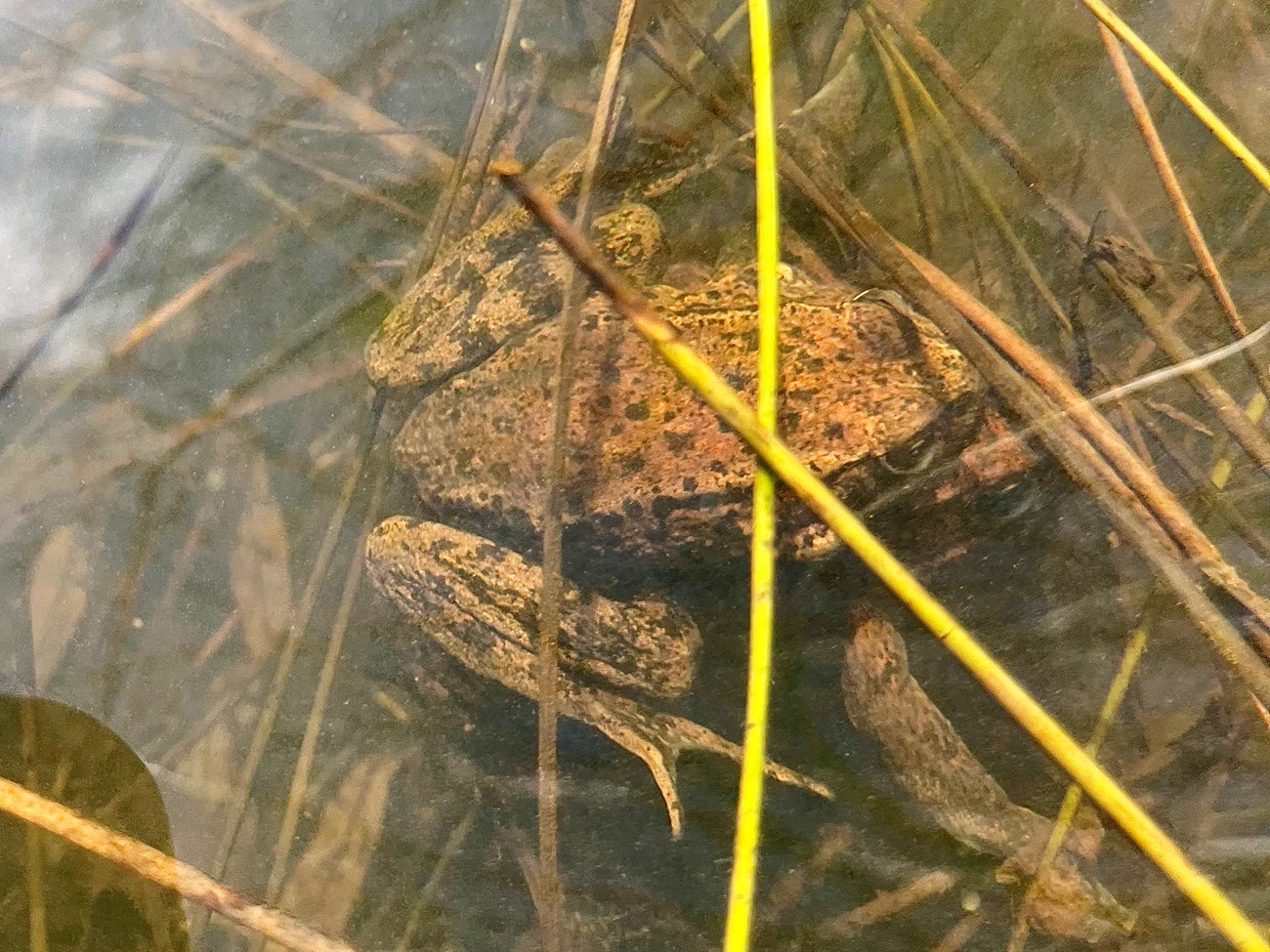
A pair of red-legged frogs in amplexus—a mating behavior in which a male clings to a female during the fertilization process. NPS / Aiko Goldston

California red-legged frog egg masses are grapefruit-sized and laid near the water's surface. NPS / Matt Millado
May 2023 - California red-legged frogs are federally listed as threatened under the Endangered Species Act. Historically, their range extended from Marin County, CA to Baja California, Mexico. It has since been reduced to 30% of its original size due to overharvesting in the 1800s, habitat destruction, and invasive species such as bullfrogs. In response to this decline, National Park Service staff and partners have implemented several habitat restoration and population monitoring projects throughout the Golden Gate National Recreation Area, Point Reyes National Seashore, and Sharp Park.
One way biologists monitor red-legged frog populations is by counting their egg masses. Red-legged frog egg masses—grapefruit-sized and laid near the water’s surface— are much easier to count than the frogs themselves. During the 2023 breeding season (December 2022-March 2023), we found 348 egg masses across 37 sites in Marin San Mateo Counties. This is an overall decrease compared to previous years, with 491 total egg masses observed in 2022 and 496 in 2021.
From a site-specific standpoint, we saw considerable decreases in egg masses from 2022 to 2023 at Tennessee Valley and Rodeo Lagoon in Marin County. In San Mateo County, we didn’t find any egg masses at Milagra Ridge this year. This site features a seasonal wetland whose frog population may have been negatively impacted by consecutive years of drought. Meanwhile, numbers increased at Laguna Salada and Sharp Park.
Notably, the observed decreases in egg masses in 2023 may be influenced by gaps in data collection from multiple large rain events. Lots of rain can reduce visibility and prevent us from surveying, possibly resulting in fewer egg mass observations.
California red-legged frog egg mass observations in Marin County, 2001-2023

Total number of California red-legged frog egg masses observed each breeding year (December-March) across watersheds in Marin County, California. Egg mass observations generally decreased in Marin, except at Bolinas Lagoon.
California red-legged frog egg mass observations in San Mateo County, 2001-2023

Total number of California red-legged frog egg masses observed each breeding year (December-March) across watersheds in San Mateo County, California. Egg mass observations generally increased in San Mateo in 2023, except at Milagra Ridge, we found no egg masses this year.

Breeding surveys are sometimes conducted by boat. Here, a biologist observes a red-legged frog egg mass from a kayak. NPS / Matt Millado
Overall, red-legged frog populations appear to be improving since monitoring began in the early 2000s. This is thanks in part to park efforts to increase hydrologic connections within watersheds, construct new breeding ponds, and manage invasive species.** **Park biologists will continue to monitor California red-legged frog populations in years to come.
For more information
- Pacific Coast Science & Learning Center California Red-legged Frogs page
- Contact Wildlife Biologist Rachel Townsend or Aquatic Ecologist Darren Fong
See more from the Bay Area Nature & Science Blog
Where this belongs
- Golden Gate National Recreation Area
Where this page came from
This page was imported from National Park Service. Produced by the U.S. National Park Service and, as a work of the United States government, in the public domain.
Nobody has written it yet — it is the source material at a new address, which is why search engines are asked to skip it and why no one earns from it. It is up for grabs: take it on, and it is yours to rewrite and to earn from.
In queste raccolteGolden Gate National Recreation Area
Licenza: CC0 1.0 (pubblico dominio) · Tratto da www.nps.gov
1
0
0
0

Commenti
Da leggere dopo


