
Vuoi migliorare il contenuto della pagina? Prova a proporre una modifica.
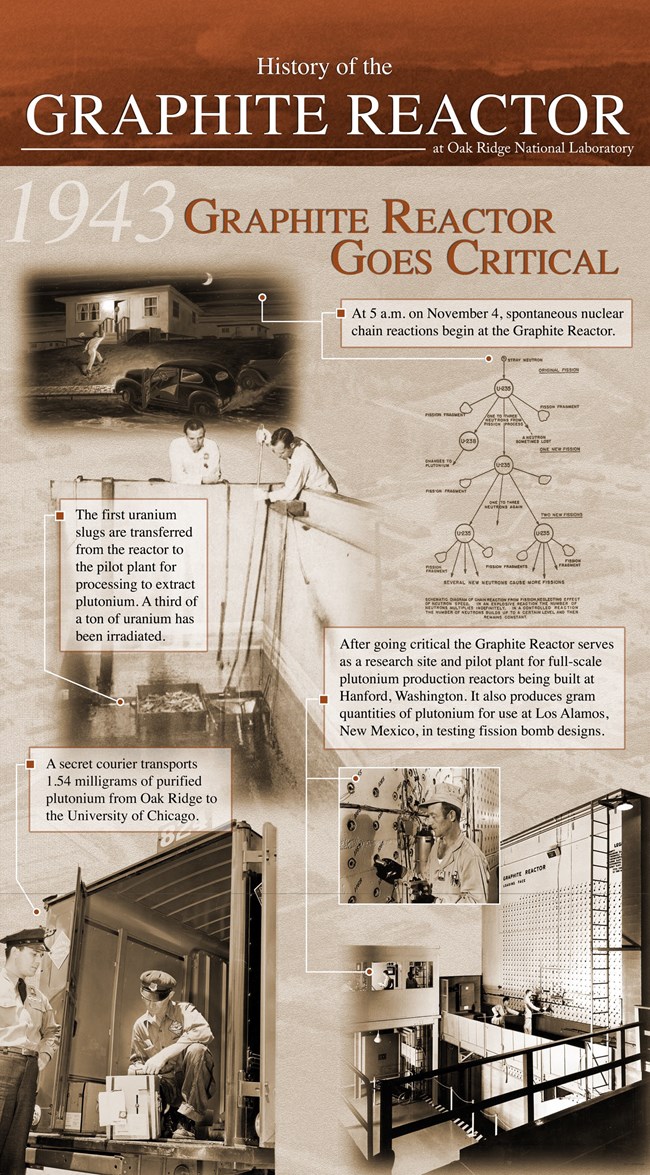
The panel at the X-10 Graphite Reactor. U.S. Department of Energy.
At 5 a.m. on November 4, 1943, the X-10 Graphite Reactor at Oak Ridge, Tennessee, went critical: nuclear chain reactions in its uranium began sustaining themselves. It was the world's second reactor and the first built to run continuously. A panel inside the reactor building, now part of Manhattan Project National Historical Park, tells what happened next.
How a chain reaction works
The panel's diagram follows one neutron. It strikes a uranium-235 nucleus, which splits into two fragments and releases one to three new neutrons. One of those hits another U-235 nucleus, and the process repeats. Some neutrons are captured instead by uranium-238, which turns — through a short chain of decays — into plutonium.
- In a bomb, the number of neutrons multiplies without limit.
- In a reactor, it builds to a set level and holds steady.
What X-10 did
| First plutonium | the first irradiated uranium slugs — a third of a ton — were moved from the reactor to a pilot plant to extract plutonium |
| A courier's cargo | 1.54 milligrams of purified plutonium went by secret courier from Oak Ridge to the University of Chicago |
| Pilot plant | X-10 was the research site and testbed for the full-scale plutonium production reactors being built at Hanford, Washington |
| Los Alamos | it produced gram quantities of plutonium for the scientists designing the bomb in New Mexico |
On the panel
A mural of a man hurrying through the night to a small house where another peers from the door; two workers in coveralls using a long pole to move open metal boxes in a sunken pit; a guard watching as a courier signs for a small crate on the back of a truck; and operators at the reactor's loading face, pushing fuel into its channels by hand while others watch from the control room.
Visiting
The Graphite Reactor stands inside the secure grounds of Oak Ridge National Laboratory and can be seen only on a guided tour.
Sources
Written from "Oak Ridge X-10: 1943 — Graphite Reactor Goes Critical", National Park Service, Manhattan Project National Historical Park, describing a panel by the U.S. Department of Energy; both are works of the United States government in the public domain.
In queste raccolteManhattan Project National Historical Park
Licenza: CC0 1.0 (pubblico dominio) · Tratto da www.nps.gov
1
0
0
0

Commenti
Da leggere dopo


