
Vuoi migliorare il contenuto della pagina? Prova a proporre una modifica.
When Mamie Eisenhower was born in 1896, few people had ever seen an automobile, and the First Lady was Frances Cleveland. When she died in 1979, at 82, men had walked on the moon, and the First Lady was Rosalynn Carter. Set side by side, the three women trace how the role of First Lady — and the lives of American women — changed over eighty years.
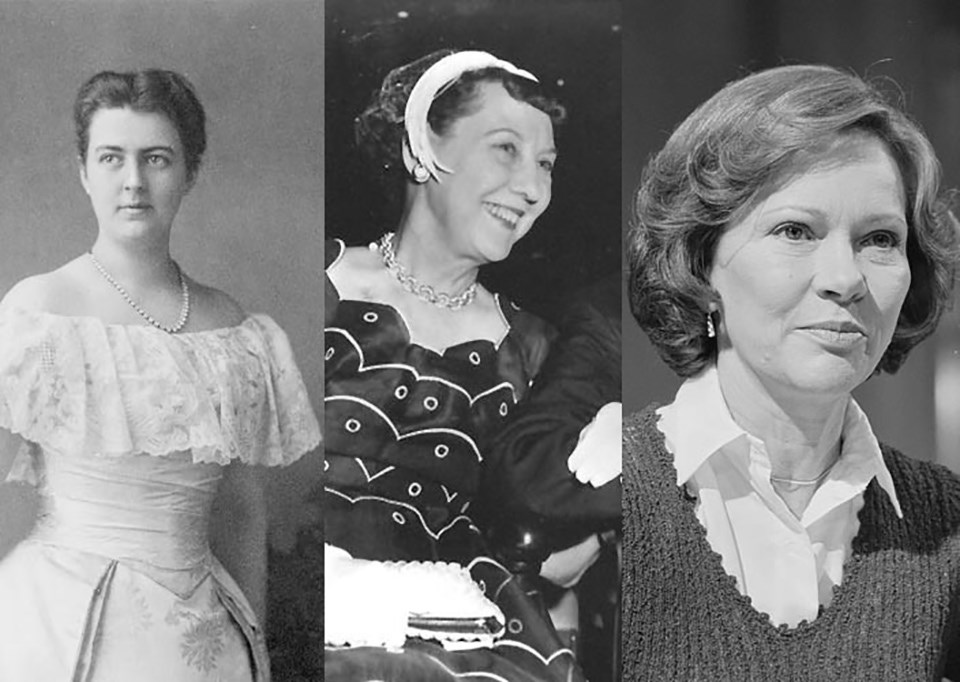
Frances Cleveland, Mamie Eisenhower and Rosalynn Carter. Library of Congress and Eisenhower National Historic Site.
Frances Cleveland: the Victorian ideal
Frances holds two records: the youngest First Lady, and the only one married in the White House. At 21 she married President Grover Cleveland, then 49, in the Blue Room — a surprise to many, who had assumed the bachelor president was courting her mother. She was an instant success and did much for his image.
Though a college graduate at a time when few women were, she seems to have shared her husband's view of women's place; after his presidency, Cleveland called a woman "the moral compass of the home." As her biographer Annette Dunlap has observed, when women's role was under growing debate, Frances acted as though there was nothing to discuss. She kept to the role of hostess, objected when her image was used to sell products or to rally Democratic women's clubs, and spoke against women's suffrage — though she voted once women won the right. Her one public cause was kindergartens, acceptable because it concerned children.
Rosalynn Carter: the partner
Rosalynn arrived after thirty years of marriage and a political partnership. She had been First Lady of Georgia first, and Jimmy Carter wanted her beside him in everything, as a sounding board from his earliest campaigns. She began painfully shy — she did not speak at all in his first, unsuccessful run for governor — but became a strong campaigner.
In the White House she was the first First Lady with her own office and staff in the East Wing. She sat in on cabinet meetings, taking notes without speaking, so she could represent the administration accurately as she traveled at home and abroad. A longtime advocate for mental health reform, she was honorary chair of the President's Commission on Mental Health and the second First Lady, after Eleanor Roosevelt, to testify before Congress. The Mental Health Systems Act of 1980 became law shortly before the Carters left office.
Mamie Eisenhower: between them
Mamie shared something with each. Like Frances, she was raised to run a household, and leaned on the roles of hostess and homemaker; like Rosalynn, she knew the life of a military wife. All three were mothers and grandmothers.
But Mamie was more political than Frances — happy to campaign and to let her image be used — and more distant from policy than Rosalynn. She said she entered the Oval Office only three times during her husband's presidency, each time by invitation. Her way of supporting Ike was to make home a refuge from the pressures of work.
Three mirrors
Each reflected what her era expected of women: Frances the ideal Victorian woman, a moral compass away from the dirty world of politics; Mamie the quintessential 1950s housewife, stylish and running a smooth household; Rosalynn the modern woman, joining family life with a career of her own. Together, they show how far women's roles moved in less than a century.
Sources
Based on "Three First Ladies, A Lifetime of Change," National Park Service, Eisenhower National Historic Site, which draws on Rosalynn Carter, First Lady from Plains (1984); Annette Dunlap, Frank: The Story of Frances Folsom Cleveland (2009); Susan Eisenhower, Mrs. Ike (1996); and Stuart E. Eizenstat, President Carter: The White House Years (2018); a work of the United States government in the public domain; rewritten in hubnx's own words.
In queste raccolteEisenhower National Historic SiteJimmy Carter National Historical Park
Licenza: CC0 1.0 (pubblico dominio) · Tratto da www.nps.gov
1
0
0
0

Commenti


