Vedi qualcosa da migliorare? Proponi una modifica.
Questa pagina è pubblica.
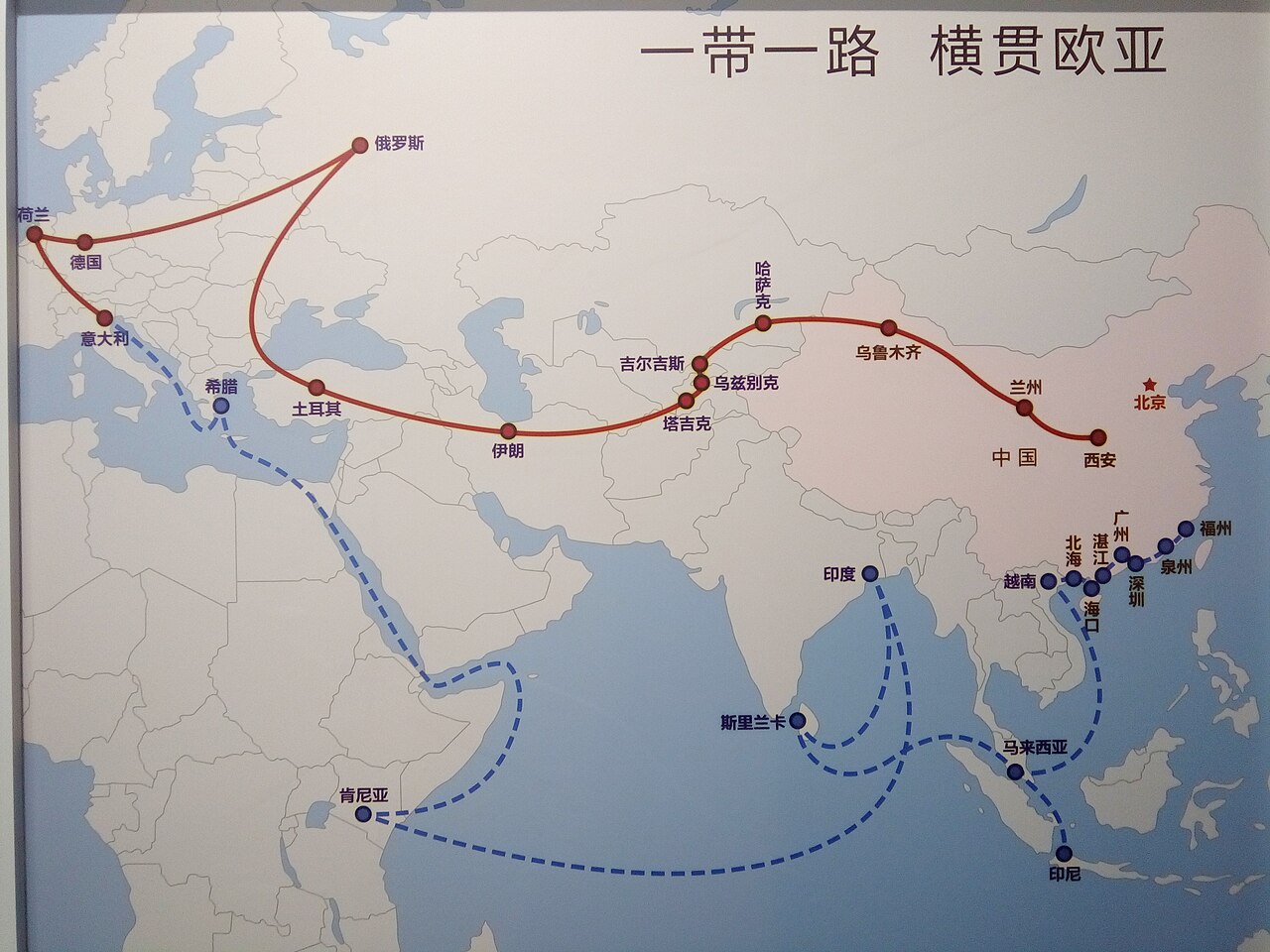
Plan outlining the general paths of the “belt” and the “road” (Image: Yauaaisnhaongwaix, CC BY-SA 4.0)
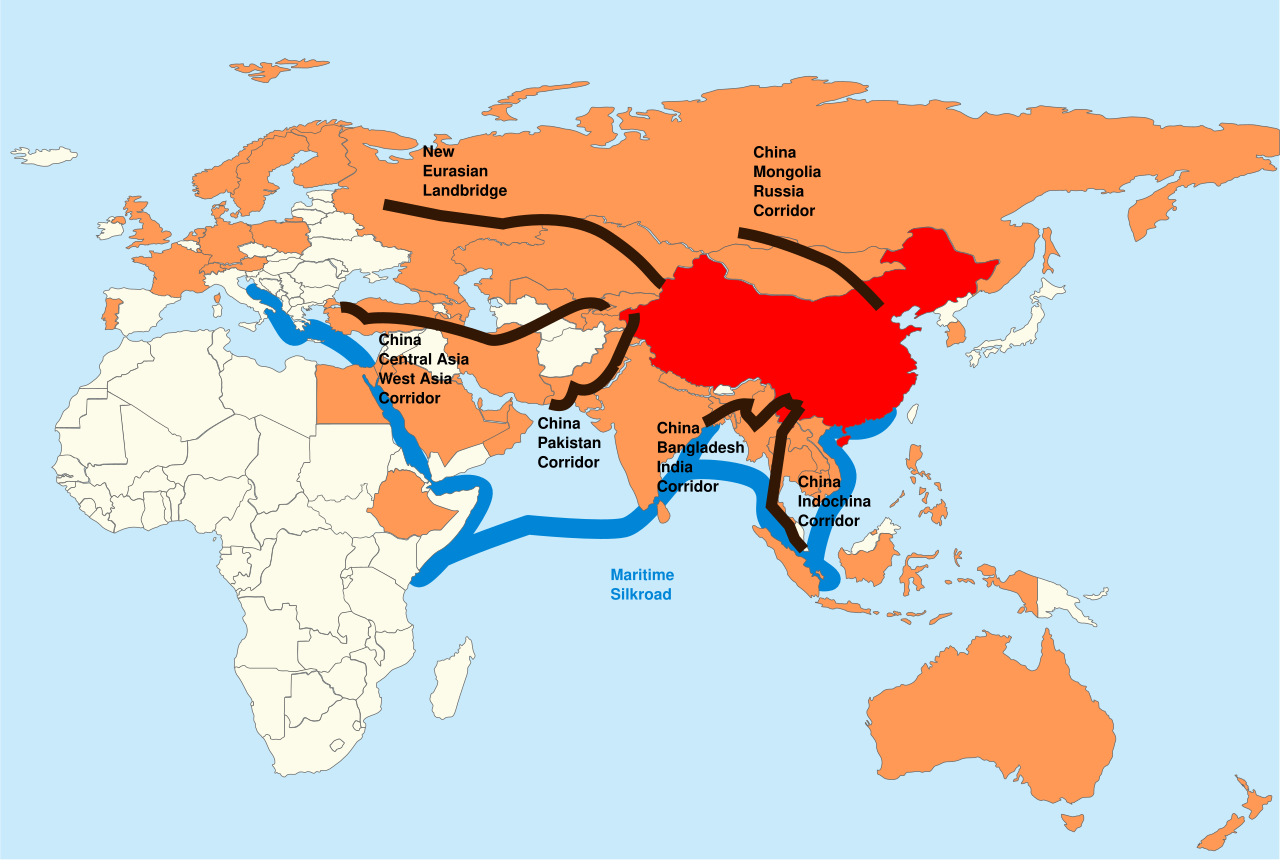
Individual corridors of the “belt” (Image: Lommes, CC BY-SA 4.0)
The Belt and Road Initiative (BRI) is a global investment and infrastructure development program introduced in 2013 by CCP general secretary Xi Jinping of the Chinese Communist Party (CCP). “Belt” is short for the new Silk Road Economic Belt, a vision to restore the Han Dynasty Silk Road trade routes through Central Asia.1] “Road” refers to the existing sea corridor spanning from South China to India, the Middle East, and Europe, known as the [21st-century Maritime Silk Road.[2] The BRI lacks a precise definition. Although its name suggests that it is confined to the "belt" and "road," it is a global initiative reaching as far as the Americas.[3][4] Even leaders of the program discuss it in vague terms.[5]
The BRI is a focal point of Chinese foreign policy. It is controversial, particularly among Western countries, due to the lack of transparency in many of its projects.2] While advocates praise the BRI as a model for sustainable regional development, critics view it as a political agenda to re-establish a [Sinocentric world economy.[2][6][7] Other critics warn about the climate consequences of the BRI.[8]
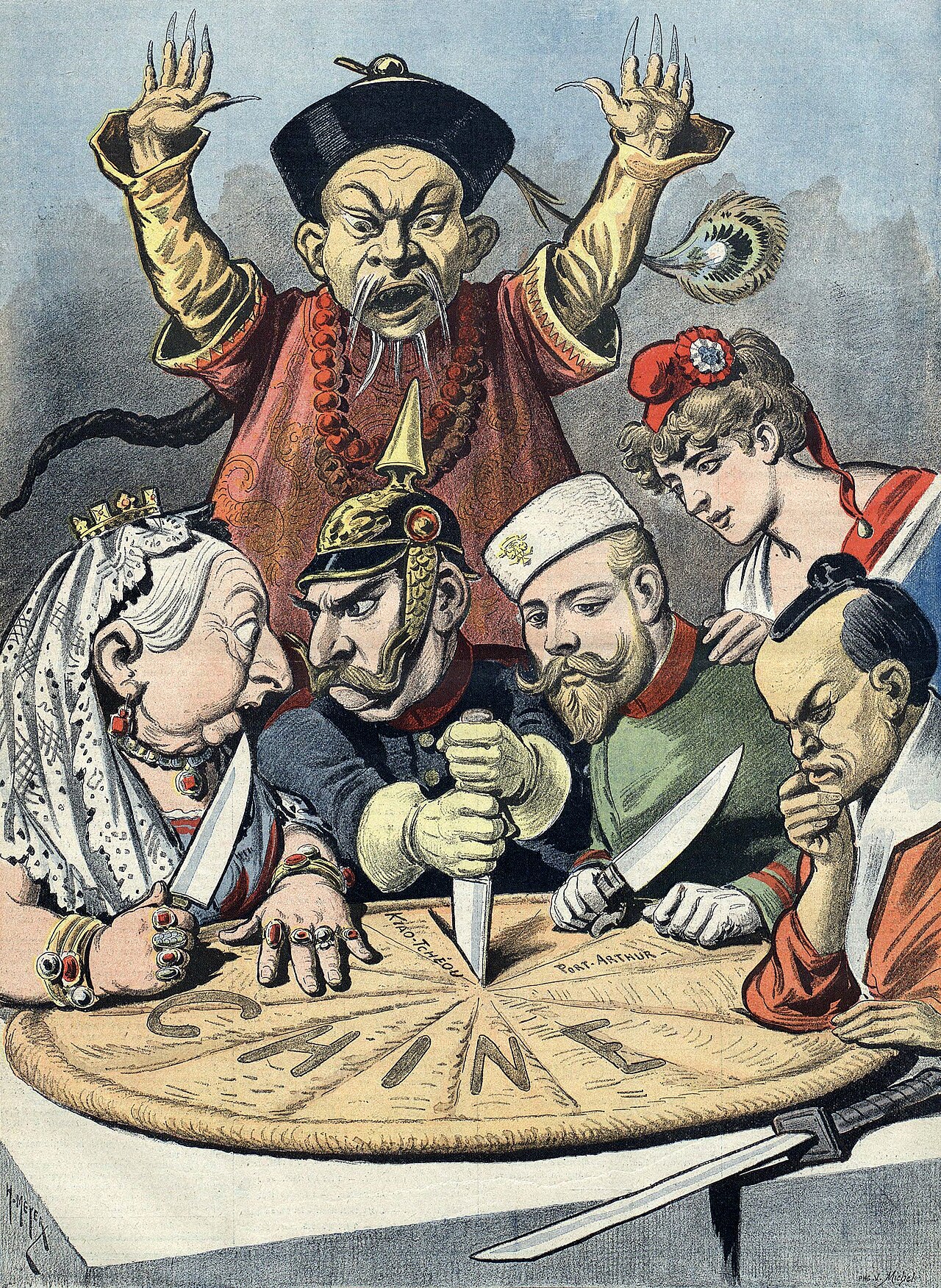
Political cartoon of imperial powers dividing China (Image: Henri Meyer, Public domain)
The historical context of the “Century of National Humiliation” and the security of China's core interests are key motivations behind the BRI.
Sinocentrism and The Century of National Humiliation
For most of China's imperial history, Asia was organized in a Sinocentric system. Nearby tributary nations would send emissaries to kowtow to the Chinese emperor, seeking protection in return. These states were effectively vassals, but also had de facto autonomy.9] China's relationship to the West was also skewed in China's favor. The West desired Chinese goods such as tea and silk, but lacked goods to trade in return. From 1500 AD to the mid-1800s, China’s GDP surpassed that of all the European nations combined.[10] The notion of hegemony is so ingrained in Chinese tradition that [China's name in Mandarin, 中國 (Zhōngguó), translates to Central Country.
However, the outbreak of the First Opium War in 1839 was the beginning of a century in which which China was bullied, attacked, and torn apart by imperial powers. 11] This period, known in the Chinese historical consciousness as “Bainian Guochi” ([a Century of National Humiliation), has been a central motivation for the PRC’s rapid modernization since Mao Zedong announced its end in 1949.[12]
The West often views China’s tremendous transformation since the 1980s as its “rise.” The Chinese instead use the word “rejuvenation,” which “emphasizes their determination to wipe out past humiliations and to restore themselves to their former glory.”[11] Given China's longstanding tradition of hegemony, the BRI may serve to rectify the Century of Humiliation by restoring a Sinocentric trade network and world economy. With heavy investment and infrastructure development throughout Asia, Africa, and Europe, China increases its power locally, expands its spheres of influence globally, and secures its interests, returning to the preeminent nation it once was.
In imperial China, Sinocentrism was justified by the Mandate of Heaven. Now, the CCP hails legitimacy from China's rapid economic development,[13] and may wish to use this rationale to justify any future attempts at hegemony.
Security
The BRI serves China’s core interests in guaranteeing "state sovereignty, national security, territorial integrity and national reunification, China's political system...and overall social stability.”[14] According to an official white paper, the Chinese government believes ”security and development are closely linked and mutually complementary.”[15] The Chinese seem to think that economic development in regions susceptible to insecurity, such as many of China’s neighbors, will lead to security development.[16] Economic cooperation leads to security cooperation, enhancing China's security.[16]
The Chinese regions which border Central Asia, Xinjiang and Xizang (Tibet), are historically the most prone to insecurity due to their non-Han ethnic majority. BRI projects along the “belt” will lead to economic development and connectivity in these two regions. The CCP hopes that through this economic development, the stability of these regions can be guaranteed.16] The CCP couples this economic strategy with [the mass internment of ethnic minorities, especially in Xinjiang.
The CCP fears that a situation mirroring the collapse of the Soviet Union, where economic decline contributed to the loss of legitimacy, is possible in China.16] According to The National Interest, the CCP believes that “economic success legitimizes one-party rule in China, and that without it the country could break out in some kind of spontaneous combustion.”[17] China has a surplus industrial capacity and is facing the [middle income trap. Exporting this surplus capacity and increasing Chinese construction abroad through the BRI prevents the stagnation of the Chinese economy, securing legitimacy for the CCP.
Initially, the Belt and Road Initiative was praised by participant countries and criticized mainly by the United States, which views the BRI as a threat to its global soft power. However, reactions from some participant countries have changed in recent years because of leadership changes and loan repayments.
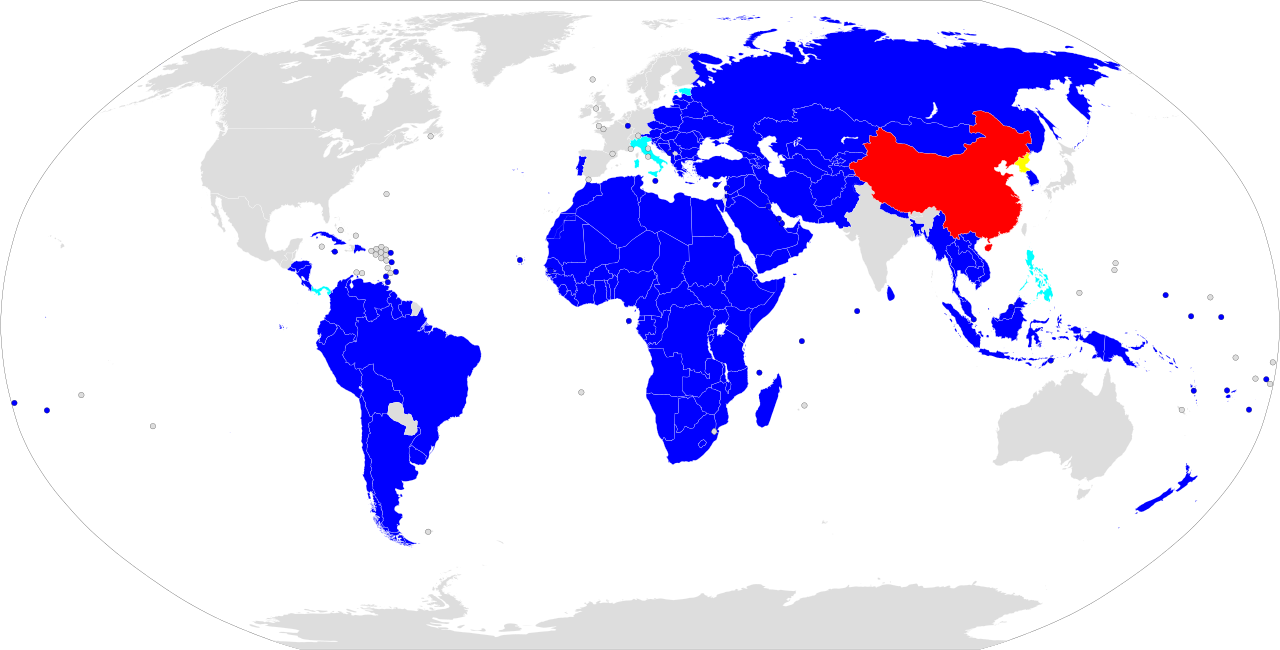
Countries which signed documents to endorse or join the BRI (Image: Owennson, CC BY-SA 4.0)
Support
The Chinese government has made significant efforts to control the perception of the BRI and has persuaded over 130 countries (largely non-Western) to endorse the program.[18] Russia, which is involved in more than 150 BRI projects, is the largest supporter of the initiative outside of China itself.[19] Other countries such as Italy, Greece, the Philippines, and Singapore have also chosen to either join or endorse it.
Criticism
Critics accuse the BRI of promoting corruption, being a form of neocolonialism, and exacerbating climate issues.
Debt Trap Diplomacy (“Loan to Own”)
Claims that the BRI is a form of neocolonialism and a salami-slicing strategy stem from accusations that China utilizes debt-trap diplomacy. Critics allege that China knowingly negotiates loans with countries that cannot repay them in time. When those countries then default on the loan, China seizes strategic assets and gains political influence.20] In many BRI countries the external debt to China comprises a significant percentage of the GDP.[18] Many ports along the "road" have been seized in the wake of payment defaults. China’s current relationship with some BRI countries is similar to China’s relationship with tributary states in the imperial era (periodic collection of payments, influence in politics and government, preferential treatment in trade, etc.). The Chinese government denies accusations of neocolonialism, and evidence is difficult to obtain because of the lack of transparency in negotiations. Due to [COVID-19, many countries have reached out to the G20 (which includes China) for aid. African BRI participants in particular owe $145 billion to China, with over $10 billion due in 2020.[18] How the Chinese government deals with upcoming defaults will influence the future perception of the BRI.
Corruption
The BRI has been accused of fostering and exploiting corruption in some participant countries. Many BRI participant countries rank in the bottom half of the TRACE Bribery Risk Matrix. 10 of these countries are within the top 25 corruption-prone countries in the world.[21][22] In these countries, many of the procedures for investment negotiations are allegedly bypassed through bribes and back-door deals.[22] China gets favorable terms and the corrupt leaders of the participant countries are able to sustain their corruption.[22] The Chinese government denies these allegations, however, some view the Malaysia and Sri Lanka case studies as evidence that China has fostered corruption.
Bank erosion on the Mekong (Image: BacLuong at Vietnamese Wikipedia, Public domain)
Climate Consequences
A Tsinghua University report indicates that BRI participant countries are expected to exceed a 2-Degree Scenario carbon budget by 2030.23] If this expectation holds, BRI countries would account for half of the global carbon emissions by 2050.[23] China is ahead of schedule to meet its [Paris Agreement goals, but critics argue that China's progress is offset by the BRI's heavy reliance on coal.8][24] China is the world leader in renewable energy but conspicuously does not promote it for BRI projects. Yale Climate Connections suggests that this discrepancy is because most renewable companies are private while traditional energy companies are state-owned. China also possesses a strong workforce for coal, and the BRI may be a way to export its coal technology and surplus industrial capacity. Development along the waterways of the “road” causes disruption to coastal wetlands, declines in biodiversity, and drops in drinking water quality according to Yale Climate Connections.[8] The [Mekong River is a case study which validates the environmental concerns associated with the BRI. Projects along the “belt” pose risks such as “landslides, flooding, soil erosion, sedimentation in rivers, and interruptions of water courses.”[8] In Myanmar, 25 million people live down-slope of BRI projects and are at risk of flooding. Critics warn that the BRI requires strategic environmental planning, which the Chinese government is failing to do.
Case Studies
The following case studies are often cited in the accusations of how debt-trap diplomacy and corruption play a role in BRI dealings.
Malaysia
Malaysia was a BRI country before 2018. Despite heavy criticism within the country, former Prime Minister Najib Razak negotiated with the Chinese government to be a part of three BRI projects: the East Coast Rail Link, the Trans-Sabah Gas Pipeline, and the Multi-Product Pipeline.25] Razak was the head of the authoritarian [UMNO party that had been in power since Malaysian independence in 1957.26] In 2016, he offered China stakes in Malaysian railway projects and space at two ports to dock Chinese navy ships as part of the BRI.[27] In return, he sought Chinese aid in influencing the United States to drop investigations into the [1MDB scandal that involved him.27] In 2018, there was a [historic change of power in Malaysia, partially due to Razak's corrupt dealings. The new Prime Minister Mahathir bin Mohamed promptly canceled all three BRI projects, stating that they were detrimental to the country and its fiscal health.[25]
Hambantota Port in Sri Lanka (Image: Deneth17, CC BY-SA 3.0)
Sri Lanka
Former Sri Lankan President Mahinda Rajapaksa looked for funding for an ambitious port project in his hometown of Hambantota. After being rejected by frequent lenders like India because feasibility studies indicated the debt would be unsustainable, Rajapaksa turned to China.[28] Over the course of development, Sri Lanka incurred heavy debt to China, which it was unable to repay. In 2015, Rajapaksa was voted out of office, despite the Chinese directly funding his campaign to keep him in power. As a result of heavy pressure from the Chinese government, in 2017 the new Sri Lankan government leased the entire port and 15,000 surrounding acres to China for 99 years.[28] The deal erased some of Sri Lanka’s debt, but $12.3 billion out of the Sri Lankan government’s $14.8 billion revenue in 2018 was still debt repayments.[28]
The Belt and Road Initiative may be the largest infrastructure project ever undertaken. The initiative provides great opportunities for cooperation and economic development throughout the world, especially in Asia. However, understanding the historical motivations behind the BRI is necessary in discerning its true purpose. The manifest function is to build infrastructure globally, but there are a variety of important side effects (Sinocentrism in economic and geopolitical contexts, security motivations, climate consequences, etc.). The BRI is still in its early stages, but it is being watched closely by the West to see how it will shape the geopolitical and economic climate for the rest of the century.
There are many other aspects of the BRI that warrant expansion of the chapter. For example, the BRI's impact on the Sino-Indian border dispute, which involves the world's two most populous countries, can be investigated to expand this chapter. This chapter also focuses heavily on the criticisms of the BRI and only informs readers that support exists. Case studies about the support of the BRI will add meaningful value to this chapter.
Below is a list of links to information outside the scope of this chapter, as well as tangentially related topics that curious readers may find interesting.
Directly related to the BRI
- How Chinese BRI investment in Pakistan affects the Sino-Indian border dispute
- Blue Dot Network (how some western powers aim to counter the BRI)
- Chinese investment in the Congo
- Further investigation into accusations of the BRI as a form of neocolonialism
- Specific discussion of the BRI with respect to poverty and economic impacts
- University of Virginia assessment of the BRI
Tangentially related to the BRI
- Made in China 2025
- Free and Open Indo-Pacific Strategy
- Territorial disputes in the South China Sea (Nine-dash line)
- Marshall Plan
- String of Pearls Theory
- History of colonialism
- ↑ The State Council of The People's Republic of China. (2015, March 30). Action plan on the Belt and Road Initiative. http://english.www.gov.cn/archive/publications/2015/03/30/content_281475080249035.htm
- ↑ a b c Dollar, D. (2020, October 01). Seven years into China's Belt and Road. Brookings Institution. https://www.brookings.edu/blog/order-from-chaos/2020/10/01/seven-years-into-chinas-belt-and-road/
- ↑ The World Bank. (2018, March 29). Belt and Road Initiative. https://www.worldbank.org/en/topic/regional-integration/brief/belt-and-road-initiative
- ↑ Huang, Y. (2016). Understanding Chinas Belt & Road Initiative: Motivation, framework and assessment. China Economic Review, 40, 314-321. doi:10.1016/j.chieco.2016.07.007
- ↑ Ang, Y. Y. (2019, June 20). Demystifying Belt and Road. Foreign Affairs. https://www.foreignaffairs.com/articles/china/2019-05-22/demystifying-belt-and-road
- ↑ Khan, M., Sandano, I., Pratt, C., & Farid, T. (2018). China’s Belt and Road Initiative: A Global Model for an Evolving Approach to Sustainable Regional Development. Sustainability, 10(11), 4234. doi:10.3390/su10114234
- ↑ House of Representatives Document. Hearing on China's Belt and Road Initiative: Five Years Later at pg. 64 (2018). https://www.uscc.gov/sites/default/files/transcripts/Hearing%20Transcript%20-%20January%2025,%202018_0.pdf
- ↑ a b c d Spiegel, J. (2020, February 15). The potential climate consequences of China's Belt and Roads Initiative. Yale Climate Connections. https://yaleclimateconnections.org/2020/02/the-potential-climate-consequences-of-chinas-belt-and-roads-initiative/
- ↑ Kissinger, H. (2011). On China. New York, NY: Penguin Books.
- ↑ Cox, W. (2015, September 21). 500 Years of GDP: A Tale of Two Countries.New Geography. https://www.newgeography.com/content/005050-500-years-gdp-a-tale-two-countries#:~:text=1500: In 1500, China was,GDP's of approximately $100 billion
- ↑ a b Wang, Z. (2012). Never forget national humiliation (The Focus: Postcolonial dialogues). International Institute for Asian Studies. https://www.iias.asia/sites/default/files/nwl_article/2019-05/IIAS_NL59_3233.pdf
- ↑ Schiavenza, M. (2017, February 16). How Humiliation Drove Modern Chinese History.The Atlantic. https://www.theatlantic.com/china/archive/2013/10/how-humiliation-drove-modern-chinese-history/280878/
- ↑ Wang, A. (2018). Symbolic Legitimacy and Chinese Environmental Reform. Environmental Law, 48(4), 699-760. doi:10.2307/26948602
- ↑ Information Office of the State Council of The People's Republic of China. (2011, September 7). China's Peaceful Development. https://www.fmprc.gov.cn/mfa_eng/topics_665678/whitepaper_665742/t856325.shtml
- ↑ The State Council of The People's Republic of China. (2017, November 1). China's Policies on Asia-Pacific Security Cooperation. https://www.fmprc.gov.cn/mfa_eng/zxxx_662805/t1429771.shtml
- ↑ a b c d Holt, P. (2020, June 18). A Truly Friendly Neighbor? The Motivations behind China's Belt and Road Initiative in its Periphery. The Institute of World Politics. https://www.iwp.edu/articles/2020/06/17/a-truly-friendly-neighbor-the-motivations-behind-chinas-belt-and-road-initiative-in-its-periphery/
- ↑ Babones, S. (2019, October 20). No, China's Communist Party Is Not Running on Borrowed Money. The National Interest. https://nationalinterest.org/feature/no-chinas-communist-party-not-running-borrowed-money-89176
- ↑ a b c The Economist. (2020, June 4). The pandemic is hurting China's Belt and Road Initiative. https://www.economist.com/china/2020/06/04/the-pandemic-is-hurting-chinas-belt-and-road-initiative
- ↑ Ehret, M. J. (2020, February 18). BRI transforming world economic order. Asia Times. https://asiatimes.com/2019/04/bri-transforming-world-economic-order/
- ↑ Green, M. (2019, April 25). China's Debt Diplomacy. Foreign Policy. https://foreignpolicy.com/2019/04/25/chinas-debt-diplomacy/
- ↑ TRACE. (2020). TRACE Matrix. https://traceinternational.org/trace-matrix
- ↑ a b c Doig, W. (2019, January 01). The Belt and Road Initiative Is a Corruption Bonanza. Foreign Policy. https://foreignpolicy.com/2019/01/15/the-belt-and-road-initiative-is-a-corruption-bonanza/
- ↑ a b Zadek, S. (2019, April 25). The critical frontier: Reducing emissions from China's Belt and Road. Brookings Institution. https://www.brookings.edu/blog/future-development/2019/04/25/the-critical-frontier-reducing-emissions-from-chinas-belt-and-road/
- ↑ Lozos, E., Pfaff, A., Olander, L., Mason, S., & Morgan, S. (n.d.). Reducing Environmental Risks from Belt and Road Initiative Investments in Transportation Infrastructure (pp. 2-3, Rep.). The World Bank and Duke University.
- ↑ a b Blake H. Berger for The Diplomat. (2018, August 27). Malaysia's Canceled Belt and Road Initiative Projects and the Implications for China. The Diplomat. https://thediplomat.com/2018/08/malaysias-canceled-belt-and-road-initiative-projects-and-the-implications-for-china/
- ↑ Grassi, S. (2020, April 1). Analysis: The Belt and Road Initiative in Malaysia. Friedrich-Ebert-Stiftung. https://www.fes-asia.org/news/analysis-the-belt-and-road-initiative-in-malaysia/
- ↑ a b Wright, T., & Hope, B. (2019, January 07). WSJ Investigation: China Offered to Bail Out Troubled Malaysian Fund in Return for Deals. The Wall Street Journal. https://www.wsj.com/articles/how-china-flexes-its-political-muscle-to-expand-power-overseas-11546890449
- ↑ a b c Abi-habib, M. (2018, June 25). How China Got Sri Lanka to Cough Up a Port. The New York Times. https://www.nytimes.com/2018/06/25/world/asia/china-sri-lanka-port.html?auth=login-email&login=email
Where this page came from
This page was imported from Wikibooks. From “Lentis” on Wikibooks, by its contributors, under CC BY-SA 4.0. Changed here: set as a page; navigation and edit links left out; each image under its own licence, credited in its caption.
Nobody has written it yet — it is the source material at a new address, which is why search engines are asked to skip it and why no one earns from it. It is up for grabs: take it on, and it is yours to rewrite and to earn from.
In queste pubblicazioniLentis
Licenza: CC BY-SA 4.0 · Tratto da en.wikibooks.org
Commenti