
Vedi qualcosa da migliorare? Proponi una modifica.
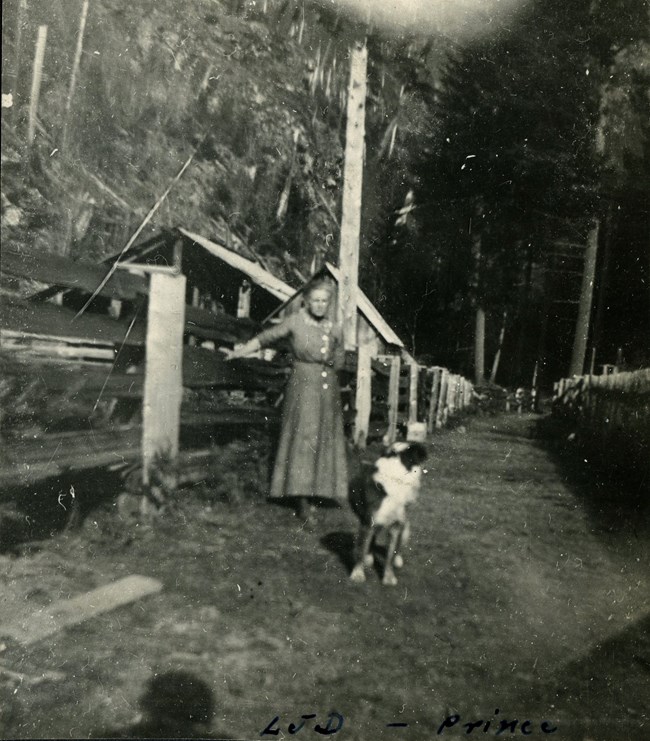
Lucinda Davis at the family homestead with her dog Prince, about the 1910s. Davis Family Collection, North Cascades National Park archives.
Lucinda J. Davis's life is bound up with the North Cascades. Her love of the wilderness and her wish for independence brought her there in the late nineteenth century, where a divorced mother could start again. She built two homesteads, one near Marblemount on the Cascade River and one at Cedar Bar on the Skagit River, near today's Diablo. As across much of the late-nineteenth-century West, the region also offered white women openings in business, serving the single men who came with American expansion and settlement.
Coming west
Davis was born in 1852 in Preston, Pennsylvania, to Juliette A. Tallman and George W. Leach, a Methodist minister. In her twenties she taught school, married Etsyl Clum Davis and moved to Milford, Nebraska. In the 1880s two of her brothers, George and Will Leach, staked claims on the Cascade River; when George drowned in a canoe accident in 1890, Will urged her to take up his claim. Recently divorced and living in Colorado, she set out for Washington with her three children, Frank (13), Idessa (8) and Glee (5), by train, boat, wagon and on foot.
The Cascade River homestead
Within two years the family had cleared enough land for a garden of vegetables and grains, raspberries, a milk cow and chickens. In the summers of 1893 and 1895 Davis ran a small store and hotel at Goodell's Landing while its owners were away prospecting, serving customers on their way to the gold fields. In winter she took the animals down river to Mount Vernon or Sedro-Woolley, away from the harsh weather, and so the children could go to school. In 1897 a flood ruined most of the homestead.
The Davis Ranch
The family moved to a new homestead at Cedar Bar in June 1898, and within days Davis was feeding travellers. Well placed on the Skagit, the Davis Ranch became a favourite stop for miners and others, with fresh milk, home-grown vegetables and fruit, homemade pies and beds for the night.
- In 1900 two guests burned the house down, whether by accident or on purpose was never clear, and the family built a bigger one within a year.
- By 1903 the guestbook recorded more than 400 customers a year.
- In 1907 they built a new house with a sign over the porch: "Davis Ranch-Meals and Beds."
- By 1917 it had 11 rooms, lit by electricity from a dam and flume the Davis sons built. A traveller in the 1920s called it a "mecca in the wilderness of gaunt mountain crags, evergreen forests, and 'white water.'"
Davis also loved to explore the peaks around her. In 1911 she and Hazel Campbell, her future daughter-in-law, climbed what is now Pyramid Peak and Sourdough Mountain, the first white women to reach their summits.
Losing the land
For years Davis had to negotiate with the U.S. Forest Service to keep her homestead, whose ownership was disputed; she received full title in 1917. In the 1920s Seattle City Light wanted the area for hydroelectric projects and in 1928 condemned her property. She fought the utility twice in court, lost, and sold the homestead in 1929. She lived out her life with her son Glee and his family, and died in their home in Sedro-Woolley in June 1931. Davis Peak, near Diablo, keeps the family's name on the land.
Sources
- National Park Service, North Cascades National Park, "Lucinda J. Davis," by Charlotte Hansen Terry, in the series Women's History in the Pacific West. https://www.nps.gov/articles/000/lucinda-j-davis.htm. Produced with the University of California, Davis, History Department, with a grant from the National Park Foundation.
- Its sources include Gretchen A. Luxenberg, Historic Research Study: North Cascades National Park Service Complex (National Park Service, 1986), and articles by Dick Fallis (1981), Dolly Connelly (1955) and Glee Davis (1953).
- Words on this page from people and organisations outside the federal government are paraphrased; rewritten in hubnx's own words.
In queste pubblicazioniNorth Cascades National Park
Licenza: CC0 1.0 (pubblico dominio) · Tratto da www.nps.gov
1
0
0
0

Commenti


