
Vuoi migliorare il contenuto della pagina? Prova a proporre una modifica.
Three years after the first phase of a salmon habitat project at Muir Woods, Redwood Creek is doing things it hasn't done in roughly a century: meandering, scouring out deep pools, and collecting the mix of sediment sizes that signals a healthy stream. By 2022, the amount of winter habitat in the restored stretch had reached levels considered to be good — and project manager Carolyn Shoulders says the work is overdue. "This project should have been done 20 years ago," she said. "The changes that we're making are overdue."
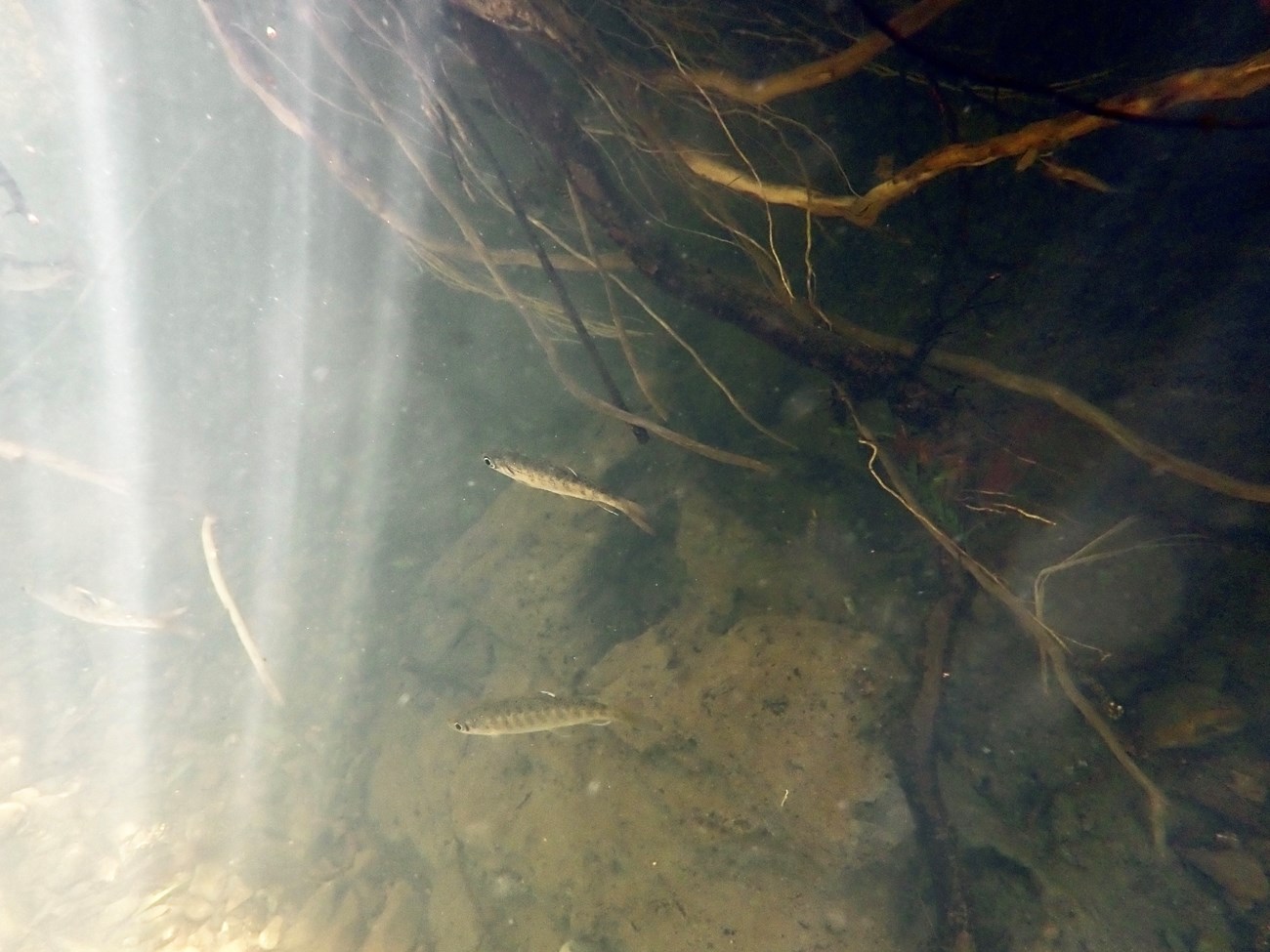
Newly hatched coho fry and juveniles need river bends, pools of water, logs and tree roots to safely grow up in Redwood Creek. NPS / Matt Millado
How the creek got straightened out
About a century ago, the Civilian Conservation Corps built riprap — large boulders — into the banks of Redwood Creek. On top of that, the National Park Service at the time removed debris and logs from the channel. The result was a faster-moving, homogenous channel with a flattened bed. Adult coho salmon (Oncorhynchus kisutch) could still spawn there, but young fry had nowhere to hide. Coho juveniles need river bends, pools, logs, and tree roots to survive. Although a high percentage of salmon in the watershed spawn at Muir Woods, the area was producing a small number of juveniles.
What the restoration crews did
In 2019, teams removed riprap from the creek banks and added both small and large wood features to the channel upstream of Bridge 3.

In 2019, teams removed riprap from the creek banks and added small and large wood features to Redwood Creek upstream of Bridge 3. NPS
Without riprap holding it in place, the creek can meander and cut into its banks. That movement, combined with the woody structures, creates differences in flow velocity and gives the creek chances to scour out pools — exactly the sheltered, slower-water spots that coho juveniles need during high flows.
A storm did some of the work
The defining event of Water Year 2022 (October 2021 to September 2022) was an October 2021 storm. The high flows it produced likely caused woody debris to shift, triggered erosion, and drove the substantial gains in winter habitat reported that year.
Not all of that movement was planned. Woody structures anchored with vertical stabilizing pieces stayed put, while most loose pieces washed downstream — but the creek put them to use anyway. Some drifted to the area near Bridge 3 and Bridge 4, where two log jams grew significantly. The jam upstream of Bridge 3 gained three large logs and plenty of smaller debris, creating a pool beneath it over 4.4 feet deep.
One log originally placed near Cathedral Grove drifted to the opposite bank and uprooted a maple sapling, carving a cavity that filled with water and became a habitat pool. In total, three new eroded areas along the bank created winter habitat.
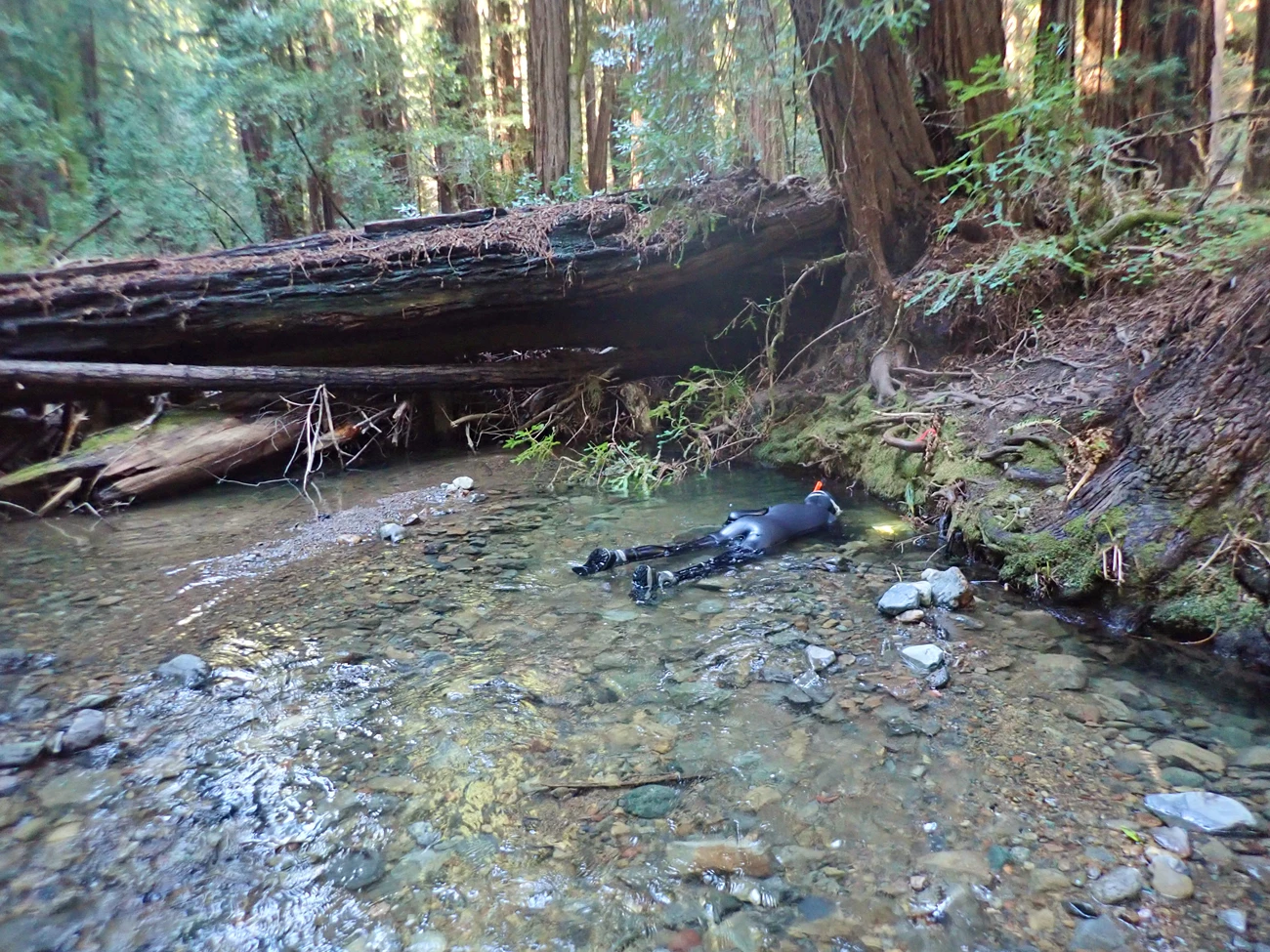
Snorkel survey near a log jam that grew significantly during WY22, leading to a pool beneath it over 4.4 feet deep. NPS / Matt Millado
What the monitoring shows
Each January or February, scientists conduct winter habitat mapping and snorkel surveys, counting coho juveniles and steelhead trout in a subset of habitat areas. The WY22 annual monitoring report found:
- Increased winter habitat density
- More natural sediment deposition
- Changes in woody debris placement that led to habitat improvements
- Higher variation in grain size and a smaller median grain size in sediment analysis — signs of more natural channel processes and healthier hydrology
By 2022, winter habitat levels in the Phase 1 area had reached levels considered good, and they remained similar the following year.

Juvenile salmon in Redwood Creek. By 2022, the amount of winter habitat where Phase 1 took place reached levels considered to be good. NPS / Matt Millado
The vast majority of large woody debris structures placed in 2019 created sheltered pools rated as good habitat. These surveys will also serve as baseline data for Phase 2, which will restore additional stretches of the creek. Phase 2 construction was set to begin in the summer of 2023.
Sources
This article is based on "Extreme Home Makeover: Salmon Habitat Project Yielding Impressive Results," published by the National Park Service, Golden Gate National Recreation Area. It is a work of the United States government and is in the public domain.
In queste raccolteGolden Gate National Recreation AreaMuir Woods National Monument
Licenza: CC0 1.0 (pubblico dominio) · Tratto da www.nps.gov
1
0
0
0

Commenti
Da leggere dopo


