
Vuoi migliorare il contenuto del nodo? Prova a fare una richiesta di modifica.
In a development that signals a pivotal shift in the artificial intelligence sector’s maturation, OpenAI has reportedly moved to delay its highly anticipated initial public offering (IPO) from late 2026 to 2027. According to reports surfaced today, May 2, 2026, CFO Sarah Friar has advised leadership to postpone the offering, citing the necessity for more rigorous financial controls and internal operational readiness. For months, the market has viewed an OpenAI IPO as the "coming of age" moment for the generative AI wave. However, the reported decision to wait indicates that the company—and perhaps the broader sector—is transitioning from a phase defined by aggressive, "growth-at-all-costs" capital deployment to one focused on sustainable unit economics, financial transparency, and operational stability. The reported pressure from CFO Sarah Friar suggests a strategic pivot akin to other major technology companies during their pre-public phases. Friar, known for her ability to instill fiscal discipline, is reportedly cautioning that the organization is not yet prepared to meet the intense regulatory and reporting scrutiny required of a public entity. This delay is not merely an administrative choice; it is a concession that the current financial metrics—likely impacted by high compute costs and intensive R&D spending—require more time to align with the expectations of public market investors. This move ripples across the AI ecosystem. It forces investors and competitors to reconsider the "AI Gold Rush" narrative. As OpenAI takes extra time to fortify its house, the rest of the industry will likely follow suit, shifting focus toward margin improvement and long-term sustainability rather than mere model capability. The message is clear: the era of speculative AI exuberance is yielding to the era of industrial accountability.
Beyond the Hype—The New Reality of AI Finance
The news that OpenAI is pushing its IPO timeline into 2027 marks a definitive turning point in the technology sector’s recent history. For the past three years, the industry has been driven by a relentless focus on model scaling, parameter growth, and aggressive hiring. Today’s report, however, underscores that the underlying economics of AI are finally coming to the forefront of corporate decision-making.
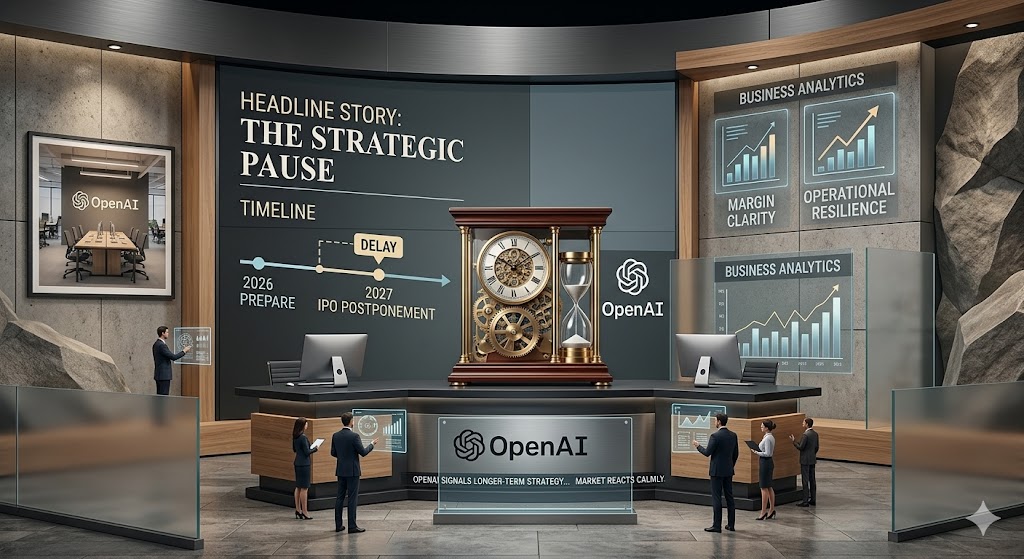
The Economics of "Agentic" Scale
The push toward an IPO in 2026 was largely fueled by the belief that AI would rapidly replace traditional enterprise software, driving massive revenue growth. However, as companies have begun the transition from simple chatbot interfaces to complex, agentic AI systems capable of real-world task execution, the cost structures have evolved. Running autonomous agents requires significantly more inference compute and sophisticated guardrails than static large language models (LLMs).
CFO Sarah Friar’s reported hesitation is a recognition of this reality. Moving from a private lab environment to a public company requires a predictable, scalable, and auditable financial model. In the current landscape, where the cost of inference is still fluctuating and the ROI for many enterprise AI deployments is just beginning to materialize, taking such a company public would subject it to the brutal, quarter-by-quarter scrutiny of the public markets. By waiting until 2027, OpenAI is giving itself the necessary runway to prove that its "agentic" capabilities can be monetized at scale without eroding its margins.
The Shift in Investor Sentiment
For years, the public markets have been starved for the next major tech success story, leading many to clamor for an OpenAI IPO. Yet, the current environment is markedly different from the 2020-2021 IPO window. Today's institutional investors are demanding more than just "vision." They are asking for:
- Gross Margin Clarity: How much does each inference actually cost, and how is that cost being optimized?
- Enterprise Adoption Metrics: Is the software actually being integrated into core business workflows, or is it merely a supplementary tool?
- Regulatory Resilience: Can the company withstand impending global AI legislation without a catastrophic hit to its operations?
The decision to delay is a signal that OpenAI is choosing to address these questions internally rather than under the glare of public financial disclosure. It is a maturing move.
The Ripple Effect on the Ecosystem
OpenAI’s delay sends a clear signal to every other foundation model provider and AI startup: the "IPO window" for AI companies is not an automatic pass. It is a gate that must be earned through financial discipline. Startups that have been burning cash to subsidize rapid user growth will likely find the path to the public markets significantly narrower.
We are likely to see a "flight to quality." Companies with clear, defensible moats and sustainable margins will continue to attract capital, while those reliant on venture subsidies to hide high inference costs may struggle. This will likely trigger a wave of M&A activity, as larger tech incumbents (like Microsoft, Google, and Amazon) look to absorb talented teams and technology from smaller AI firms that cannot bridge the gap to sustainable profitability.
Operational Discipline as a Competitive Moat
The comparison of CFO Sarah Friar to past Silicon Valley "fixers" is apt. In previous cycles, the introduction of a seasoned financial executive has often signaled the end of a company’s "experimental" phase and the beginning of its "industrial" phase.
If OpenAI can successfully demonstrate that its models are not just technically superior but economically sustainable, it will reset the benchmark for the entire AI industry. The challenge for 2026-2027 will not be building the smartest model; it will be building the most efficient and reliable platform. The winners of this next phase will be the companies that treat AI like critical infrastructure—reliable, predictable, and profitable—rather than a research project in search of a business model.
Conclusion: The End of the Beginning
The postponement of the OpenAI IPO is not a sign of weakness; it is a sign of seriousness. It marks the end of the AI "Wild West" era and the start of a more sober, disciplined, and rigorous industrial phase. For the technology journalist, this is the most critical story of the day because it defines the trajectory of the most important technology of our time. The industry is no longer just dreaming about the future; it is preparing to finance and operate it.
1
0
0
0

Commenti