Vedi qualcosa da migliorare? Proponi una modifica.
A tremendous amount of rain fell across central and southern West Virginia and western Virginia during the third week of June. With nowhere to go but into local waterways, many streams, creeks and rivers turned into raging torrents, washing away anything in their paths. The flash floods killed at least 23 people making the event the third deadliest flood in West Virginia history according to news reports citing the West Virginia state climatologist, Kevin Law.
A storm system that initially formed closer to the Great Lakes brought repeated rounds of torrential thunderstorms across the state. Rainfall totals were staggering. In Greenbrier County, West Virginia, Maxwelton received 9.67 inches of rain in the 36 hours leading up to June 24. White Sulphur Springs observed 8.29 inches in 24 hours, doubling the previous record for wettest day (4 inches, set in 1890).
An "early glimpse" of 24-hour rainfall totals from storms over West Virginia on June 23, 2016, based on PRISM data from Oregon State University. "Early glimpse" data may not include data from all stations in the reporting network, and totals should be considered preliminary. Even the preliminary totals are enormous, however, with up to 8 inches of rain in many areas of southeastern West Virginia. Map by NOAA Climate.gov.
National Weather Service radars estimated more than 10 inches in localized parts of Greenbrier County. To the west, in Alleghany County, Virginia, more than 5.5 inches of rain fell near Covington. Much of the rain fell in just 12 hours.
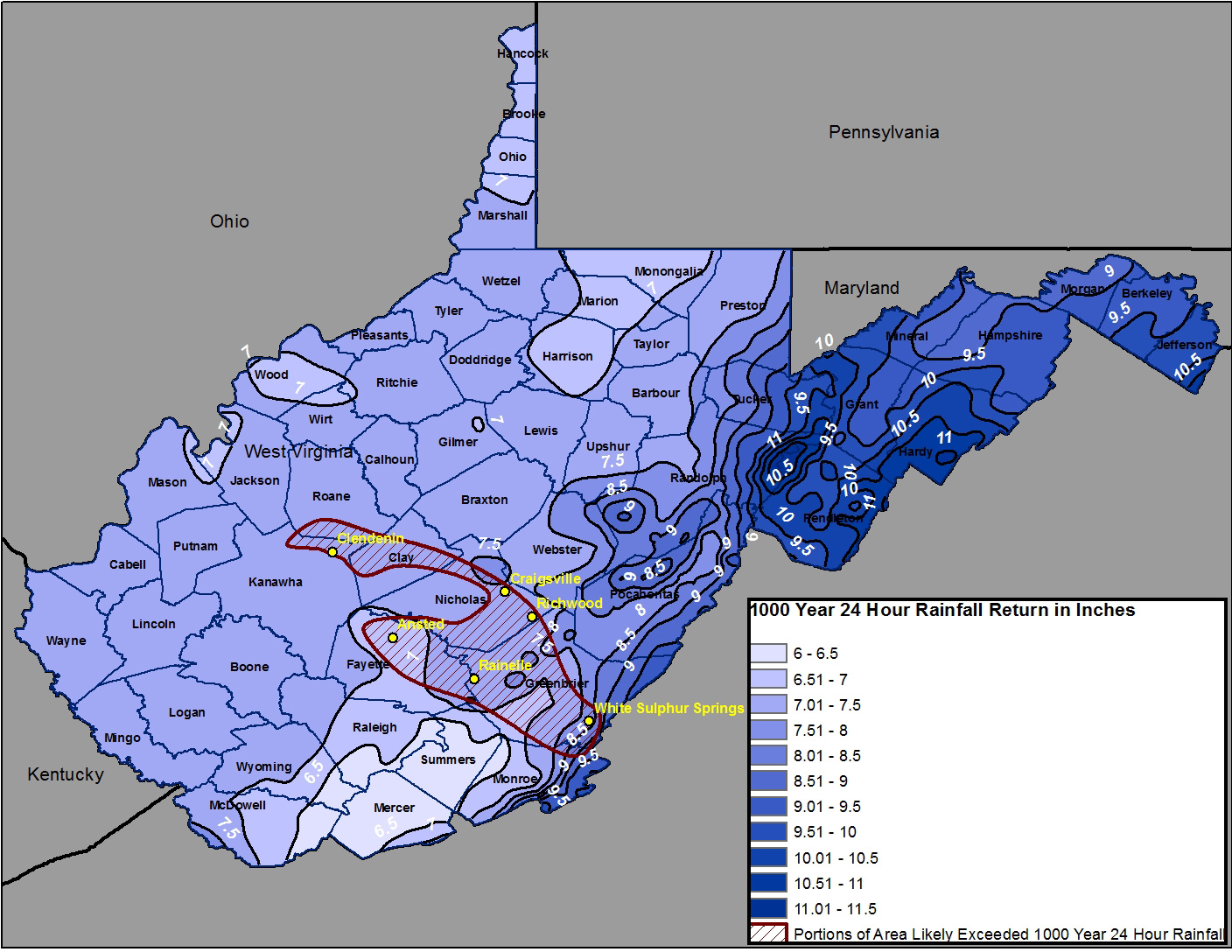
Based on the fixed "day" used by forecasters, the National Weather Service said that 24-hour rainfall amounts in parts of Fayette, Nicholas, and Greenbrier Counties were a “thousand-year event,” meaning there is only a 0.1% chance of an event of this magnitude happening in any given year (stick around for a follow-up post which explains how—given that we don’t have a thousand years of rainfall observations—weather experts make these estimates.) An analysis by Nick Webb, a meteorologist with the Charleston, WV, forecast office, based on the 24-hour period spanning the event, concluded that thousand-year 24-hour rainfall totals were also likely exceeded in parts of Kanawha, Roane, and Clay counties.
The 24-hour rainfall totals that history and statistics indicate would only happen, on average, once every thousand years. According to analysis from National Weather Service meterologists, 24-hour rainfall amounts in parts of Kanawha, Roane (north of Kanawha, not labelled), Clay (east of Kanawha), Fayette, Nicholas, and Greenbrier Counties likely exceeded the 1-in-1,000-year return amounts. NOAA Climate.gov, based on NOAA Atlas 14 data.
As the water rushed into streams and rivers, waters began to rise rapidly. The Elk River at Queens Shoals, West Virginia, rose to over 33 feet, breaking the previous high water record set in 1888. Record or near-record crests also occurred at stations on the Gauley, Meadow, Cranberry, Greenbrier, and New Rivers.
Normally tranquil rivers turned into a violent mash-up of water and whatever else had washed into the streams. In addition to the terrible loss of life, property damage was enormous: bridges and roads washed out, houses destroyed, whole towns inundated.
Aerial footage of flooding in the Greenbrier County town of Rainelle, WV, on June 24, the day after the 1-in-1000 year rainfall event. Video produced by Rob Atha, Elevated Media. Used by Climate.gov with permission. See full length video here.
Where this page came from
This page was imported from NOAA Climate.gov. Published by NOAA Climate.gov, which lets anything credited to it be re-used with attribution; material credited to others is left out.
Nobody has written it yet — it is the source material at a new address, which is why search engines are asked to skip it and why no one earns from it. It is up for grabs: take it on, and it is yours to rewrite and to earn from.
Licenza: CC0 1.0 (pubblico dominio) · Tratto da www.climate.gov
1
0
0
0

Commenti