
ノードのコンテンツを改善したいですか? 編集リクエストを行ってみてください。
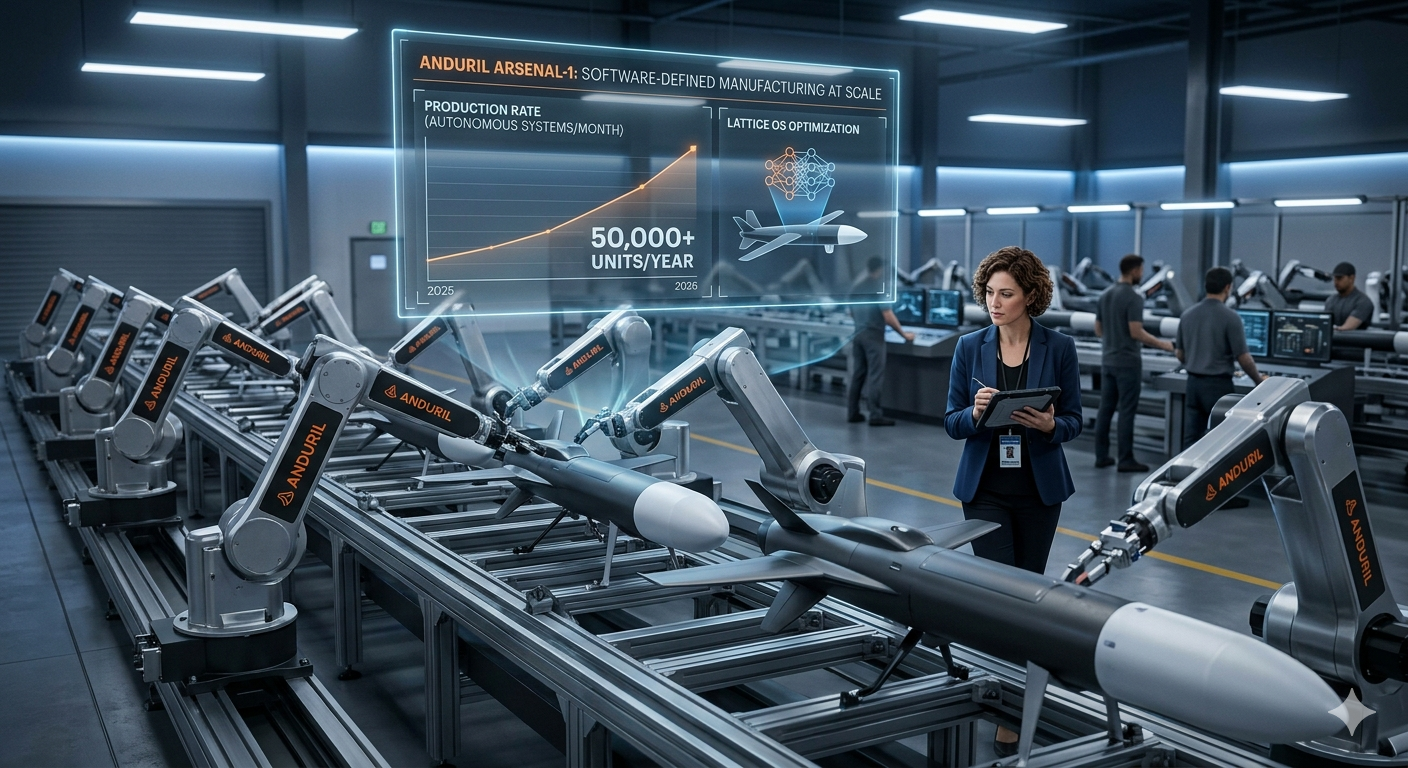
On May 13, 2026, the technology sector’s focal point shifted from generative consumer AI to the industrialization of defense technology. Anduril Industries announced a landmark $5 billion funding round led by Thrive Capital and Andreessen Horowitz (a16z), doubling its valuation to $61 billion in just over a year. This capital injection marks a definitive transition in Silicon Valley’s role within the global defense apparatus. Unlike traditional defense contractors that rely on decades-long procurement cycles, Anduril is utilizing this capital to scale "Arsenal-1," its massive software-defined manufacturing facility in Ohio. The facility is designed to mass-produce autonomous systems—ranging from low-cost loitering munitions to advanced underwater drones—at a pace comparable to commercial automotive production. This news coincides with Anthropic’s push toward a $1 trillion valuation and Microsoft surpassing $30 billion in revenue from OpenAI-related infrastructure, signaling that the most significant returns in the current tech cycle are now flowing toward companies that can bridge the gap between AI software and physical, industrial-scale deployment. For tech leaders, this event underscores a "New Cold War" economy where the primary growth drivers are no longer just digital services, but the rapid, autonomous manufacturing of hardware essential to national security and infrastructure resilience.
The $5 billion investment in Anduril Industries represents more than a successful venture capital round; it is a structural realignment of how technology is valued and deployed in 2026. As the "software-only" era of AI matures, the market is aggressively pivoting toward companies that own the manufacturing and infrastructure layer.
The Arsenal-1 Paradigm: Moving Beyond Prototypes
The centerpiece of Anduril’s strategy is the "Arsenal" concept. For years, the U.S. defense industrial base has struggled with "exquisite" hardware—highly capable but prohibitively expensive systems produced in low volumes. Anduril’s Ohio-based Arsenal-1 factory disrupts this by applying "Silicon Valley speed" to the production line. The facility treats hardware as a vessel for Lattice, Anduril’s AI-powered operating system. By standardizing the components across various autonomous platforms, the company can produce thousands of units per month, a feat previously impossible for traditional aerospace firms. This "software-first" approach allows for rapid iterations; a drone’s capabilities can be overhauled via a firmware update in the morning and be on the production line by the afternoon.
Market Context: The Infrastructure Squeeze
The timing of this valuation surge is critical. Today’s broader tech landscape is defined by an intense competition for resources. As Microsoft reports generating over $30 billion from its OpenAI partnership, the bottleneck has shifted from "Who has the best model?" to "Who has the power and the factory to build the hardware?" Anduril’s $61 billion valuation reflects a market belief that defense tech is the ultimate "sink" for advanced AI. While consumer chatbots face regulatory headwinds and monetization fatigue, the demand for autonomous defense systems is effectively bottomless, driven by escalating geopolitical tensions and a global push for "sovereign AI" capabilities.
The Converging Ecosystem: Anthropic and Microsoft
To understand why Anduril’s news is today's most significant story, one must look at the surrounding ecosystem. Anthropic is currently nearing a $1 trillion valuation, driven by its dominance in enterprise-grade AI safety and coding. Simultaneously, Microsoft is navigating a stock slide as activist investors demand clearer paths to ROI on its massive infrastructure spending. Anduril provides that path by applying AI to a high-margin, mission-critical physical sector. It is the practical application of the scaling laws that have defined the last three years: if you have the compute (Microsoft/Anthropic), you must have the physical "edge" to deploy it (Anduril).
The Risks of Hyper-Scaling
Despite the optimism, the 2026 tech journalist must note the inherent risks. Anduril’s valuation is now larger than several established defense primes, yet it operates on a fraction of their historical revenue. The "Arsenal" strategy relies on a continuous supply of high-end semiconductors, a sector currently facing its own crisis. As TSMC and Tower Semiconductor report record-breaking demand for AI and photonic chips, Anduril’s ability to secure long-term supply contracts will be as vital as its ability to secure venture capital. Any disruption in the semiconductor supply chain—currently projected to see a 50% price spike in specialized components by year-end—could stall the very manufacturing lines Anduril is betting its $61 billion future on.
The End of the "Light" Tech Era
The ascent of Anduril to a $61 billion powerhouse signals the end of "asset-light" technology dominance. In 2026, the companies leading the narrative are those that build factories, secure energy grids, and manufacture the physical infrastructure of the future. Whether it is Google exploring orbital data centers with SpaceX or Anduril building autonomous swarms in Ohio, the most significant tech stories of today are no longer found in the cloud—they are found on the factory floor and the tactical edge.
1
0
0
0

コメント