
Cultural Continuity at the Robinson House Site

Mancala gaming pieces from Manassas National Battlefield Park NPS
Artifacts found at the Robinson House site indicate that the Robinson family retained a portion of their African identity. Mancala gaming pieces excavated from the site are typically small, diamond-shaped objects fashioned out of broken ceramic and glass sherds. Mancala, derived from the Arabic word manqala meaning, "to move," is documented as one of the most widely distributed board games in the world. Different versions of the game have been found in the Near East, Egypt, West Africa, and the Caribbean. Also called Adi, Adji, Awale, Awele, Awari, Ayo, Ayo-ayo, Gepeta, Ourin, Ourri, Oware, or Wari, the game is played by distributing gaming pieces into holes or cups. Approximately two dozen gaming pieces were found in areas around the house foundation ruins and in the backyard.
Mathematicians who study games often call the Mancala family "sowing games." Instead of using pebbles or seeds, the Robinson and Nash families used pieces of broken ceramics and glass. The ceramic sherds shown in the photo are smoothed and worn around the edges from years of play.
Cultural Continuity at the Nash Site
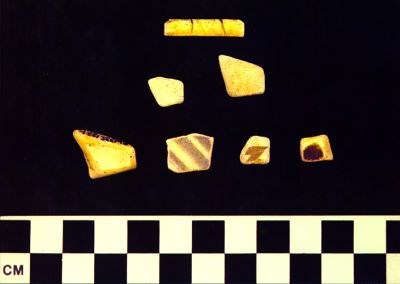
Mancala gaming pieces in the middle row and far right, bottom row were found at the Nash site. NPS
Mancala gaming pieces were also found at the Nash site. In addition, the discovery of quartz crystals may suggest that the Nash family practiced a traditional African religion. A cache of six quartz crystals which included a lump of the mineral galena (not available locally) and a quartz projectile point may have served a ritualistic purpose. Quartz crystals were also found in African-American contexts in Virginia at Thomas Jefferson’s boyhood home, Poplar Forest, and at the Charles Carroll House in Annapolis, Maryland.
Part of a series of articles titled
African American Households.
Previous:
Finding Identity Through Material Culture: The Nash Site
Where this belongs
- Manassas National Battlefield Park
Where this page came from
This page was imported from National Park Service. Produced by the U.S. National Park Service and, as a work of the United States government, in the public domain.
Nobody has written it yet — it is the source material at a new address, which is why search engines are asked to skip it and why no one earns from it. It is up for grabs: take it on, and it is yours to rewrite and to earn from.
このページを含むコレクションManassas National Battlefield Park
ライセンス: CC0 1.0(パブリックドメイン) · 出典 www.nps.gov
1
0
0
0

コメント
次に読む


