
Dwight Eisenhower spent more than thirty years moving from post to post in the Army, and through all of it he pictured, as he wrote to his wife Mamie in 1943, "a little place far away from cities." In 1950 they found it: a farm outside Gettysburg, Pennsylvania. He wanted to "leave the place better than [he] found it" — and the soil records say he did.
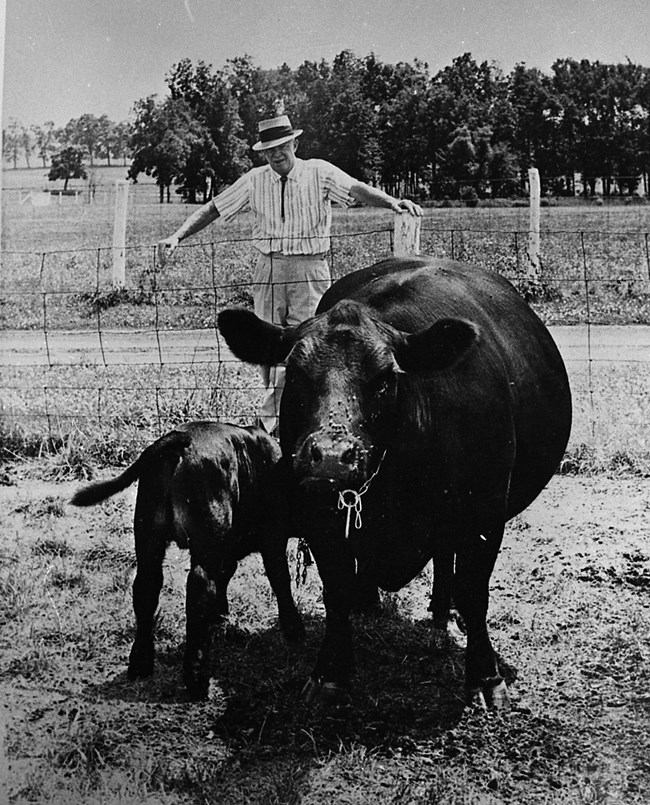
Eisenhower tending his cattle at the Gettysburg farm. Eisenhower National Historic Site
What they bought
The farm, near the home of their friends George and Mary Allen, came with 189 acres, a house, a barn, outbuildings, machinery and livestock — about 25 Holstein cows, a dozen heifers and 500 White Leghorn chickens. Eisenhower meant to carry on the dairy and poultry business of the previous owners, the Redding family, and to restore the worn-out soil.
He barely had time to start. A few weeks after the purchase, President Harry Truman asked him to become Supreme Commander of NATO. Eisenhower accepted and put an old friend, General Arthur Nevins, in charge. Arthur and Ann Nevins moved into the house in April 1951 and ran the farm with hired hands, while Eisenhower followed it by letter from Europe and later from the White House. In September 1951 he wrote to Nevins that he and Mamie often talked about the day they would finally settle there.
Once he was president, privacy became a concern. Between 1954 and 1955 his friend W. Alton Jones, president of Cities Service Company (later CITGO), bought more than 300 acres around the farm — land that would matter for what came next.
From dairy to Angus
| Year | What changed |
|---|---|
| 1950 | farm bought: dairy herd and laying hens |
| 1951 | Arthur Nevins takes over as manager |
| 1954 | dairy herd sold; first Aberdeen Angus bought |
| 1956 | the prize bull Ankonian 3551 bought from Ankony Farms, New York |
| 1957 | a show barn built on land Jones had bought |
| 1966 | breeding ends; the herd sells for about $90,000 |
| 1969 | Eisenhower dies |
Dairy farming wore everyone out. The cows had to be milked morning and evening, the hours were long, and Nevins struggled to keep farmhands. The chickens were a great deal of work for little money, and neither man liked them much. So in 1954 they switched to breeding beef cattle, and aimed high. Ankonian 3551 became the farm's most prized bull and sired many of its animals. A head herdsman, Bob Hartley, ran the daily care of the show herd, supervised the hands, chose animals for shows and travelled with them. The herd won ribbons from Grand Champion prizes at the Pennsylvania Farm Show to a Junior Champion award at the International Stock Show in Chicago.
A gentleman farmer
Eisenhower did not work the fields himself; farming was his hobby, not his living. But it was his biggest hobby — his escape from the presidency — and he followed the operation closely and liked to try the latest methods. The farm grew corn, barley, oats and hay to feed the cattle.
His real passion was the soil. Years of heavy corn growing had drained it, and he was willing to spend time and money to bring it back:
- he sent soil samples to the Soil Conservation Service every year and followed its advice on what to add;
- he rotated crops to put nutrients back;
- he ploughed along the contours of the land to stop erosion.
Leaving it better
By 1966 his health was failing and farm labour was scarce and expensive, so the breeding herd was sold; Hartley retired soon after. When Eisenhower died in 1969, the land really was in better shape than when he bought it. Today it is Eisenhower National Historic Site, and the Park Service leases the fields to local farmers, who keep them working.
Sources
Written from "General Eisenhower's Gettysburg Farm," Eisenhower National Historic Site, National Park Service; a work of the United States government in the public domain. Quotations are from Eisenhower's letters, as cited there.
このページを含むコレクションEisenhower National Historic SiteDwight D. Eisenhower Memorial
ライセンス: CC0 1.0(パブリックドメイン) · 出典 www.nps.gov
1
0
0
0

コメント
次に読む


