このページは公開されています。
A star's mass, how much material it holds, is one of the most important things to know about it: it tells astronomers roughly how long the star will shine and how it will end. Yet mass is very hard to measure directly. There is no cosmic scale to put a star on. Fortunately, not every star lives alone as the Sun does. About half of all stars are binary stars, two stars bound by gravity and orbiting each other, and their orbits reveal their masses, just as the planets' orbits reveal the Sun's.
Stars in pairs
The first binary was found in 1650, when the Italian astronomer John Baptiste Riccioli saw through his telescope that Mizar, in the middle of the Big Dipper's handle, was two stars. Thousands have been catalogued since, along with triple and quadruple systems. Not every pair that looks close is a true binary, though: a double star can be a chance alignment of stars at very different distances.
By 1804 William Herschel, who also discovered Uranus, noticed that the fainter member of Castor in Gemini had shifted relative to the brighter one. One star was moving around the other, the first evidence that gravity acts beyond the solar system. A pair in which both stars can be seen through a telescope is a visual binary. Using observations of such a pair, an international team later measured the mass of an ultra-cool brown dwarf directly for the first time: barely the size of Jupiter, it has 8.5% of the Sun's mass.
In 1889 Edward C. Pickering at Harvard found a second kind. The dark lines in the spectrum of Mizar's brighter star were usually double, the gap between them kept changing, and sometimes they merged. He deduced that this star, Mizar A, is itself two stars circling each other every 104 days. A star that looks single even through a telescope but shows its double nature in its spectrum is a spectroscopic binary. Mizar, it turns out, is four stars: Mizar A and Mizar B, each a spectroscopic binary, orbiting each other, with the naked-eye star Alcor nearby as an optical double that does not orbit them.
The balance point
Strictly, one star does not orbit the other. Gravity pulls both ways, so both stars orbit a point between them, the center of mass. Picture them at the ends of a seesaw: the pivot that balances it sits closer to the heavier star.
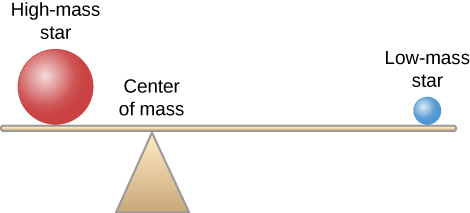
Both stars orbit their center of mass, which lies nearer the more massive star. Illustration from OpenStax, Astronomy (CC BY 4.0).
When one star swings toward us, the other moves away. The Doppler effect shifts the first star's spectral lines toward blue and the second's toward red, so a line in the combined spectrum splits in two. When both stars move across our line of sight, neither approaching nor receding, their lines come back together.
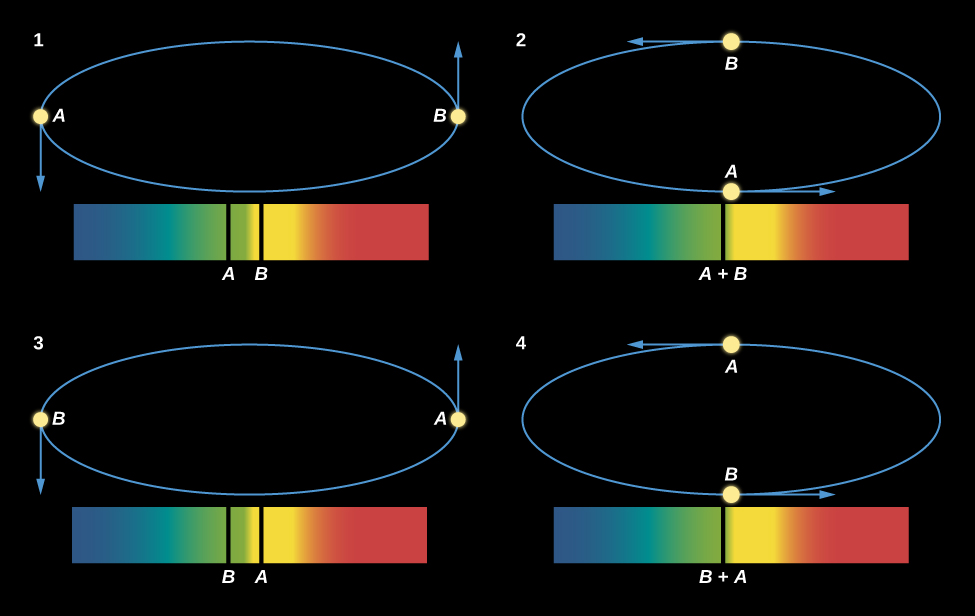
As the stars orbit, their spectral lines separate and merge. Illustration from OpenStax, Astronomy (CC BY 4.0).
A plot of the stars' velocities over time is a radial velocity curve.
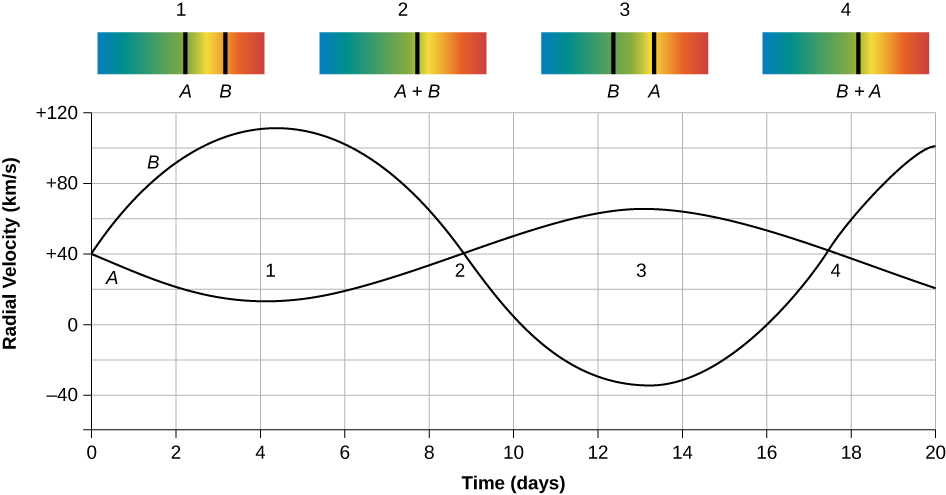
Radial velocity curves of the two stars in a spectroscopic binary. Positive velocity means moving away; the whole system is receding at 40 kilometers per second. Illustration from OpenStax, Astronomy (CC BY 4.0).
Weighing a pair
Newton's form of Kepler's third law links the period of a pair's mutual orbit, P, in years, to the size of the orbit, the semimajor axis D, in astronomical units (AU), through the sum of the two masses in units of the Sun's mass:
D^3 = (M_1 + M_2)\,P^2So if the size of the orbit and the period can be measured, the total mass follows. Most spectroscopic binaries orbit in a few days to a few months, less than 1 AU apart, far too close to see as two stars at stellar distances. The radial velocity curve still gives their speeds and period, and from those the size of the orbit. The split between the two stars comes from their speeds: the heavier star, closer to the center of mass, travels a smaller orbit in the same time and so moves more slowly. With the orbit's tilt to our line of sight also known, each star's mass can be worked out. Because the method rests only on gravity, it works as well 100 light-years away as next door, and such measurements are the foundation of the theory of how stars evolve.
Sirius is an example. It and its faint companion are about 20 AU apart and orbit every 50 years, so:
M_1 + M_2 = \frac{20^3}{50^2} = \frac{8000}{2500} = 3.2The two stars together have 3.2 times the Sun's mass.
How heavy, how light
Stars heavier than the Sun are rare. None within 30 light-years of the Sun has more than four times its mass. Distant searches have found a few of about 100 solar masses, and perhaps a handful, a few among several billion, as heavy as 250. Most stars are lighter than the Sun.
Theory puts the smallest true star, one hot enough to fuse protons into helium, at about 1/12 of the Sun's mass. Objects between about 1/100 and 1/12 of a solar mass may fuse deuterium for a while but never protons. These are brown dwarfs, about Jupiter's size but 13 to 80 times its mass; exactly where planets end and brown dwarfs begin is still debated. Below about 1/100 of the Sun's mass, or 10 Jupiter masses, are planets, which may glow with heat from radioactivity or slow contraction but never host nuclear reactions. Jupiter, at about 1/1000 of the Sun's mass, is unquestionably a planet.
Brighter means heavier
With many masses measured, a pattern appears: for most stars, the more massive, the more luminous. This is the mass–luminosity relation. Luminosity goes roughly as the mass to the power 3.9, and it is a fair approximation to call it the fourth power. A star with twice another's mass is about 16 times brighter; one with a third of another's mass is about 81 times fainter.
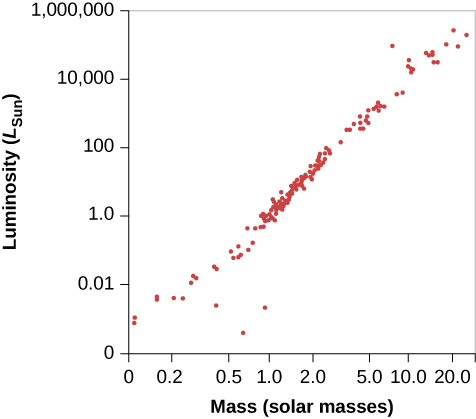
The mass–luminosity relation. The three points below the line are white dwarfs. Illustration from OpenStax, Astronomy (CC BY 4.0).
Turned around, the relation gives a mass from a brightness. Sirius is 23 times as luminous as the Sun, so its mass is the fourth root of 23, about 2.2 solar masses, which leaves 3.2 − 2.2 = 1.0 solar mass for its companion. About 90% of stars follow the relation; the roughly 10% that do not have their own story to tell.
Sources
- Andrew Fraknoi, David Morrison and Sidney C. Wolff, Astronomy, "Measuring Stellar Masses", OpenStax (Rice University), licensed under CC BY 4.0. Changed: rewritten in hubnx's own words and shortened, the worked example folded into the text, and figures credited to other institutions not reproduced; the illustrations are the book's. This page is shared under the same licence.
このページを含むマガジンAstronomy (OpenStax)
ライセンス: CC BY 4.0 · 出典 openstax.org
コメント