
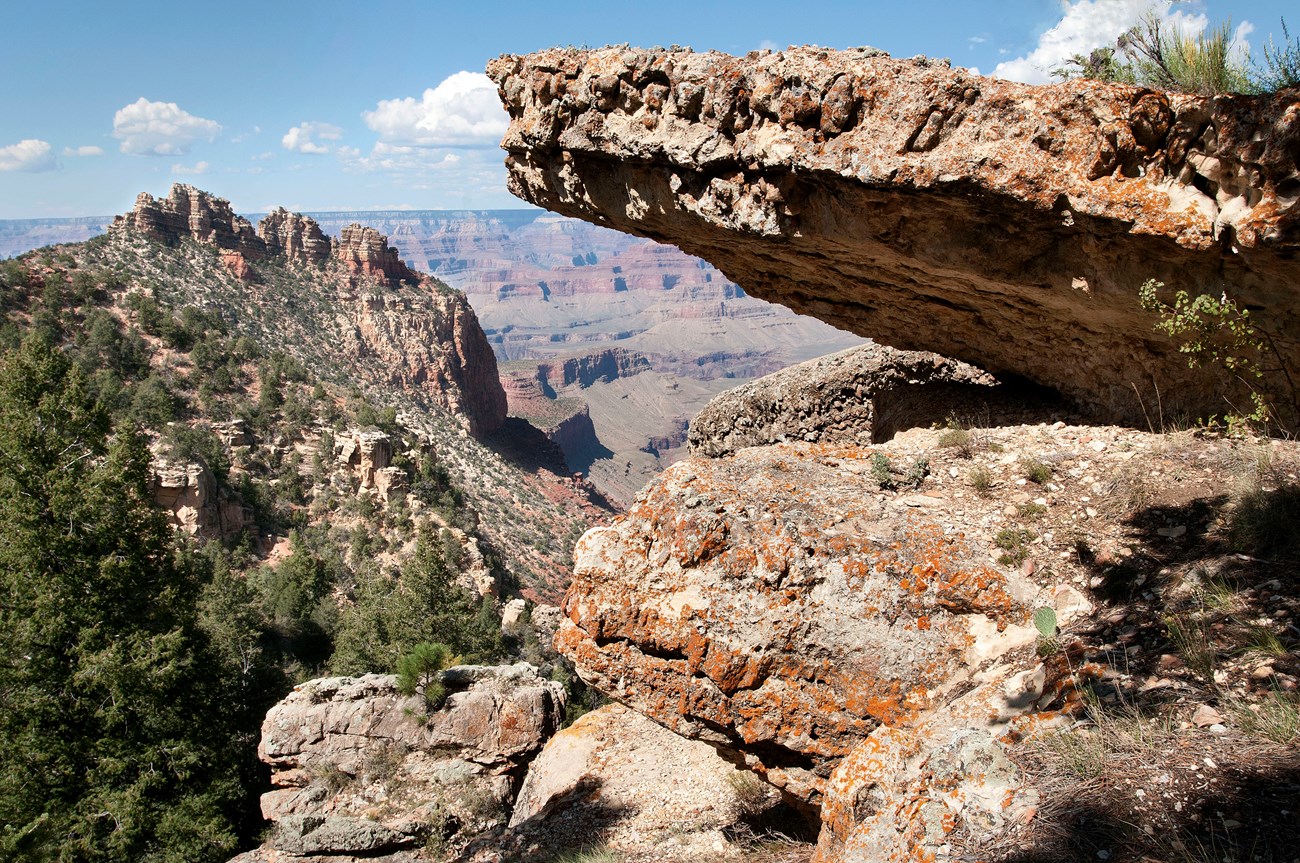
The Kaibab Formation, the canyon's topmost layer, deposited about 270 million years ago in the Early Middle Permian. Photo: NPS.
Why a number matters
Telling most people that the Kaibab Formation is Permian — let alone naming a fossil stage — means little. Telling them it is 270 million years old makes sense at once. So numeric ages are essential for explaining geology, to the public and among geologists.
Yet good numbers are hard to find. Some studies give only a rock's stratigraphic age or broad era or period; papers with radiometric dates don't always say what a date actually means geologically; and popular and technical sources quote conflicting ages, some out of date. This compilation, from the NPS report Telling Time at Grand Canyon National Park: 2020 Update, offers one consistent list of best ages. They are still approximations — limited by dating methods, by how much datable material or fossils a unit holds, and by the geology itself — and will be revised as research moves on.
The best ages
Ma: millions of years ago.
| Rock set | Unit | Stratigraphic age | Age (Ma) |
|---|---|---|---|
| Layered Paleozoic rocks | Kaibab Formation | Early Middle Permian | 270 |
| Toroweap Formation | Late Early Permian | 275 | |
| Coconino Sandstone | Early Permian | 280 | |
| Hermit Formation | Early Permian | 285 | |
| Supai Group: Esplanade Sandstone | Early Permian | 290 | |
| Supai Group: Wescogame Formation | Late Pennsylvanian | 300 | |
| Supai Group: Manakacha Formation | Early Pennsylvanian | 315 | |
| Supai Group: Watahomigi Formation | Early Pennsylvanian | 320 | |
| Surprise Canyon Formation | Late Mississippian | 325 | |
| Redwall Limestone | Late Early–Middle Mississippian | 340 | |
| Temple Butte Formation | Middle–Late Devonian | 385 | |
| Tonto Group: Frenchman Mountain Dolostone | Late Middle Cambrian | 500 | |
| Tonto Group: Muav Formation | Late Middle Cambrian | 504 | |
| Tonto Group: Bright Angel Formation | Middle Cambrian | 506 | |
| Tonto Group: Tapeats Sandstone | Middle Cambrian | 508 | |
| Sixtymile Formation | Early Middle Cambrian | 510 | |
| Grand Canyon Supergroup | Chuar Group: Kwagunt Formation (Walcott, Awatubi, Carbon Butte, Duppa Members) | Neoproterozoic | 729–755 |
| Chuar Group: Galeros Formation (Carbon Canyon, Jupiter, Tanner Members) | Neoproterozoic | 757–770 | |
| Nankoweap Formation | Mesoproterozoic | 775 | |
| Unkar Group: Cardenas Basalt | Mesoproterozoic | 1,082 | |
| Unkar Group: Dox Formation | Mesoproterozoic | 1,120 | |
| Unkar Group: Shinumo Sandstone | Mesoproterozoic | 1,130 | |
| Unkar Group: Hakatai Shale | Mesoproterozoic | 1,230 | |
| Unkar Group: Bass Formation, with its Hotauta Conglomerate Member | Mesoproterozoic | 1,255 | |
| Vishnu basement rocks | Quartermaster granite (youngest granite) | Mesoproterozoic | 1,375 |
| Phantom granite | Paleoproterozoic | 1,662 | |
| Cremation pegmatite | Paleoproterozoic | 1,698 | |
| Zoroaster Plutonic Complex: Horn Creek granite, Ruby gabbro, Trinity granite, Diamond Creek granite, Zoroaster granite | Paleoproterozoic | 1,713–1,740 | |
| Granite Gorge Metamorphic Suite: Vishnu and Brahma Schists; Rama Schist | Paleoproterozoic | 1,750; 1,751 | |
| Elves Chasm pluton (oldest basement) | Paleoproterozoic | 1,840 |
Member-by-member ages for the Chuar Group: Walcott 729, Awatubi 750, Carbon Butte 753, Duppa 755, Carbon Canyon 757, Jupiter 765, Tanner 770. Zoroaster complex: Horn Creek 1,713, Ruby 1,716, Trinity 1,730, Diamond Creek 1,736, Zoroaster 1,740.
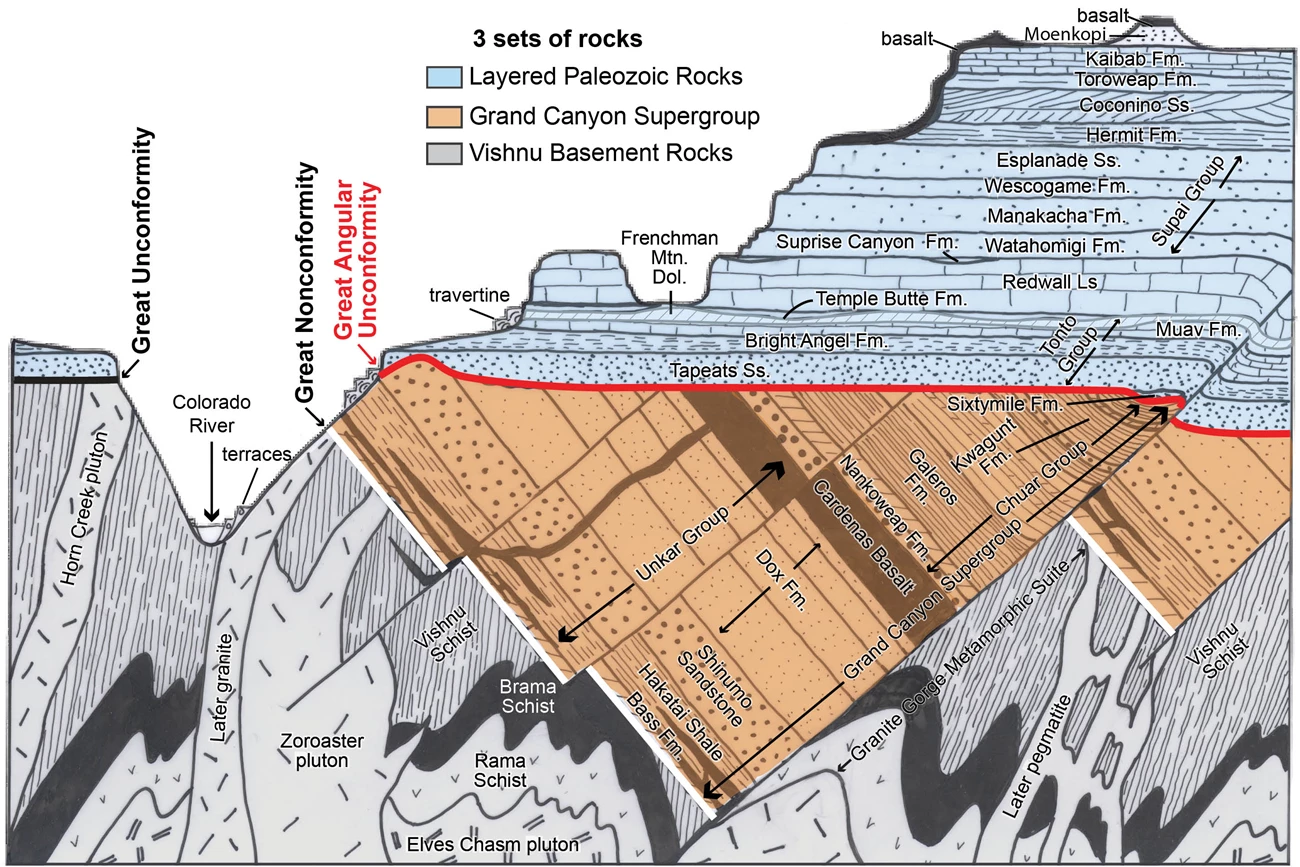
The canyon's three sets of rocks and its great unconformities: the Great Nonconformity (white line), the Great Angular Unconformity (red) and the Great Unconformity (black). Image from the National Park Service's page.
The three sets are described in their own articles: Vishnu basement rocks, the Grand Canyon Supergroup and the layered Paleozoic rocks.
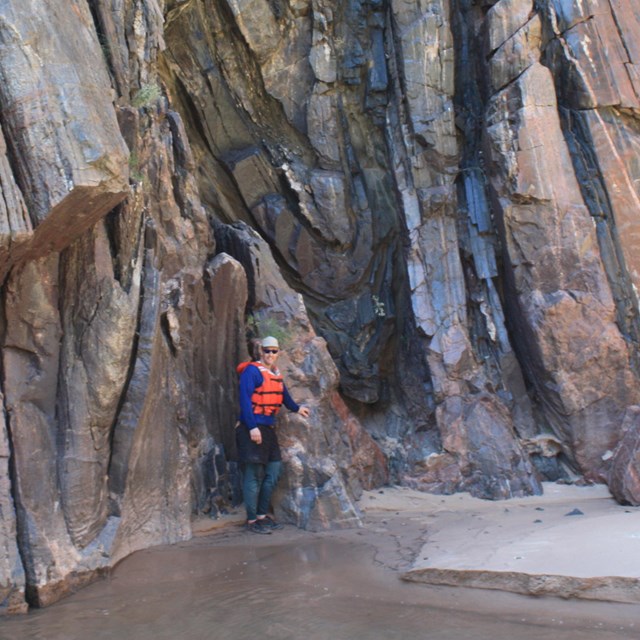
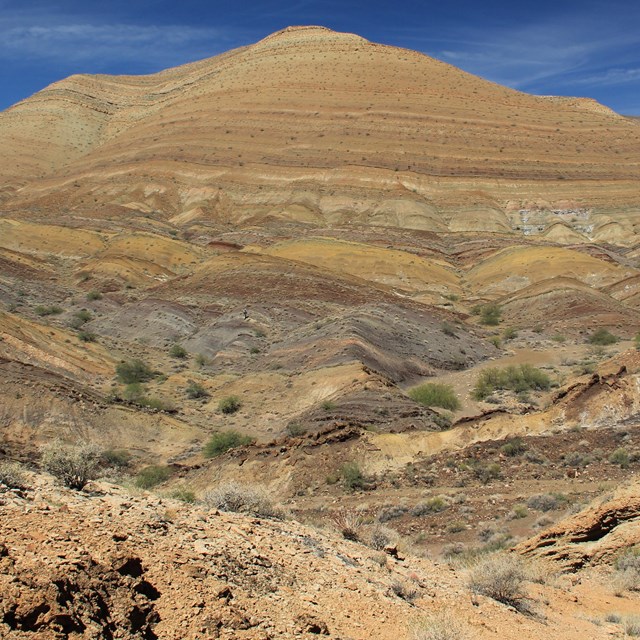
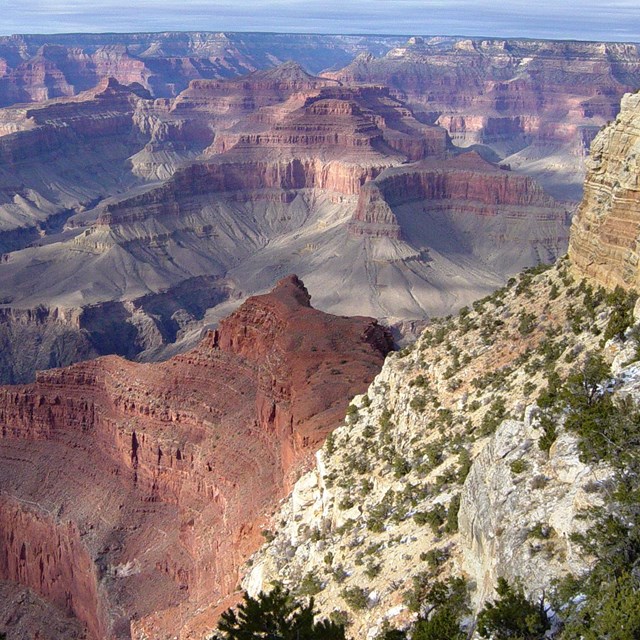
Vishnu basement rocks, the Grand Canyon Supergroup and the layered Paleozoic rocks. Images from the National Park Service's page.
What one date really means
The Elves Chasm pluton, at 1,840 Ma, is the oldest dated rock in the canyon. The date, from uranium-lead dating of zircon, is precise to about a million years: if the same grains were dated again and again, scientists are 95% sure the result would fall within a million years either way. Its accuracy also depends on what has happened to the rock since.
And the outcrops are complicated. Dark inclusions were engulfed by the main magma, so they are older, and dikes cut through both later. Strictly, only the main magma body crystallized 1,840 ± 1 million years ago.
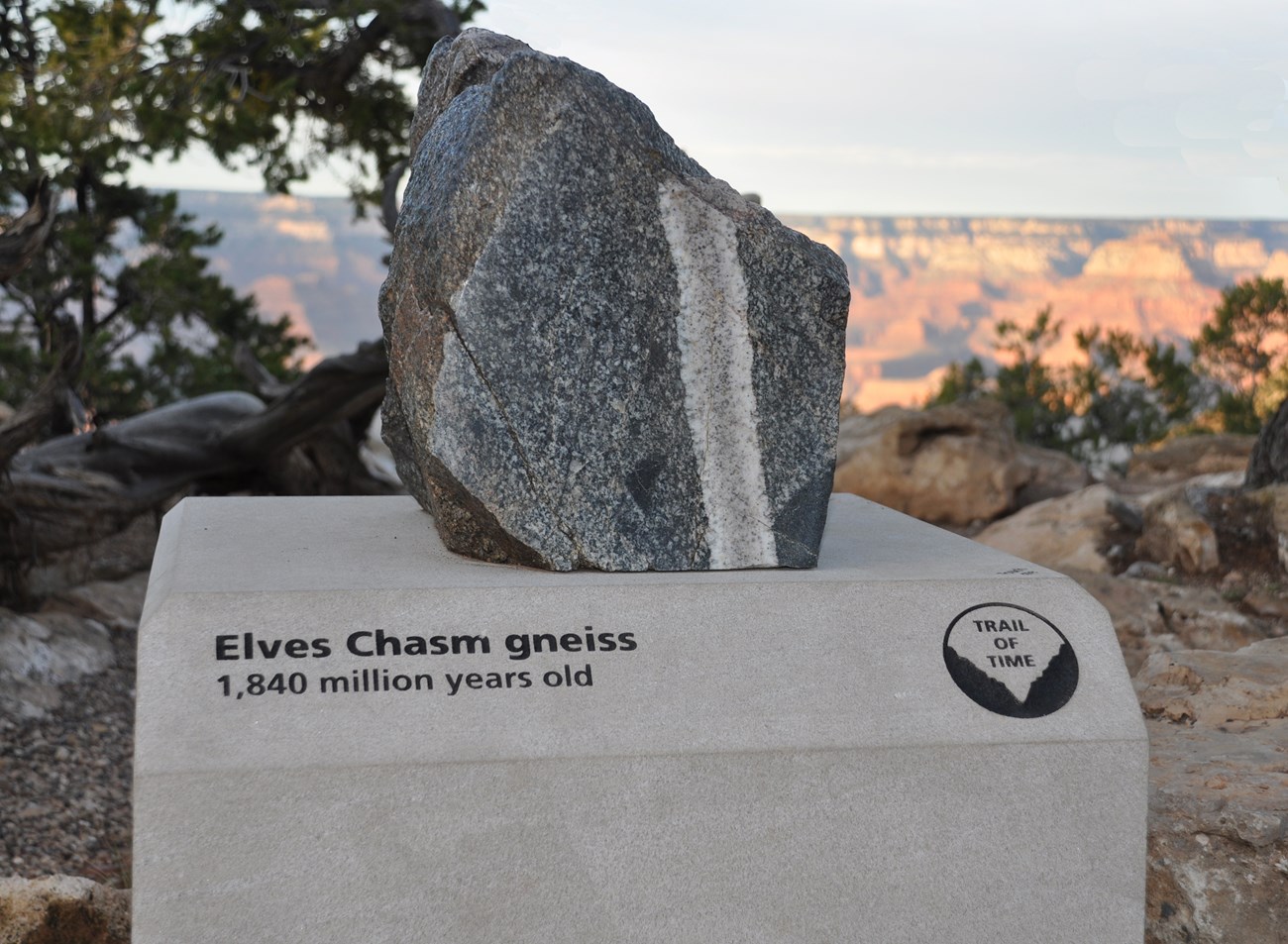
A specimen of the Elves Chasm pluton on the Trail of Time. Photo: NPS/Michael Quinn.
Dating sedimentary rocks
Sedimentary rocks usually built up over long spans of time, so a single number is not strictly right, though useful.
- The Bass Formation, laid down as lime mud in shallow seas, holds stromatolites, the oldest visible fossils in the canyon. Its best age, 1,255 ± 2 Ma, comes from uranium-lead dating of a volcanic ash bed within it.
- Fossil-rich rocks often have well-known stratigraphic ages but no numeric ones. The Redwall Limestone's fossils — crinoids, bryozoans, bivalves, snails — place it in the late Early to Middle Mississippian, about 340 million years old, though it too was deposited over a long time.
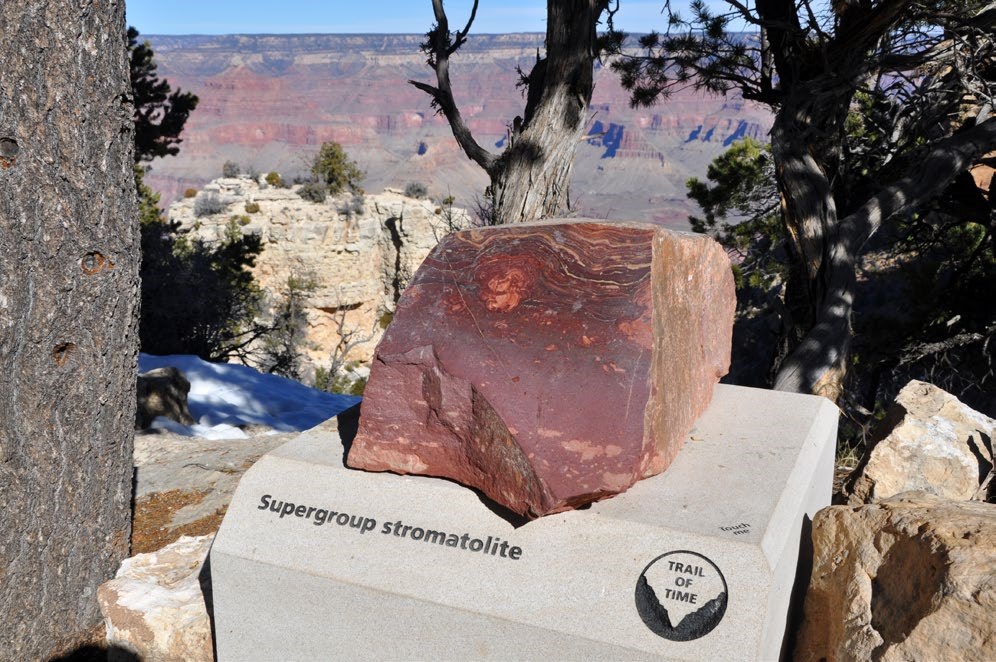
The Bass Formation on the Trail of Time. Photo: NPS/Michael Quinn.
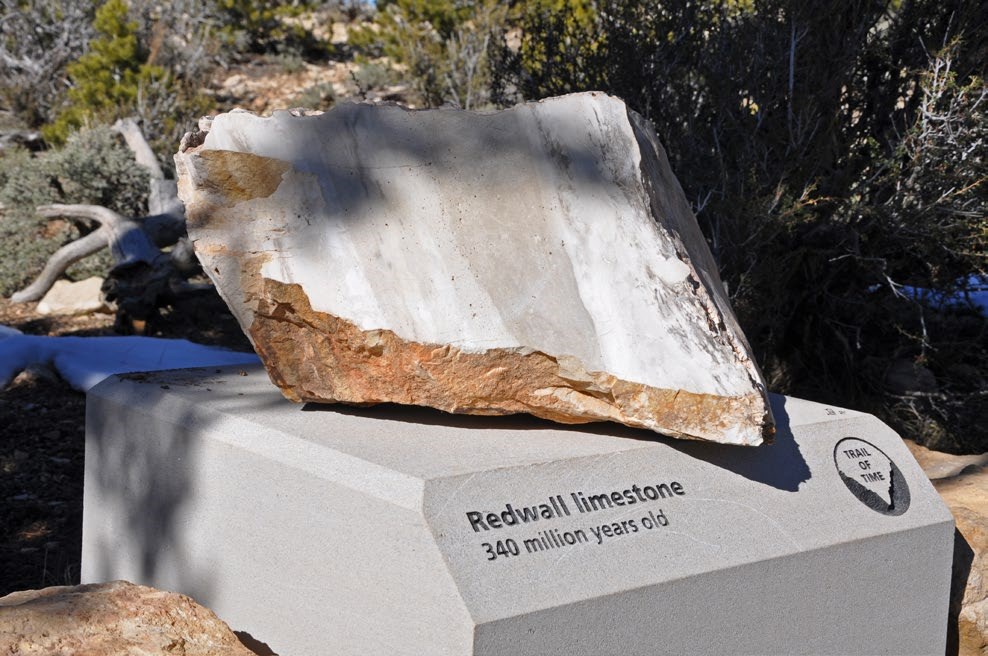
The Redwall Limestone on the Trail of Time. Photo: NPS/Michael Quinn.
The Trail of Time
The Trail of Time is a geologic timeline along the Rim Trail on the South Rim, from the Yavapai Geology Museum to Grand Canyon Village, with spectacular views, interpretive panels and rock samples to see and touch — an easy family walk. Its theme runs in a cycle: rock captures time, time carves canyon, canyon reveals rock.
- Bronze markers every meter — one long step — stand for a million years, so the 2,000 steps from the museum to the village span the last 2 billion years, the whole of the canyon's rock record.
- Rock specimens collected along the river sit at their "birthday" on the timeline.
- The Early Earth Trail continues to Maricopa Point and the age of the Earth, 4,560 million years.
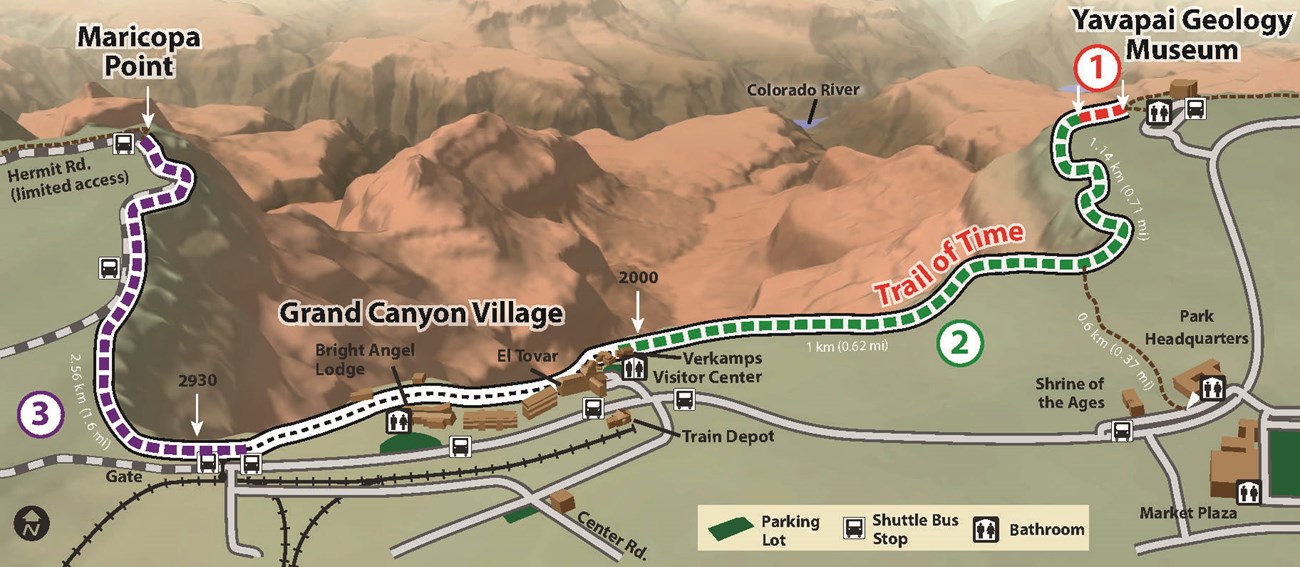
The Trail of Time from Yavapai Geology Museum to Grand Canyon Village and Maricopa Point: (1) Million Year Trail, (2) main Trail of Time, (3) Early Earth Trail. Image from the National Park Service's page.
Funded by the National Science Foundation with support from the park, the trail opened in 2010, the product of 25 years of research on the canyon's geology, and it still links new research with geoscience education. A book and walking guide, the Grand Canyon Trail of Time Companion, followed in 2019.
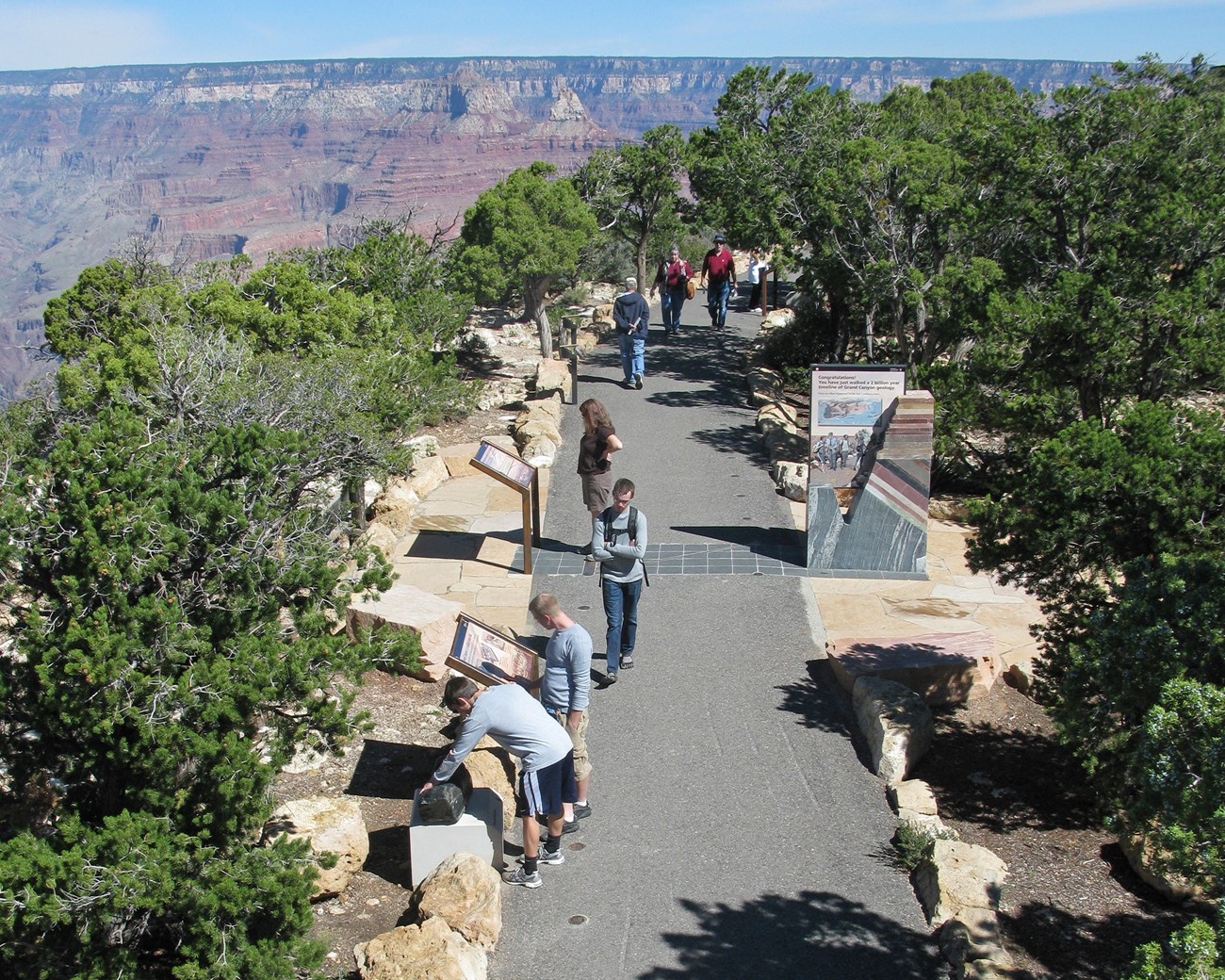
Visitors near the "time zero" portal on the main Trail of Time. Photo: NPS/Michael Quinn.
Earlier compilations
The first systematic list of best ages appeared in 2005 in the park's Nature Notes, compiled by consulting the geoscientists working on the canyon. It was republished in Park Science and the Boatman's Quarterly Review, used in park publications and ranger programs, and has now been superseded by the 2020 update.
Sources
Based on "Numeric Ages of Grand Canyon Rocks," part of the Telling Time at Grand Canyon series, National Park Service, adapted from Karlstrom K, Crossey L, Mathis A and Bowman C, Telling Time at Grand Canyon National Park: 2020 Update, Natural Resource Report NPS/GRCA/NRR—2021/2246 (doi.org/10.36967/nrr-2285173); rewritten in hubnx's own words. The ages are as published. Sketches credited to Karl Karlstrom and Stan Beus are not reproduced.
このページを含むマガジンGrand Canyon National ParkTelling Time at Grand Canyon National Park
ライセンス: CC0 1.0(パブリックドメイン) · 出典 www.nps.gov
1
0
0
0

コメント


