このページは公開されています。
The largest database of organic compounds lists about 10 million substances, and one estimate puts the number of possible organic compounds at 10⁶⁰. The reason is carbon: each carbon atom can form up to four strong bonds, including to other carbon atoms, so it builds chains and rings of almost any size and shape.
The simplest of these compounds contain only carbon and hydrogen — the hydrocarbons. Even with two elements they come in endless variety: chains of any length, branched chains, rings, and different kinds of carbon–carbon bonds. Many come from plants, animals and their fossils; others are made in the laboratory. We use them every day, mostly as fuels — natural gas, acetylene, propane, butane, gasoline — and as the raw material of plastics.
Four families
| Family | Carbon–carbon bonds | Simplest member | Typical reaction |
|---|---|---|---|
| Alkanes (saturated) | single bonds only; each carbon bonded to four atoms | methane, CH₄ | combustion; substitution |
| Alkenes (unsaturated) | at least one double bond | ethene (ethylene), C₂H₄ | addition |
| Alkynes (unsaturated) | at least one triple bond | ethyne (acetylene), C₂H₂ | addition, even more readily |
| Aromatics | a ring with shared (delocalized) bonding | benzene, C₆H₆ | substitution |
Alkanes: fuels
In an alkane every carbon has four single bonds, and the bonds are angled — so a "straight" chain like pentane is really a zigzag, whatever a flat diagram suggests. Chains that do not close into rings all follow the formula CₙH₂ₙ₊₂, and as they grow longer the attraction between molecules grows too, so melting and boiling points rise smoothly.
Chemists draw them three ways: an expanded formula with every atom and bond, a condensed formula such as CH₃CH₂CH₃, and a skeletal structure, in which each end or bend of a line is a carbon and the hydrogens on carbon are left out.

Methane, ethane and pentane as Lewis structures, ball-and-stick and space-filling models. (Image: OpenStax, Chemistry, CC BY 4.0)
Alkanes are fairly stable, but heat or light starts reactions. The big one is combustion: alkanes burn in oxygen to carbon dioxide and water, releasing a great deal of heat, which is why they make excellent fuels. Natural gas is mainly methane; camping stoves and lighters burn butane; gasoline is a mixture of straight- and branched-chain alkanes of five to nine carbons, plus additives; kerosene, diesel and fuel oil are heavier alkanes. Most come from crude oil, separated by fractional distillation: oil heated to about 425 °C vaporizes at the base of a tower, and as the vapors rise and cool, fractions with different boiling points condense at different heights.

Fractional distillation of crude oil. Photo credit: modification of work by Luigi Chiesa. (Image: OpenStax, Chemistry, CC BY 4.0)
Alkanes also undergo substitution: a hydrogen is swapped for another atom, as when ethane and chlorine give chloroethane. The new C–Cl part is a functional group — the part of a molecule that gives it its particular reactivity, and the basis on which chemists classify organic compounds.
Same formula, different molecule
Two alkanes share the formula C₄H₁₀: n-butane, an unbranched chain, and 2-methylpropane (isobutane), which is branched. Molecules like these, with the same formula but atoms arranged differently, are structural isomers. Careful: drawings that look different can show the same molecule — a chain of four carbons bent on paper is still n-butane.
Naming them
The IUPAC system starts from the longest carbon chain — meth-, eth-, prop-, but-, then pent-, hex-, hept-, oct-, non- and dec- for 5 to 10 carbons — and adds substituents in front, in alphabetical order, each with the number of the carbon it sits on, counting from the end that gives the lowest numbers. Halogens take an -o ending (chloro-, bromo-); di-, tri- and tetra- count repeats. A branch that is an alkane missing one hydrogen is an alkyl group: methyl, ethyl and so on. So a four-carbon chain with chlorine on carbon 1 and bromine on carbon 2 is 2-bromo-1-chlorobutane, and a six-carbon chain with a two-carbon branch on carbon 3 is 3-ethylhexane.
Alkenes: a rigid double bond
A double bond — one σ bond and one π bond — changes a molecule's shape and properties. Ethylene (ethene) is the starting material of polyethylene: more than 135 million tons were produced worldwide in 2010, mostly by cracking long hydrocarbon chains in petroleum into smaller molecules. Alkenes are named like alkanes with -ene in place of -ane, numbered to give the double bond the lowest position.
Because atoms can rotate around a single bond but not around a double bond, some alkenes come in geometric isomers. In 2-butene the two methyl groups can sit on the same side of the double bond (cis) or on opposite sides (trans) — two molecules with different physical properties.
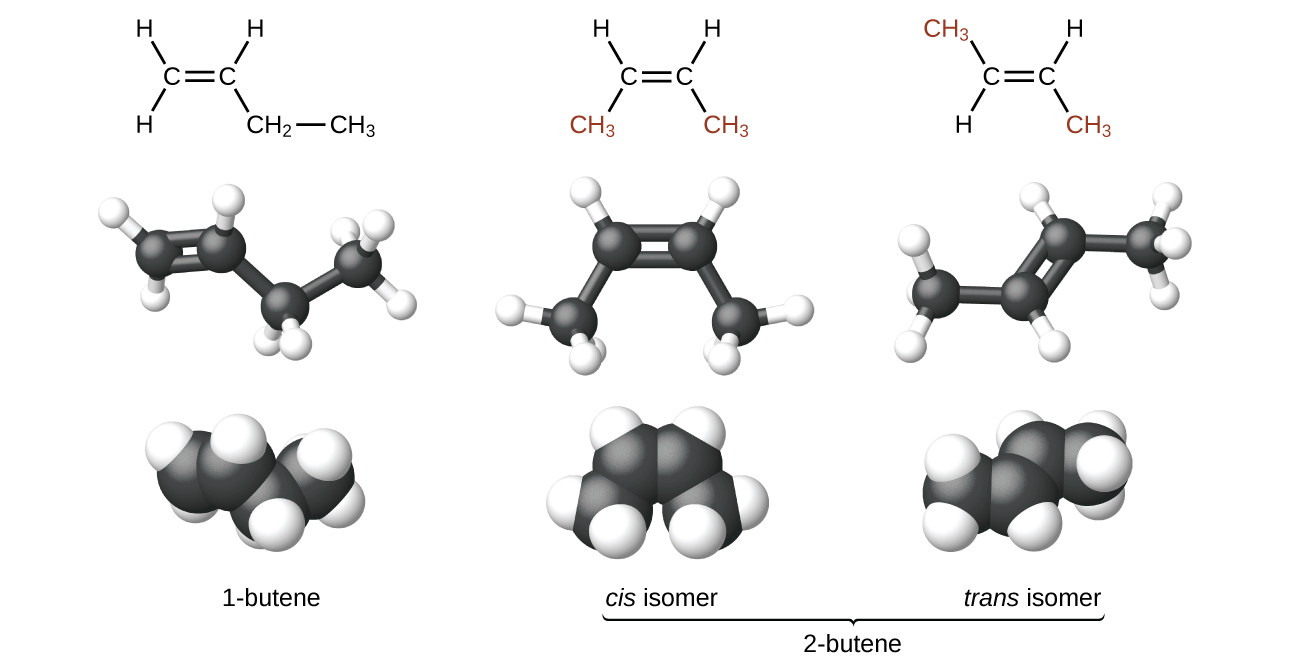
The isomers of butene, including cis- and trans-2-butene. (Image: OpenStax, Chemistry, CC BY 4.0)
The π bond is weaker and breaks easily, so alkenes are much more reactive than alkanes. Their characteristic reaction is addition: chlorine, for instance, adds across the double bond of ethene to give 1,2-dichloroethane instead of replacing a hydrogen.
Plastics and recycling
Polymers — "many parts" — are giant molecules of repeating units, or monomers. Some are natural, like starch and proteins; others are made, like polyethylene, PVC and polystyrene. With a transition-metal catalyst, ethylene gas polymerizes into long chains of –CH₂– units: polyethylene, used mainly for bags and films. Most monomers of common plastics come from petrochemicals and are not very biodegradable, which makes them good candidates for recycling: soft-drink bottles of polyethylene terephthalate can become furniture or carpet, and bags and food containers can be reprocessed. Recyclable plastics carry a numbered code to identify them, and recycling programs have run since the 1970s.
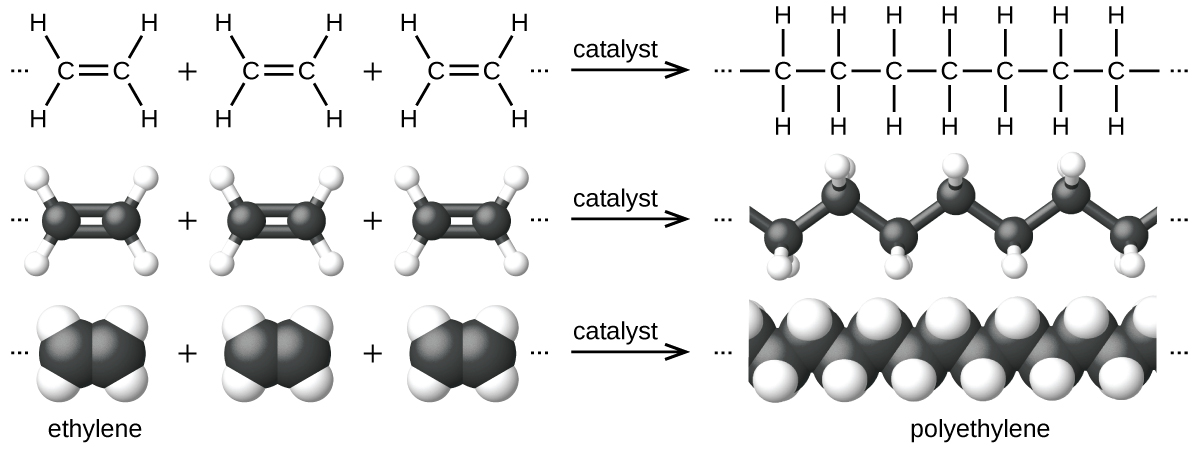
Ethylene monomers join into polyethylene. (Image: OpenStax, Chemistry, CC BY 4.0)
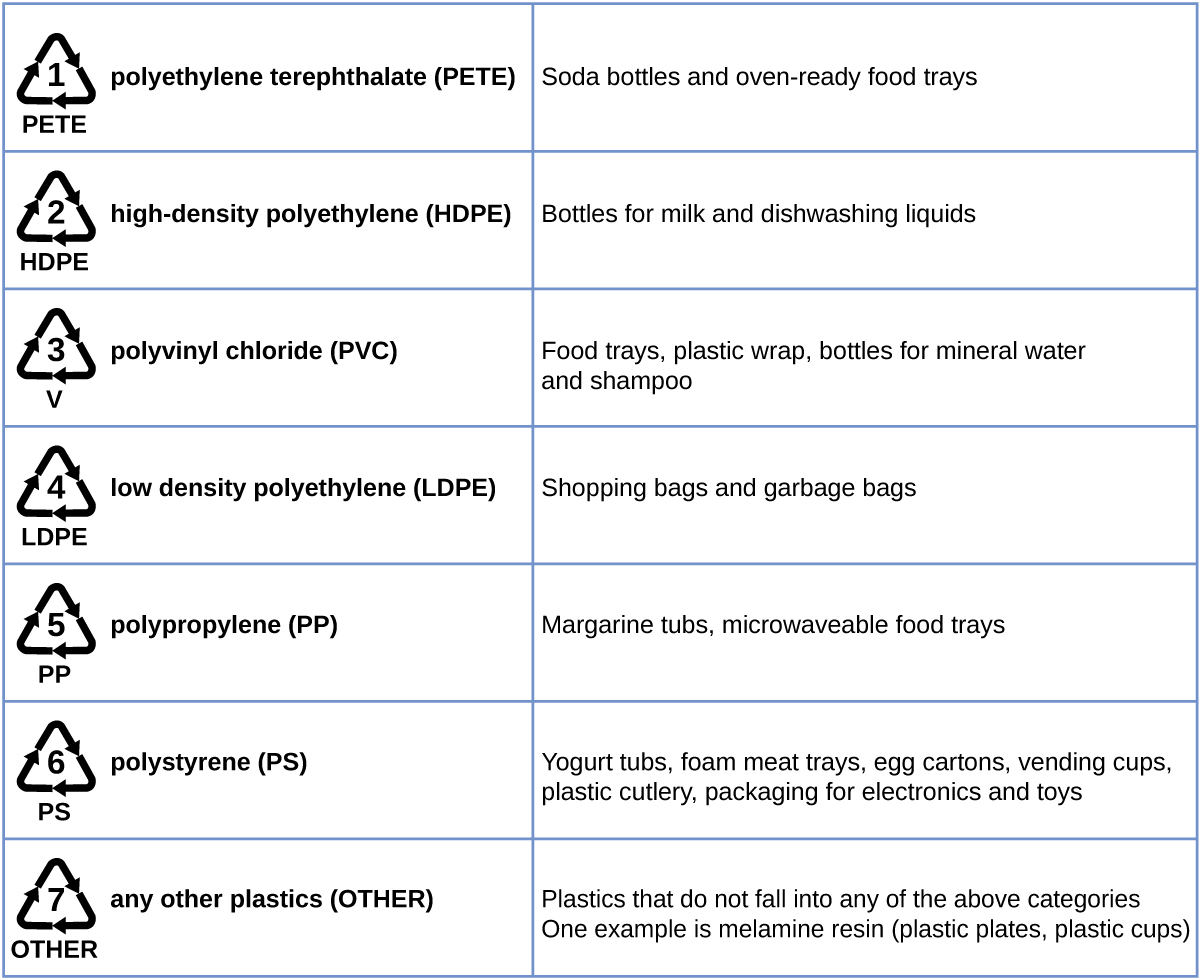
The recycling codes of common plastics. (Image: OpenStax, Chemistry, CC BY 4.0)
Alkynes and aromatic rings
In an alkyne, a triple bond — one σ and two π bonds — holds the carbons in a straight line, at 180°. Alkynes react even more readily than alkenes, taking up twice as much reagent in addition reactions, and they burn hot: an acetylene torch uses the high heat of combustion of ethyne. The suffix is -yne, as in 1-butyne.
Benzene is the simplest aromatic hydrocarbon: a flat hexagon of six carbons whose remaining electrons are shared around the whole ring rather than fixed in three double bonds. That shared bonding is stable, so aromatic compounds prefer substitution to addition, keeping the ring intact. Among its derivatives, toluene and xylene are important solvents and raw materials, and styrene is the monomer of polystyrene.
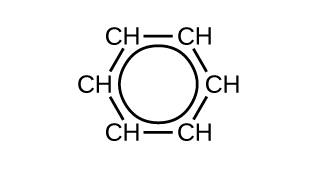
Benzene’s ring of shared bonding. (Image: OpenStax, Chemistry, CC BY 4.0)
Sources
- Paul Flowers, William R. Robinson, Richard Langley and Klaus Theopold, Chemistry, section 20.1, "Hydrocarbons", OpenStax (Rice University), licensed under CC BY 4.0. Changed: rewritten in hubnx's own words and shortened; the worked examples and exercises left out; the figures and their credits are the book's. This page is shared under the same licence.
このページを含むマガジンChemistry (OpenStax)
ライセンス: CC BY 4.0 · 出典 openstax.org
コメント