

Robert Fulton's North River Steamboat of Clermont, 1807. Library of Congress.
From 1837 to 1839, nine steamboats helped carry Cherokee detachments toward Indian Territory: the Knoxville, Newark, Revenue, Smelter, Little Rock, George Guess, Tecumseh, Itasca and Victoria. Several also carried Muscogee (Creek), Chickasaw and Seminole people in their removals.
What the boats were like
Steamboats had worked American rivers for decades; Robert Fulton is credited with the first commercially successful one in 1807. The boats on Southern rivers in the removal years shared a design: a shallow wooden hull and a steam-driven wooden paddlewheel — on the sides (sidewheelers, faster and easier to steer) or at the stern (sternwheelers, better in shallow water). They burned wood and coal, and carried pilot houses, several decks, gangplanks and smokestacks.
| Boat | Built | Size |
|---|---|---|
| Revenue | Louisville, Kentucky, 1834 | 127 feet long, 18 feet 5.5 inches wide |
| Little Rock | Cincinnati | 144 feet by 20 feet 6 inches |
| Tecumseh | Jeffersonville, Indiana, 1835, by James Howard | 115 feet by 16 feet |
Most of the removal boats were light-draught packets, built to carry people and goods on western and southern rivers. A witness recalled first seeing the Knoxville at night: its "great tall chimneys," a white, house-like cabin two or three stories high, the pilot house perched on top.
The Smelter
Built in Cincinnati in 1837, the Smelter was famed for speed and luxury. Its owners, brothers Daniel Smith Harris (captain) and Robert Scribe Harris (engineer) of Galena, Illinois, courted the tourist trade: it was the first boat on the Upper Mississippi with private staterooms, was decked with evergreens, and fired a cannon when approaching landings. Lt. Edward Deas called it "a very good boat," with a cooking stove on board.
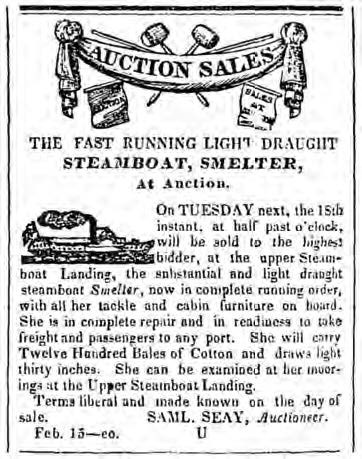
The Smelter advertised for sale at auction, Nashville's Daily Republican Banner, February 15, 1840.
Dangerous rivers
- Short lives: between 1830 and 1839, 272 steamboats were destroyed, each after less than three years on the river. The Newark and Itasca both later hit snags; the Newark sank in two minutes.
- Other hazards: sandbars, storms, fires and boiler explosions.
- Groundings: in 1838 Capt. Gustavus Drane's party stuck when the Smelter grounded below Little Rock in low water; they switched to the Tecumseh, and at Little Rock the Cherokee refused to continue by land once the river rose, so he chartered the Itasca. Lt. Deas wrote of a day spent trying to force a boat over a bar before camping ashore to wait.
Most walked
The removal came as a transportation revolution — steamboats, railroads, better roads — was beginning. The Cherokee used some of it, but most traveled on foot, over rough roads.
Sources
Based on "Steamboats: Transportation During the Cherokee Removal 1837 - 1839," Trail of Tears National Historic Trail, National Park Service, prepared with the Center for Historic Preservation at Middle Tennessee State University; a work of the United States government in the public domain. The witness's 1876 recollection is paraphrased with a short quotation. Link-card images at the foot of the page are not reproduced.
このページを含むマガジンTrail Of Tears National Historic Trail
ライセンス: CC0 1.0(パブリックドメイン) · 出典 www.nps.gov
1
0
0
0

コメント


