
By the Heartland Inventory and Monitoring Network, National Park Service, 2024

Reconstructed prairies at Homestead (top left), Herbert Hoover (top right) and Pipestone (bottom right), and Sioux Quartzite prairie at Pipestone (bottom left). NPS.
Three prairie parks
Tallgrass prairie is an imperiled ecosystem. Three parks of the Heartland Network protect it:
| Park | State | Prairie |
|---|---|---|
| Herbert Hoover National Historic Site | Iowa | reconstructed, since 1971 |
| Homestead National Historical Park | Nebraska | reconstructed, since 1939 — one of the oldest prairie reconstructions in the U.S. |
| Pipestone National Monument | Minnesota | reconstructed; remnant (original, native) tallgrass prairie; and Sioux Quartzite prairie, a rare type among quartzite outcrops and surface rock |
A reconstructed prairie is one kind of restoration. At Pipestone, the history is less clear: its western 80 acres, once farmed, were left fallow in 1956, and some were reseeded in 1986. Ending grazing and other measures also protected its remnant and quartzite prairies.
Prairies were once kept up by natural fire, grazing and drought. Now managers use prescribed fire and mowing.
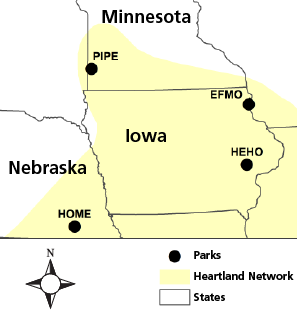
The three parks — and Effigy Mounds National Monument, another Heartland Network park. NPS.
What is monitored
Monitoring began at Homestead and Pipestone in 1997 and at Herbert Hoover in 2004. The network records:
- climate and fire history;
- how many plant species are present;
- plant cover — how much ground each species covers, a measure of abundance;
- bare ground and ground covered by rock, grass litter and other material;
- tree seedlings and saplings in the prairie.
Over the long term, that shows how the prairies are changing and whether management is working.

Mary Short monitoring prairie plants at Homestead, 2022. NPS.
Climate
| Herbert Hoover | Homestead | Pipestone | |
|---|---|---|---|
| Annual precipitation | 954.79 mm (37.59 in) | 791.46 mm (31.16 in) | 718.31 mm (28.28 in) |
| Average temperature | 10.7°C (51.3°F) | 10.7°C (51.3°F) | 7.2°C (45.0°F) |
| Average maximum | 16.7°C (62.1°F) | 17.2°C (63.0°F) | 13.2°C (55.8°F) |
| Average minimum | 4.8°C (40.6°F) | 4.2°C (39.6°F) | 1.1°C (34.0°F) |
Herbert Hoover and Homestead have similar temperatures, but Homestead gets less rain; Pipestone is drier and cooler than both. A changing climate could alter the prairies and how they're kept — parks may need flood management, wildfire protection, and seed of species suited to new climates.
What the plants show
Native plants. Diversity in reconstructed prairies often declines over time, but only Pipestone saw that:
| Park | Native plants since monitoring began |
|---|---|
| Herbert Hoover | up 49% |
| Homestead | no change |
| Pipestone | down 19% |
Few species were planted at first, and more have been seeded since. The differences may reflect how long ago each reconstruction began — the prairies may be at different stages of maturity.
Wildflowers and grasses. Pipestone has less forb (wildflower) and grass cover than the others, probably because of its exposed rock. Grasses seem to be declining in all three parks.
Trees moving in. When woody plants spread into prairie, it can turn into shrubland, savanna or woodland — so keeping shrubs and trees out is central to prairie care.
- Herbert Hoover and Homestead: tree encroachment is a concern; both are very close to qualifying as shrubland.
- Pipestone: counted as shrubland in 1988 (mean woody cover 13.3%), it now fits the definition of tallgrass prairie.
Nonnative plants.
- Pipestone has the most nonnatives.
- Herbert Hoover has seen them increase, and Kentucky bluegrass may be rising there too.
- Homestead has had few throughout.
- Smooth brome may need more control at Herbert Hoover and Pipestone.

Mean nonnative plant cover (%) at Herbert Hoover (HEHO), Homestead (HOME) and Pipestone (PIPE), 1998–2022. NPS.

Prairie at Homestead after a prescribed burn. NPS.
Comparing three parks
Looking at all three together shows how similar management plays out in different places.
- Fire: every park has used prescribed burning, but Herbert Hoover has not been burned since 2011 because of administrative obstacles.
- Mowing ("brush hogging") treats problem plants or stands in for fire, with timing, location and frequency varying by park.
- Earlier studies linked Herbert Hoover's increase in woody plants to fewer burns; fire mattered less in shaping Pipestone's plants.
A focused study of the parks' fire histories could show how fire, and access to treatments, affect reconstructed tallgrass prairie in general. Though climate and land-use history differ, the parks share challenges, and comparing their data helps each make better-informed decisions.
More: full report · Heartland Inventory and Monitoring Network.
Sources
Based on "Prairie Plant Community Monitoring in Three Heartland Network Parks," by the Heartland Network, 2024, National Park Service; a work of the United States government in the public domain. The source calls Homestead a national "historical park" in the text and a "historic park" in one caption; it is a National Historical Park.
ライセンス: CC0 1.0(パブリックドメイン) · 出典 www.nps.gov
1
0
0
0

コメント


