
Part of the Park Service's Teaching Suffrage series, created with the Hard History Project.
| Grade | designed for 4th grade, adaptable for any elementary grade |
| Guiding questions | How do you respond when you're told you can't do something? Have you seen someone else excluded or left out? |
Objectives. Students will:
- see people as individuals, not representatives of groups, and recognize stereotypes;
- show empathy when people are excluded or mistreated, and recognize when they themselves are treated unfairly;
- understand their responsibility to stand up to exclusion, prejudice and injustice;
- speak up, with courage and respect, when they or someone else is hurt or wronged.
The story
Ida B. Wells spent her life fighting for truth and equality, including everyone's right to vote. In 1913, she came to Washington, D.C., to march in the Woman Suffrage Procession with the Illinois delegation.
The women marching were demanding fair treatment — the same right to vote as men. But white suffragists such as Alice Paul often treated Black women unfairly, and Wells was told she would have to march at the back of the parade. She had faced unfair treatment before, but she was surprised and upset to be shut out by the women of her own group; she thought they were all fighting for equality together.
Her answer:
"When I was asked to come down here [to Washington, D.C.,] I was asked to march with the other women of our state, and I intend to do so or not take part in the parade at all."
Not every white suffragist from Illinois agreed with excluding her. Virginia Brooks and Belle Squire said they would march beside her, refusing to let their friend stand alone. Wells stepped away from the group for a while — then reappeared at the front of it, leading it.
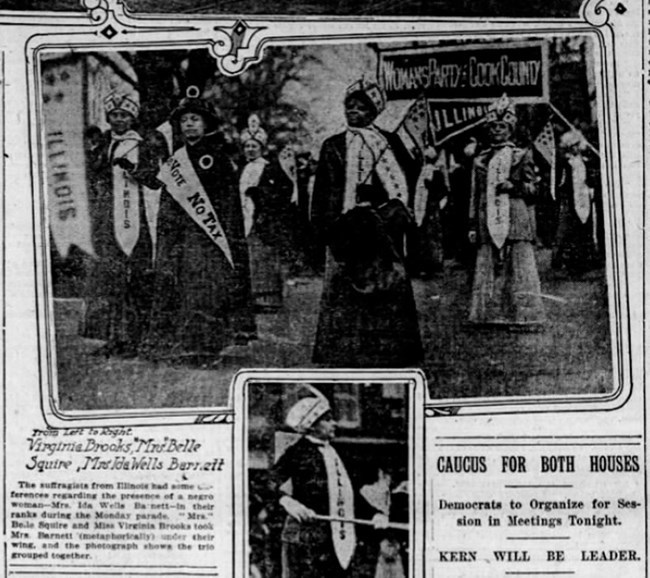
Ida B. Wells marching with the Illinois delegation, from the Chicago Daily Tribune*, March 5, 1913.*
Watch
A one-minute Suffrage in 60 Seconds video, in which Ranger Susan tells the story. Before watching, ask the guiding questions and let students share; afterward, use the questions below.
Vocabulary
| Word | Meaning |
|---|---|
| formidable | very powerful or strong, deserving respect |
| procession | a group moving forward together in an organized way, especially in a ceremony or for a purpose |
| suffrage | the right to vote |
| suffragist | someone who works for the right to vote, especially for women |
Discuss
- What does Ida B. Wells do when told she can't march with the other Illinois women?
- Why might Ranger Susan call her "formidable"?
- How do you think Ida felt when Virginia and Belle offered to stay with her?
- When have you seen someone mistreated? What did you do, and why?
For teachers: the story opens a conversation about being excluded, the responsibility to speak up when it happens to someone else, and the power of taking action.
More
- Park Service: Ida B. Wells · Places of Ida B. Wells · A Noble Endeavor: Ida B. Wells-Barnett and Suffrage · the 1913 Woman Suffrage Procession · And Nothing Less podcast, Truth is of No Color
- Stories: Jacqueline Woodson reading The Day You Begin · Grace for President by Kelly DiPucchio, illustrated by LeUyen Pham · "The New Kid in Class" by Kaitlin Cyca and Monita K. Bell
- Next in the series: Teaching Suffrage: Protest
Sources
Based on "Teaching Suffrage: Ida B. Wells in the Suffrage Procession," National Park Service, created with the Hard History Project; a work of the United States government in the public domain; rewritten in hubnx's own words.
このページを含むコレクションNational Mall and Memorial ParksBelmont-Paul Women's Equality National MonumentTeaching Suffrage
ライセンス: CC0 1.0(パブリックドメイン) · 出典 www.nps.gov
1
0
0
0

コメント


