
ノードのコンテンツを改善したいですか? 編集リクエストを行ってみてください。
In a watershed moment for the intersection of national security and private-sector innovation, the Pentagon has officially finalized agreements with a consortium of leading artificial intelligence firms, including Microsoft, Amazon, and Google, to integrate advanced AI capabilities into military operations. The deal, confirmed today, May 1, 2026, grants the Department of Defense unprecedented access to secret data to facilitate the development of an "AI-first" military infrastructure. This partnership marks a definitive shift in the relationship between Silicon Valley and the U.S. defense establishment. While previous collaborations have often been fraught with internal employee pushback and ethical debates, this agreement signals a prioritization of national security and competitive advantage in a rapidly evolving geopolitical landscape. The scope of the project includes the construction of classified networks designed to leverage generative AI for strategic decision-making, predictive logistics, and automated defense systems. However, the collaboration has not been without controversy. The deal follows months of intense behind-the-scenes negotiations regarding safety safeguards and ethical guardrails. Critics argue that integrating large language models and autonomous agents into defense frameworks risks repeating past mistakes, such as algorithmic bias and a lack of transparency in automated decision-making. Despite these concerns, the Pentagon maintains that robust governance frameworks are being implemented to ensure human oversight. As AI continues to transition from commercial proof-of-concept to critical infrastructure, this deal cements its role as the backbone of the next generation of military technology. For the tech industry, this development represents a massive new revenue stream, yet it simultaneously forces a reckoning over corporate values, global market competition, and the ethical responsibility of building the tools that will shape future conflicts.
The Strategic Pivot to an AI-Integrated Military
The announcement on May 1, 2026, that Microsoft, Amazon, and Google have formalized a pact with the Pentagon to advance the military's AI capabilities is not merely a contract—it is a transformation of the technological ecosystem. For years, the divide between "tech for good" and "tech for defense" has been a defining characteristic of corporate culture in Silicon Valley. Today, that line has been effectively erased.
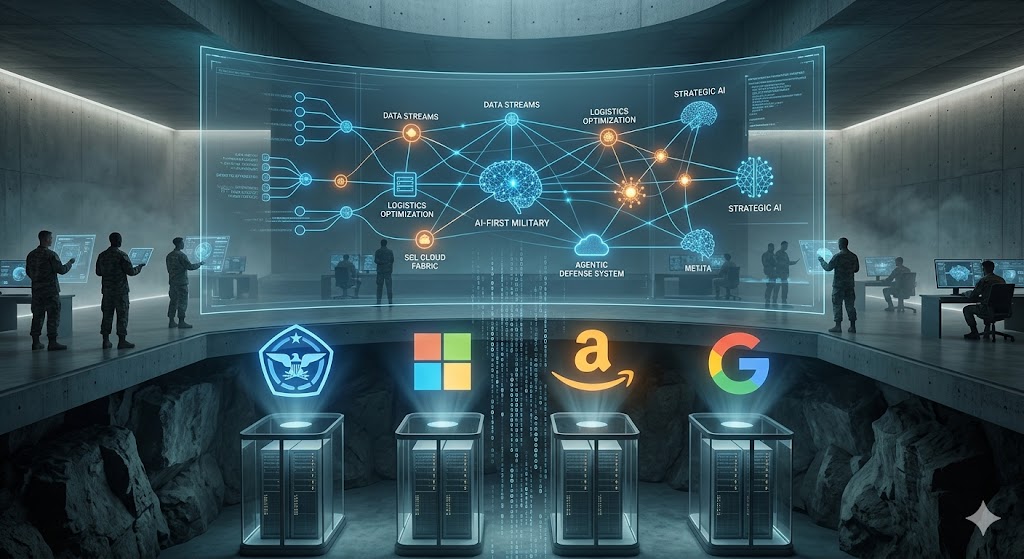
The Architecture of the Agreement
The core of this partnership rests on the development of a secure, classified cloud environment that can ingest and process sensitive military data. The inclusion of three of the world’s largest tech giants suggests a "multi-vendor" strategy designed to prevent reliance on a single provider, ensuring both redundancy and competitive innovation. By leveraging the cloud infrastructure that these companies have spent the last decade building, the Department of Defense aims to move away from legacy systems that are slow, siloed, and ill-equipped to handle the processing demands of modern AI agents.
This infrastructure is expected to support "AI-first" military operations.^^ This goes beyond simple automation. We are talking about the deployment of agentic AI systems that can independently analyze intelligence, predict logistical bottlenecks in supply chains, and optimize resource allocation in real-time. In a theater of operations, this could translate to split-second decisions that would take human teams hours—or days—to process.
The Shift in Corporate Stance
Historically, tech giants have been cautious about deep entanglement with defense contracts. The "Project Maven" controversies of the mid-2020s, which saw widespread employee protests and resignations over AI involvement in drone warfare, forced many firms to adopt strict "ethical AI" guidelines. The current agreement signals a pivot driven by two primary factors: geopolitical pressure and the maturation of AI as an enterprise-grade technology.
With competitors globally investing heavily in AI-driven defense, U.S. tech leadership has come under scrutiny. Executives now frame these partnerships as essential to maintaining democratic values in the global technological race. The narrative has shifted from "should we be involved" to "we must be the ones to build it, to ensure it aligns with our standards." This rationale allows firms to pursue highly lucrative defense contracts while maintaining their brand image as responsible actors.
Addressing the Ethical and Operational Risks
Despite the strategic necessity cited by officials, the deployment of AI in high-stakes defense environments introduces significant risks. The most prominent is the "black box" problem: when AI systems make complex decisions, explaining how they arrived at those conclusions is notoriously difficult. In a military context, the stakes are not merely financial or social—they are existential.
To mitigate this, the Pentagon has reportedly mandated a "human-in-the-loop" framework. This entails that while AI may propose actions, execute logistical tasks, or simulate outcomes, final strategic commands require human verification. This approach, however, faces practical challenges. As the speed of warfare increases, the temptation to reduce human intervention will grow. The risk is that the "human-in-the-loop" becomes a rubber stamp rather than a meaningful check.
Economic and Innovation Implications
For the broader tech market, this deal is a signal to investors that AI spending has officially moved beyond the hype cycle. The payoff is real, and it is coming from the highest-paying, most stable source: the government. This will likely accelerate the adoption of similar "agentic" systems across other high-security industries, such as healthcare, energy, and finance. The infrastructure developed for the Pentagon will inevitably find its way back into commercial products, leading to a new wave of "hardened" AI that is more reliable, secure, and context-aware.
Furthermore, this consolidation of AI power—where only the largest firms have the compute and security credentials to serve the military—further widens the gap between the dominant AI providers and smaller startups. The barrier to entry for defense-tech innovation is becoming increasingly high, cementing the current oligopoly of Big Tech.
Conclusion: A New Technological Reality
We are entering a phase where the digital and physical worlds are inextricably linked through autonomous agents. The Pentagon's move today is a recognition of this reality. As the lines between commercial and defense technology blur, the responsibility for the ethical outcomes of these systems will fall on a small group of corporate and government leaders. The coming months will be critical in observing how these governance frameworks actually perform under pressure, and whether the promised safety measures are enough to prevent the risks that critics have long warned against.
1
0
0
0

コメント