
Summary
Worldwide, children under 5 die at high rates, and those living with HIV who are not on antiretroviral treatment (ART) are especially at risk. Less was known about young children who are on treatment. This CDC report, published in MMWR in 2023, compares them with older people receiving ART at every clinical site supported by the U.S. President's Emergency Plan for AIDS Relief (PEPFAR) from October 2020 to September 2022.
Bottom line: compared with older people on ART, a higher share of children under 5 died or had interrupted treatment, and a lower share had a suppressed viral load.
How the analysis worked
PEPFAR's Monitoring, Evaluation, and Reporting data, collected each quarter from supported treatment sites, were analyzed. The sites were in 25 countries and three regions (Asia, West Africa and the Western Hemisphere). The measures:
| Measure | Definition |
|---|---|
| Mortality | a reported death; summed over four quarters and divided by the average number on ART |
| Interruption in treatment | no clinical visit within 28 days after the last scheduled contact |
| Proxy viral load coverage | a documented viral load result in the past 12 months, among those assumed eligible |
| Viral load suppression | a result under 1000 copies/mL, among those with a documented result |
Ages were grouped as under 1, 1–4, 5–14, 15–49 and 50 and older. Crude mortality ratios (CMRs) compared the share who died in each group. CDC reviewed the work and deemed it not research.
Results
About 17.9 million people received ART at PEPFAR-supported sites each quarter. On average, 11,980 were infants under 1 and 105,510 were children aged 1–4.
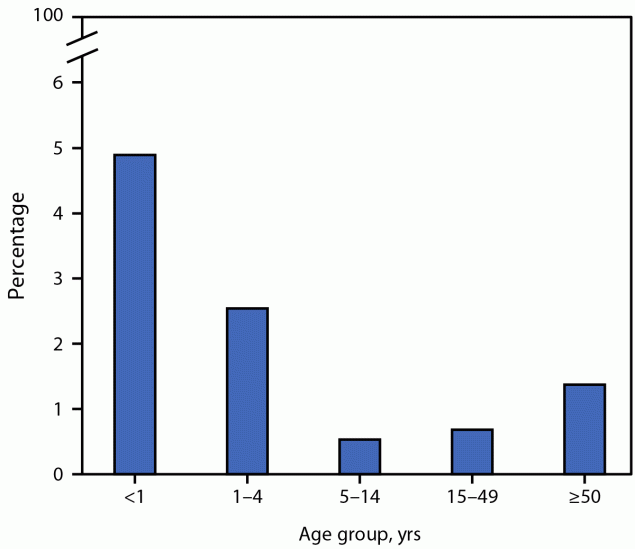
Percentage of people living with HIV and receiving ART at PEPFAR-supported sites who were reported to have died annually, by age group, October 2020–September 2022. CDC.
| Age group | Died each year | Treatment interruption | Viral load coverage | Viral load suppressed |
|---|---|---|---|---|
| Under 1 | 4.9% (586) | 4% | not reported | 78% |
| 1–4 | 2.5% (2,684) | 4% | 66% | 73% |
| 5–14 | 0.5% | 2% | 82% | 85% |
| 15–49 | 0.7% | 3% | 77% | 94% |
| 50 and older | 1.4% | 2% | 83% | 96% |
Infants' coverage is left out because the data undercount it: only infants started on treatment before 6 months of age can have a viral load recorded in their first year.
How much higher — crude mortality ratios:
| Compared with | Infants under 1 | Children 1–4 |
|---|---|---|
| Ages 5–14 | 9.2 | 4.8 |
| Ages 15–49 | 7.2 | 3.7 |
| 50 and older | 3.6 | 1.9 |
So infants died at about four to nine times the rate of older groups, and children aged 1–4 at about two to five times.
Why young children fare worse
- Hidden deaths. Treatment interruptions were also more common among young children. Some children who stop coming may have died, so their deaths may be underreported.
- Advanced disease. Many young children are severely immunosuppressed when diagnosed and started on ART. The WHO considers every child under 5 with HIV who is not clinically stable on ART to have advanced disease. For older people the bar is a WHO stage 3 or 4 illness or a CD4 count below 200 cells/mm3.
- Viral load. Young children had lower suppression, and an unsuppressed viral load is a well-described risk factor for death among children with HIV.
- Childhood risks generally. Mortality in all children under 5 stays high in many low-resource settings where PEPFAR works. A study in western Kenya found common, overlapping causes of death among children with and without HIV, including pneumonia, malnutrition and malaria.
Limitations
- Deaths and treatment interruptions are likely underreported, so the true numbers are higher.
- Reporting differs between sites, which could bias the comparison. CMRs were similar, and high, both at sites that reported treatment loss regularly and at those that did not.
- The findings may not apply to children treated outside PEPFAR-supported sites.
What can help
Global efforts include the Global Alliance to End AIDS in Children by 2030 and PEPFAR's Accelerating Progress in Pediatrics and Prevention of Mother to Child Transmission initiative. Strategies:
- Diagnose children early and link them to optimized ART, especially dolutegravir-based regimens.
- Keep them in care through family-centered, differentiated service delivery.
- Prevent, find and manage advanced HIV disease and its complications, including tuberculosis and severe acute malnutrition, following the WHO STOP AIDS Package.
- Provide general child health services on time: immunizations, micronutrient supplements and antimalarial treatment.
- Enroll high-risk children in community programs such as PEPFAR's Orphan and Vulnerable Children program, which adds family case management and socioeconomic support.
PEPFAR's 2023 country and regional planning guidance adds a section on ending preventable deaths in young children living with HIV.
Sources
Based on Nickolas T. Agathis et al., "Mortality Among Children Aged <5 Years Living with HIV Who Are Receiving Antiretroviral Treatment — U.S. President's Emergency Plan for AIDS Relief, 28 Supported Countries and Regions, October 2020–September 2022," Morbidity and Mortality Weekly Report, Centers for Disease Control and Prevention (2023), by authors from CDC, USAID, the U.S. Department of Defense and the U.S. Department of State; a work of the United States government in the public domain.
ライセンス: CC0 1.0(パブリックドメイン) · 出典 www.cdc.gov
1
0
0
0

コメント


