
Zora Neale Hurston, the author and anthropologist best known for Their Eyes Were Watching God and Mules and Men, also wrote Barracoon, published only in 2018. It tells the life of Oluale Kossola, known in America as Cudjo Lewis, who was thought to be the last of the 110 survivors of the Clotilda, one of the last ships to carry enslaved Africans to the United States. Although the United States outlawed the transatlantic slave trade in 1807, thousands of Africans were still smuggled in and enslaved until the 1860s. Kossola's experience doesn't stand for those of the millions of enslaved Africans, but it matters — and so does how Hurston came to record it.
The assignment
In 1927, on the recommendation of her professor Franz Boas, Hurston won a $1,400 fellowship offered by Carter G. Woodson of the Association for the Study of Negro Life and History and Elsie Clews Parsons of the American Folklore Society. For six months she traveled through Florida and the South collecting Black folklore. Woodson also asked her to research Fort Mose, a Black settlement in St. Augustine, Florida.
On that trip she first interviewed Kossola in Mobile, Alabama. The resulting article, "Cudjo's Own Story of the Last African Slaver," appeared in The Journal of Negro History — but evidence shows it was largely plagiarized from Emma Roche's 1914 book Historic Sketches of the South. Hurston made amends with a series of interviews with Kossola in 1928, which became the basis of Barracoon.
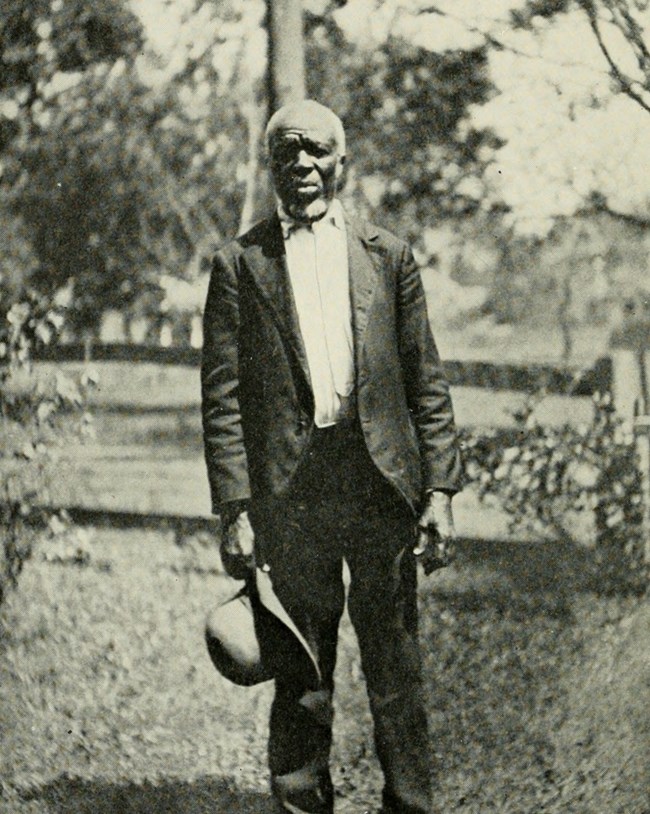
Kossola, also known as Cudjo Lewis. From Historic Sketches of the South (New York: Knickerbocker Press, 1914).
Why she wrote it
Hurston gave two reasons. One was the fellowship assignment. The more important was that the stories of captured and enslaved Africans had almost never been told: the record was full of the sellers' words and empty of the thoughts of the people who were sold. So she set down Kossola's story in his own way, without adding her interpretation — an approach she admitted might not be strictly scientific but was true. Though Hurston criticized Woodson on many points, both were devoted to documenting Black history and culture, even if they disagreed on how.
Kossola's story
| Part of his life | What he told Hurston |
|---|---|
| Family and home | His grandfather, an officer to the king; his parents, family and childhood games; his people's marriage and funeral customs, justice system and initiation into manhood |
| Capture | A raid by Dahomey on his town, Bantè; the march to the barracoon (jail) at Ouidah, where he was held until sold to William Foster, captain of the Clotilda and a conspirator in the capture of Kossola and 109 others |
| Enslavement | Illegal arrival in the United States in 1860; enslavement until the end of the Civil War in 1865 |
| Freedom | With other Clotilda survivors, he bought land and founded Africatown; he married and had six children |
| Later years | Struck by a train, he could no longer work and was denied justice in court. He outlived his wife and children, and his longing for them and for his homeland runs through his account |
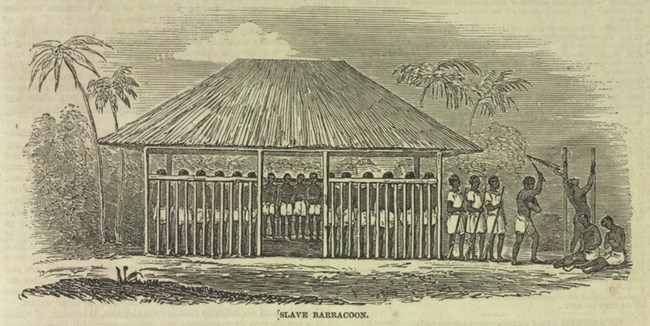
A barracoon, where kidnapped Africans were held for weeks or months before being shipped across the ocean. Illustrated London News, 1849.
The long road to print
Hurston tried many times to publish Barracoon without success, partly because she insisted on writing Kossola's story in his own dialect. Her work wasn't lost: she described interviewing him in her autobiography, Dust Tracks on a Road, and other scholars built on the story — Sylviane A. Diouf's Dreams of Africa in Alabama follows the Clotilda survivors before, during and after their capture. After Barracoon appeared, Hannah Durkin published articles in 2019 and 2020 on two other survivors who outlived Kossola, Sally "Redoshi" Smith and Matilda McCrear. Hurston herself had met one of these women: in a letter to Langston Hughes, she wrote of finding another original African, older than Cudjo, some 200 miles upstate on the Tombigbee River.
Hurston didn't receive the recognition Barracoon deserved in her lifetime, but its value for understanding the Clotilda survivors is hard to overstate, and it places her among the great preservers of history of her day.
The Carter G. Woodson Home National Historic Site, Eatonville and Africatown are members of the Reconstruction Era National Historic Network.
Sources
Based on "Zora Neale Hurston and Cudjo's Own Story," by Sydney Coleman, published by the National Park Service, which draws on Hurston's Barracoon (2018), Valerie Boyd's Wrapped in Rainbows (2004) and Hannah Durkin (2019); rewritten in hubnx's own words.
このページを含むコレクションCastillo de San Marcos National Monument
ライセンス: CC0 1.0(パブリックドメイン) · 出典 www.nps.gov
1
0
0
0

コメント
次に読む


