
In the late 1800s, lawmakers and worried citizens said they were going after Chinese abalone fishermen only because their fishing was so efficient it was unsustainable. The camps those fishermen left on California's Channel Islands tell a different story. Among the discarded shells, archeologists found only two juvenile abalone — and many oversized adults. The fishermen were letting abalone breed for several seasons before taking them.
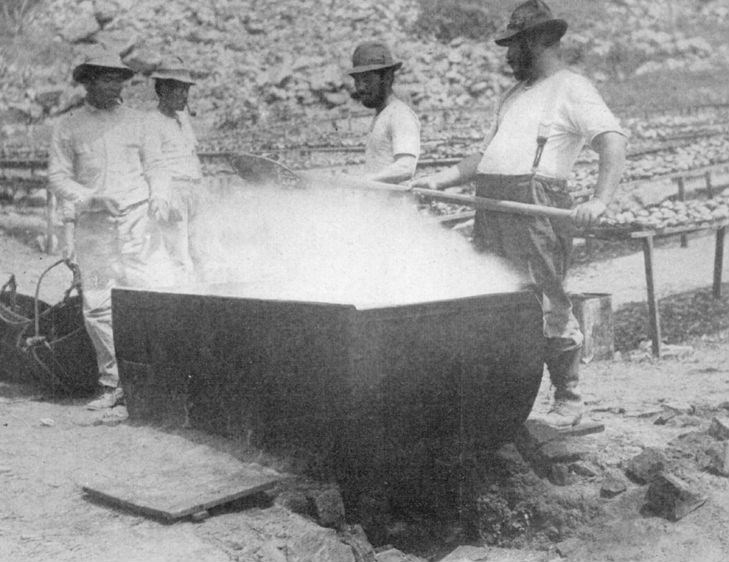
Fishermen cooking and drying abalone. Charles Lincoln Edwards, California Fish and Game Commission Fish Bulletin No. 1, 1913.
Before the trade
People have lived on the islands for more than 13,000 years, as human remains excavated on Santa Rosa Island in 1959 show. The seafaring Chumash — the name comes from Michumash, "makers of shell bead money" — used colorful abalone shells for adornment and trade with the mainland. Spanish colonization in the late 1700s brought disease and missions, and by the 1820s the last Island Chumash, the main eaters of adult abalone, had been removed to the mainland. Abalone populations exploded — briefly.
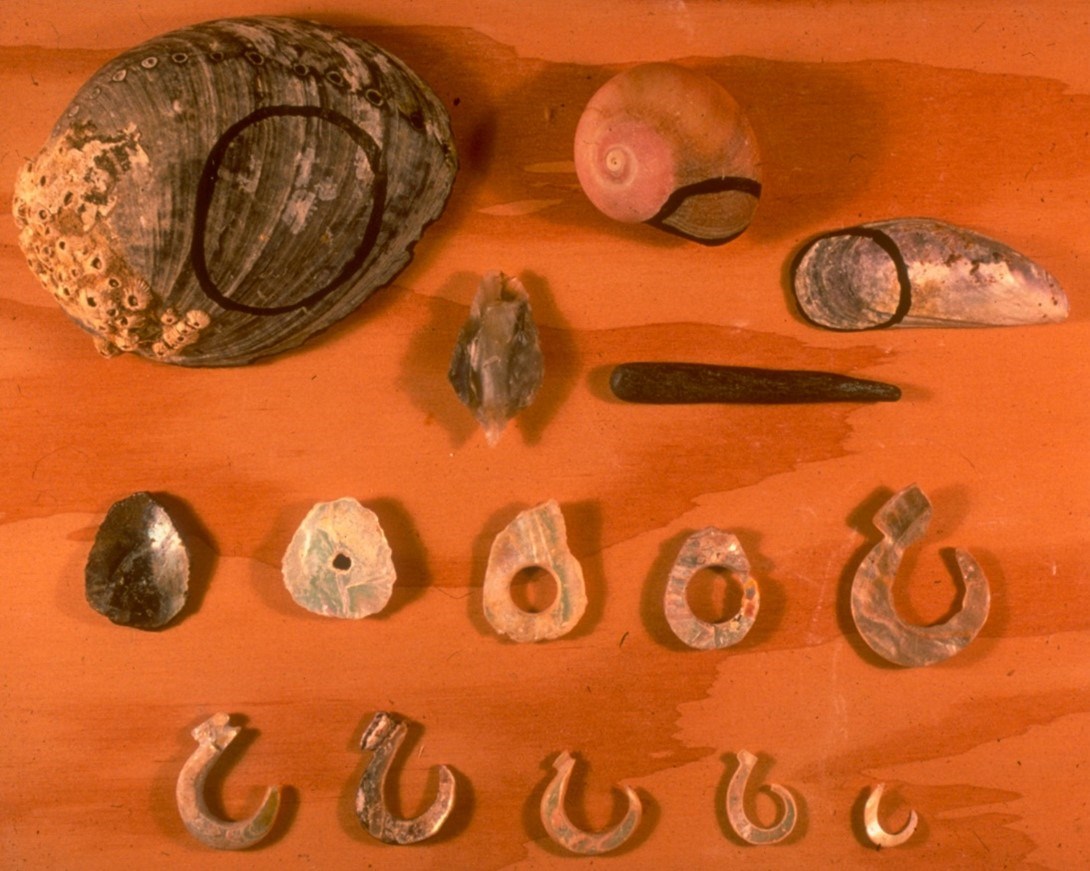
Abalone and bone fishhooks found on Santa Barbara Island. NPS photo.
A Chinese industry
Chinese immigrants came west for gold, but discriminatory laws shut them out of the Gold Rush economy. They turned instead to an untapped coastal resource. Black abalone lived in the intertidal zone and could be gathered on foot: pried off the rocks, the meat was boiled, dried and shipped to China, San Francisco and Hawaiʻi, a delicacy for affluent Chinese communities. In the 1870s, demand for the shells soared too, as Europeans and eastern Americans wanted them for vases, jewelry and buttons.
The earliest account, from 1853, describes six Chinese men gathering abalone at Monterey. By the mid-1880s, newspapers, deeds and court cases trace a prosperous Chinese trade around the islands; in 1885, Chung & Company shipped thousands of pounds of dried abalone to China by way of San Francisco.
Then came the Chinese Exclusion Act (1882), the Scott Act (1888) and the Geary Act (1892). They stopped Chinese fishing boats from leaving the country and returning, and further restrictions in 1893 threatened Chinese fishermen's right to stay. Within a decade, their part in the industry was all but over.
Japanese divers take over
Japanese hardhat divers filled the gap, taking subtidal species as well as black abalone — helped by rules that had hurt the Chinese. In 1900, California counties banned gathering abalone in less than 20 feet of water, which favored divers. The work was hard: a 1913 state Fish Bulletin described crews of a diver and six assistants working 20 to 65 feet down in four-hour shifts. Newspapers record Chinese and Japanese fishermen who drowned, and others arrested for breaking the rules.
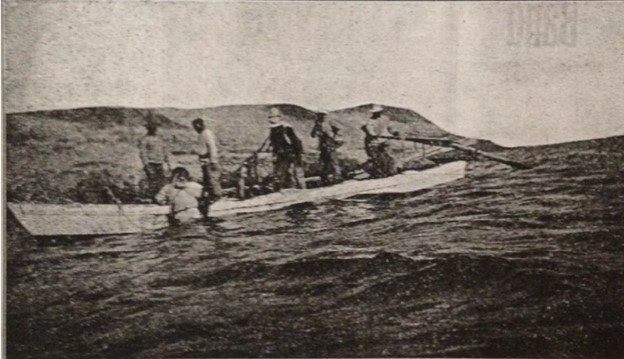
A Japanese hardhat abalone-diving operation, probably off Point Bennett on San Miguel Island, Overland Monthly, 1913.
By the early 1900s there were complaints of overfishing: green abalone that once piled on the rocks were hard to find, and San Clemente Island had been all but stripped of black abalone. Abalone exports were banned in 1913, and abalone drying in 1915. The industry limped on until the 1980s, when abalone were near extinction and stricter rules ended commercial fishing.
What the ground holds
In 2006, archeologists recovered more than 350 historical artifacts at Point Bennett, on the western tip of San Miguel Island: food-shipping containers and tableware such as a "Double Happiness" bowl — a design usually found at sites older than 1870 — showing that pickled vegetables, soy sauce and other Chinese foods were imported to camp; and a Meiji-era Japanese bowl from the late 1800s or early 1900s, probably left by Japanese divers who reused old Chinese campsites. Other finds include ceramic sherds, glass bottles, carved sea lion teeth, buttons, smoking pipes and opium boxes.
Until excavations in 2007, abalone middens — heaps of discarded shell — drew little attention, even though coastal erosion threatens them. The black-abalone middens suggest the Chinese camps were short-term and highly specialized. Hearths, drying slabs and shell scatters are what remains of the industry; lost buttons and broken pipes, of the people who ran it.
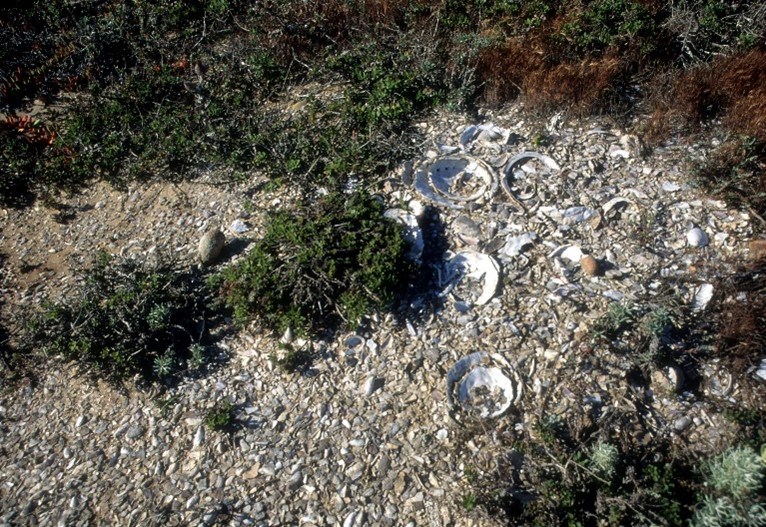
A shell midden on San Miguel Island. NPS photo.
Sources
Based on "A Short-Lived Livelihood: Chinese and Japanese Abalone Fishermen," National Park Service, Channel Islands National Park, citing Linda Bentz (1997), Todd J. Braje and others (2009, 2014) and Charles Lincoln Edwards, "The Abalone Industry in California," Fish Bulletin No. 1 (1913); a work of the United States government in the public domain.
이 페이지가 속한 컬렉션Channel Islands National Park
이용 허락: CC0 1.0 (퍼블릭 도메인) · 출처 www.nps.gov
1
0
0
0

코멘트


