
California red-legged frogs (Rana draytonii) were once widespread. Today they are rarely found along southern California's streams, and they were thought to have been extirpated — completely removed — from the Santa Monica Mountains. Then a single population was discovered in protected habitat nearby, and it has become the seed stock for bringing the species back.
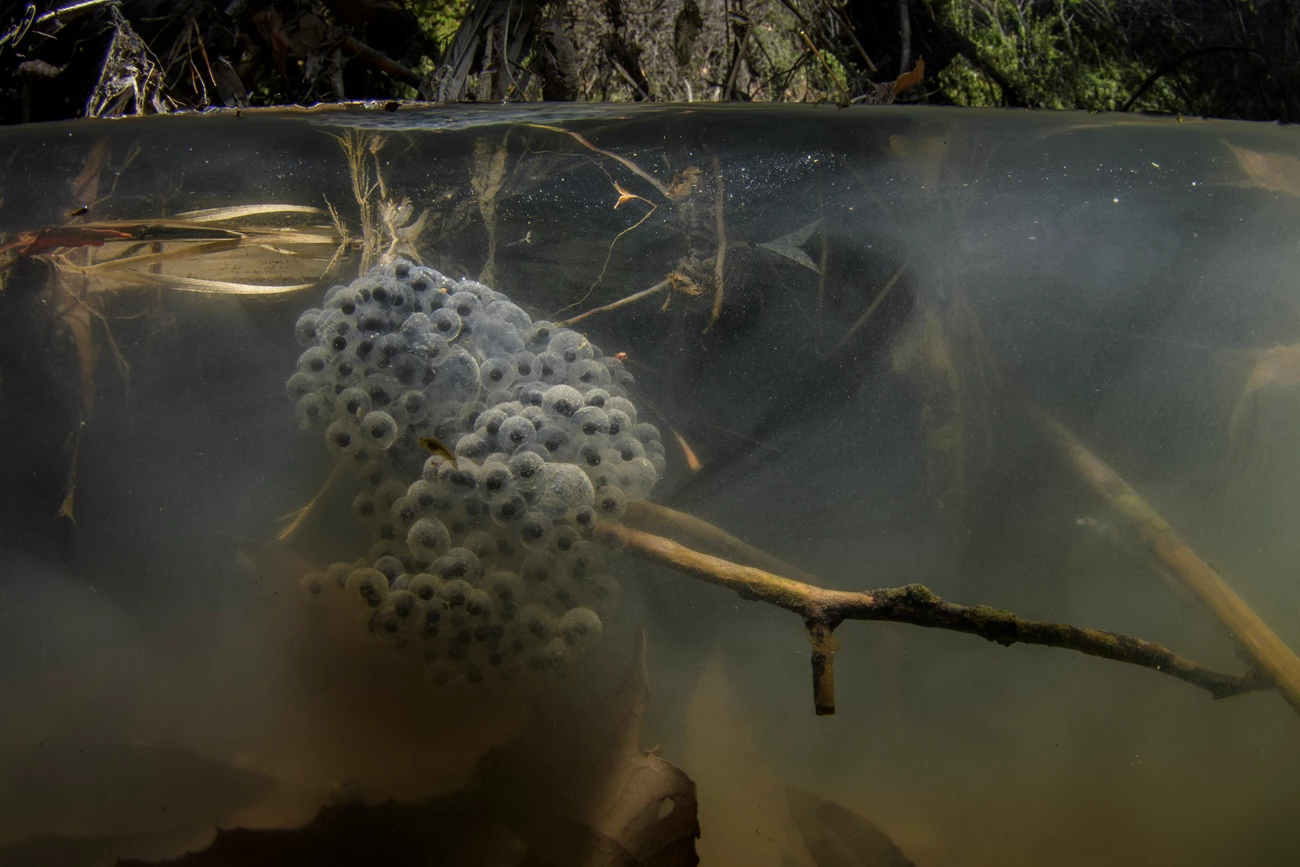
California red-legged frog eggs. Credit: Michael Ready, National Park Service.
Why the frogs disappeared
Streams in this densely populated, highly developed region are extremely sensitive to change. Once even 15 percent of a watershed is developed, a stream that was ecologically intact can quickly shift to one dominated by non-native plants and animals.
Often, protecting habitat from outside threats is enough to keep wildlife populations healthy. Occasionally, though, the National Park Service has to step in and return native wildlife to the places it used to live.
Moving frogs is not simple
After years of careful monitoring, biologists judged the surviving population healthy enough to supply adults and eggs to other nearby streams, where they could form new populations. But carrying frogs and eggs from one stream to another is not enough on its own. For long-term success, biologists need to keep genetic diversity as high as possible across the populations, which means understanding the frogs' genetic structure before any move is planned.
- The first moves. When the Park Service began translocating red-legged frogs, the U.S. Geological Survey supported the work in several ways, including genetic analyses of the existing populations.
- The next moves. That data was invaluable at the time, but further translocations need fresh evidence to justify moving frogs to new places in the mountains. The Southern California Research Learning Center has since supported new genetic analyses of many frogs in the Santa Monica Mountains. The results help biologists decide which areas are the best sources of new genetic material, and where frogs can safely be moved to keep diversity high.
Through the Woolsey Fire
Before the Woolsey Fire of 2018, red-legged frogs had been moved to four streams in the Santa Monica Mountains, and they were breeding on their own at one or more of those sites. Despite the fire's devastation, the species is still found at one or more of the translocation sites — a testament both to the plan and to the frogs' tenacity.
About the research center
The Southern California Research Learning Center is one of 18 Research Learning Centers across the country. They work to increase scientific activity in the national park system, to share research that supports stewardship, and to make science part of a visit. With its partners, this center supports science-based decisions, science literacy and a conservation ethic in Santa Monica Mountains National Recreation Area, Channel Islands National Park and Cabrillo National Monument.
Sources
Based on "Genetic Analysis Supports Frog Reintroduction Effort in Santa Monica Mountains," a publication of the Southern California Research Learning Center, National Park Service; a work of the United States government in the public domain.
이 페이지가 속한 컬렉션Santa Monica Mountains National Recreation Area
이용 허락: CC0 1.0 (퍼블릭 도메인) · 출처 www.nps.gov
1
0
0
0

코멘트


