이 페이지는 공개 상태입니다.
Introduction
Vision Zero is a movement to eliminate all traffic deaths and severe injuries. It differs from the traditional approach to traffic safety in two major ways. First, it recognizes people will make mistakes, thus road systems must be designed to ensure those mistakes don't result in deaths or severe injuries. Second, it uses a multidisciplinary approach bringing together traffic planners, engineers, policy makers, and public health professionals to address this complex problem.[1] It began in Sweden in 1997 when the Swedish parliament adopted it as the official road policy. After adopting it, traffic deaths were cut in half even while the number of trips increased. Since then, cities in countries around the world have adopted the Vision Zero concept.[2] Its techniques, like using choice architecture and finding aligning interests, can be applied to many other problems today.
Participants
Vision Zero has been adopted by many places in Europe like Sweden, Norway, The Netherlands and London, England. It has also spread outside of Europe to places like Australia, New Zealand and the United States.3] As of August 2021, 51 cities in the United States partake in Vision Zero and are shown on the [Vision Zero Network map.[4]
Importance
Each year in the United States, more than 40,000 people are killed by cars and thousands more are injured.[1] This number worldwide is around 1.35 million.[5] Traditionally, society has assumed this to be an inevitable side effect of modern transportation. We have called these tragedies traffic "accidents" when in reality they can be prevented through being proactive and prioritizing traffic safety as a public health issue.[1]
Key Priorities
All communities that participate in Vision Zero uphold three key priorities.
- Managing Speed
Speeding kills more than 10,000 people each year in the United States. Drunk driving kills about the same number of people; however, speeding doesn't carry nearly the same social consequences as drunk driving. Vision Zero prioritizes safe speeds through automating speed enforcement (safety cameras), setting safe speed limits, and designing safe streets. - Centering Equity
Vision Zero believes that safe mobility is a basic human right and that communities should invest in safety strategies that ensure equity. This means prioritizing those communities that have a disproportionately high rate of traffic deaths and serious injuries.
- Engaging Communities
City officials should work with community based organizations that have public trust and respect to figure out what needs are the greatest for traffic safety in each community.[6]
Getting Involved/Recognized
If a community is interested in getting involved with and recognized by Vision Zero, they start by filling out a questionnaire. The mayor or highest city official would fill out the form, which consists of 39 questions gauging their community's commitment to the movement. Within two weeks of completing the questionnaire, the Vision Zero Network will contact the community. All communities must meet five minimum criteria to become recognized by the network:
- Have a clear goal of eliminating traffic deaths within an explicit timeframe (i.e. 10 years)
- The mayor or highest official is publicly committing to Vision Zero and directing appropriate city staff
- A Vision Zero strategy is in place
- Key city departments are actively engaged in the plan
- A Vision Zero Task Force meets regularly to lead and evaluate efforts
If the community meets these minimum criteria, they will be recognized by the Vision Zero Network. Recognized communities are added to the Network's online map of participating communities as well as invited to participate in calls, webinars, conferences, a listserv and in-person meetings. Being recognized is also a public statement of your community's commitment to making roads safe for everyone.[7]
Opposition
While anyone would support eliminating traffic deaths, many are skeptical of Vision Zero's practicality. Others are opposed to certain methods used to achieve Vision Zero. A common critique is that since Vision Zero is a goal without one "proper" way of being implemented, it is easy for a city to adopt Vision Zero without progressing towards the goal. Los Angeles, Washington D.C., and Chicago are three commonly given examples of such cities.[8] Some people support Vision Zero in theory but remain critical of solutions that have been offered in its name.[9]
Many drivers who want less restrictive driving laws oppose Vision Zero. One of the first Vision Zero actions taken in New York City involved reducing the speed limit on every road to 25mph. This earned backlash from some who were frustrated with the already-slow city traffic.[10] Similar opposition to stricter driving regulations caused Los Angeles to cancel plans to directly reduce driving in favor of less-intrusive actions such as repairing sidewalks.[11] Some people have claimed that Vision Zero's methods are not intended to lower traffic fatalities, but rather to generate city revenue.[12]
Examples
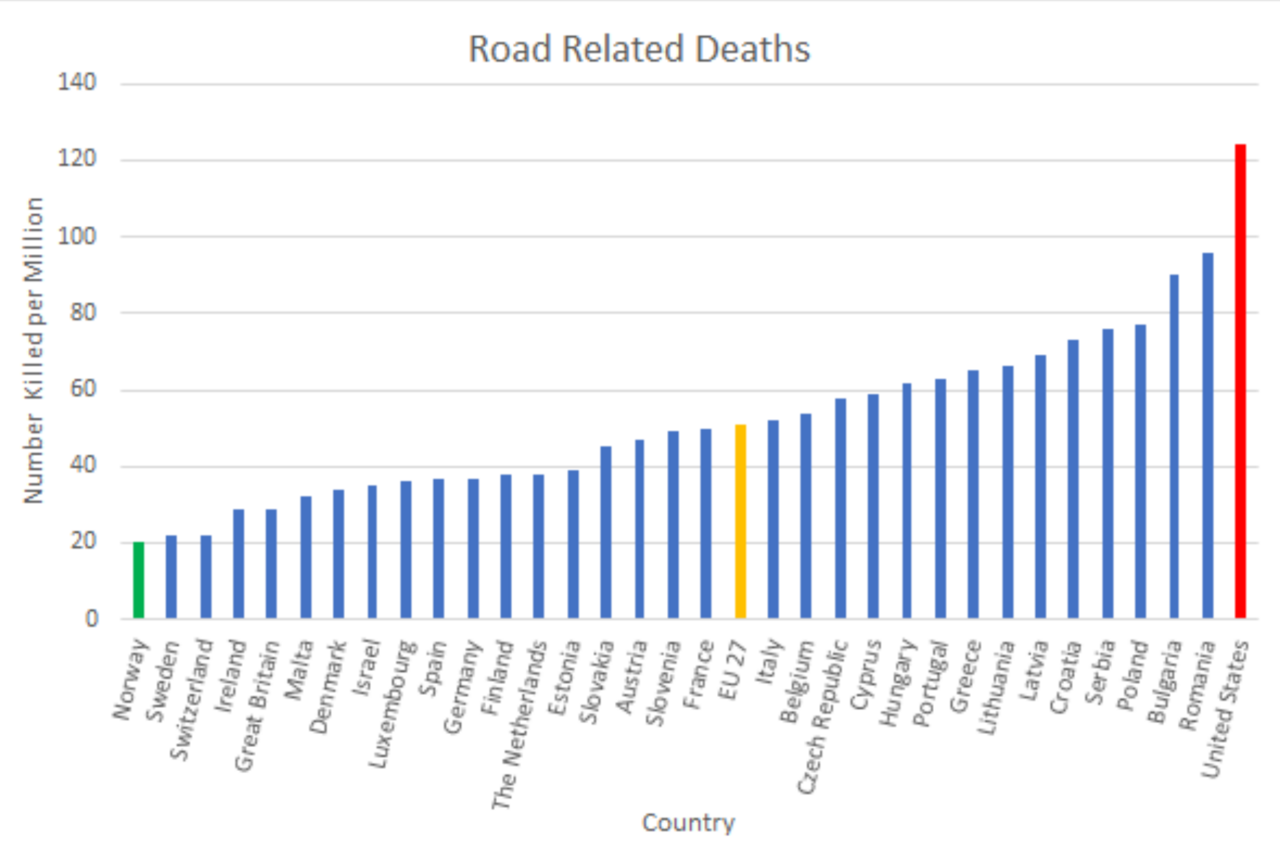
Graph showing the number of road related deaths per million for different countries. [ 13 ] (Image: ParkerJohnson60, CC BY-SA 4.0)
Norway
Norway has been a Vision Zero world leader since it began practicing in 2002.[14] In 2019, Norway had the fewest traffic related deaths per million at 20, while the average in Europe was 51.[13] In 2020, these values dropped to 17 in Norway and 42 in Europe.[15] Its capital city of Oslo has made major changes to its roadways to improve safety for drivers, bicyclists, and pedestrians that led to only one road related death in 2019 from a driver who drove his car into a fence.[14] Since 2015, when Oslo seriously started pushing for safer roads, it has added about 50 new kilometers of bike lanes throughout the city,[14] and there are plans for 25 more kilometers to be added starting in 2022.[16] Adding these cycling paths often comes at the cost of street parking for cars. Usually the renovations do not expand upon the streets, but instead they are repurposed. Much of the success towards achieving Vision Zero in Oslo is not about making streets safer for cars, but rather it comes from disincentivizing driving and making alternative modes of transport, like public transit or cycling, more appealing.
France
Paris, France is making great strides towards becoming another world leader in Vision Zero. They have introduced many of the same practices as Norway when it comes to promoting alternatives modes of transport, and they even have plans to become a 100 percent cycling city by 2026.[17] Many of the best practices for achieving success in Vision Zero involve promoting less use of personal vehicles since lower car usage means lower accident and death tolls. But sometimes it is not feasible for people to drive less, such as in a rural, more spread out area. In cases like this, improving safety for drivers is necessary to reduce fatalities. To do this, France has implemented over 30,000 roundabouts throughout the country. Of these 30,000 roundabouts, about 80 percent of them have never had an accident occur within them. [18]
United States
While the U.S. has a long way to go in reducing their road related deaths rate (124 per million in 2019), there are a few bright spots within the country. Carmel, Indiana, while not an official Vision Zero participant, may be the closest city in the U.S. to achieving Vision Zero. Like France, Carmel began using roundabouts throughout the city starting around 1996.[19] There are now over 140 roundabouts in Carmel (compared to 15 traffic lights),[20] and its road related death rate is on par with Norway at 20 deaths per million (2 per 100,000). Since beginning to use roundabouts in the city, Carmel's traffic fatality rate has fallen by 90 percent.[19] Roundabouts are safer than signalized intersections because they have fewer conflict points, and most crashes will be side swipes rather than T-bones which are much more dangerous. Roundabouts are a great option for improving safety in an area where people still need to drive and commute longer distances.
Applications
Many of the techniques used by the Vision Zero movement, such as reducing speed limits or converting car lanes into bike lanes, are clear applications of a concept called "choice architecture". This term was first coined in 2008 by Richard Thaler and Cass Sunstein[21], although the idea is much older. Choice architecture is the practice of designing a system in a way that silently encourages users to make certain decisions which the designer deems more preferable. In the example of Vision Zero, proponents intentionally design the cities to encourage people to use safer methods of transportation, such as cycling. Choice architecture is a powerful tool that can help solve many issues because it maintains system users' ability to make decisions, meaning it is often better received than more directly intervening methods.
While Vision Zero aims to eliminate traffic deaths, many strategies it employs are ones that can help solve other issues too. This enables Vision Zero to gain support from a much broader audience, rather than just those fighting traffic deaths. For example, rather than just focusing on safer cars or roads, Vision Zero has put much emphasis on encouraging bike-friendly cities. This reduces traffic deaths as desired, and also gains the support of groups focused on lowering carbon-emissions or promoting cycling. This can be seen in the European Cyclists' Federation (ECF), a group involved in the transformation of Oslo, whom advocates primarily for cycling and only sees safety as one part of its agenda.[22]
- ↑ a b c Vision Zero Network. (2018, May 11). What is Vision Zero? https://visionzeronetwork.org/about/what-is-vision-zero/.
- ↑ Center for Active Design. (2014). Vision zero: Learning from Sweden's successes. https://centerforactivedesign.org/visionzero.
- ↑ Action Vision Zero. (2019, December 3). Vision Zero – A History. https://actionvisionzero.org/resources/vision-zero-a-brief-history/.
- ↑ Vision Zero Network. (2021, August 18). Vision Zero Communities. https://visionzeronetwork.org/resources/vision-zero-communities/.
- ↑ ASIRT (2021, August 25) Association for Safe International Road Travel. Road safety facts. https://www.asirt.org/safe-travel/road-safety-facts/.
- ↑ Vision Zero Network. (2018). A Primer on Vision Zero - Advancing Safe Mobility for All. https://visionzeronetwork.org/wp-content/uploads/2018/05/What-is-VZ_FINAL.pdf
- ↑ Vision Zero Network. (2018). Consideration for Recognition as a Vision Zero Community. https://visionzeronetwork.org/wp-content/uploads/2018/05/Form_Consideration-for-Recognition-as-Vision-Zero-Community.pdf
- ↑ Bliss L. & Montgomery D. (2019) What Happens When a City Tries to End Traffic Deaths. Bloomberg CityLab. https://www.bloomberg.com/news/articles/2019-11-21/vision-zero-are-cities-reducing-traffic-deaths
- ↑ Brasuell, J. (2021) Rebuilding from the Failures of Vision Zero. Planetizen. https://www.planetizen.com/news/2021/05/113209-rebuilding-failures-vision-zero
- ↑ Paumgarten N. (2014) Slow Cab Coming. New Yorker. https://www.newyorker.com/magazine/2014/11/03/slow-cab-coming
- ↑ Tinoco, M. (2018) LA taps the breaks on Temple Street road diet. Curbed Los Angeles. https://la.curbed.com/2018/3/22/17139304/temple-street-road-diet
- ↑ Iannelli, N. (2016) Poll finds opposition to Vision Zero's new fines, offenses. WTOP News. https://wtop.com/dc/2016/02/poll-finds-opposition-to-vision-zeros-new-fines-offenses/
- ↑ a b Trygg Trafikk. (2021, July 30). Internasjonal statistikk - norge best I verden I trafikksikkerhet • trygg trafikk. Trygg Trafikk. https://www.tryggtrafikk.no/statistikk/internasjonal-statistikk-norge-best-i-verden-i-trafikksikkerhet/.
- ↑ a b c Hartmann, A., & Abel, S. (2020, Oct. 13). How oslo achieved zero pedestrian and bicycle fatalities, and how others can apply what worked: . TheCityFix. https://thecityfix.com/blog/how-oslo-achieved-zero-pedestrian-and-bicycle-fatalities-andhow-others-can-apply-what-worked/. Web of Science.
- ↑ Trygg Trafikk. (2021, July 1). Norge Med færrest Antall Omkomne I Trafikken • Nytt Fra Trygg Trafikk. Trygg Trafikk. https://www.tryggtrafikk.no/nyheter/norge-med-faerrest-antall-omkomne-trafikken/.
- ↑ Giæver, H. (2021, Sep. 22). Slik blir Oslo-Budsjettet for 2022: Kraftig økning AV gigantsatsingen på sykkel. Avisa Oslo. https://www.ao.no/slik-blir-oslo-budsjettet-for2022-kraftig-okning-av-gigantsatsingen-pa-sykkel/s/5-128-179475.
- ↑ Luoma, B. (2021, Nov. 4). Ambitious plan will make Paris a 100% cycling city by 2026. ECF. https://ecf.com/news-and-events/news/ambitious-plan-will-make-paris-100-cycling-city-2026.
- ↑ Scrase, R. (2015, April). Road cfeature ASE 5 circle of influence - home - eurorap. EuroRAP. https://www.eurorap.org/wp-content/uploads/2015/04/iRAP-case-study-5_France-roundabouts.pdf.
- ↑ a b Dorfman, P. (2020, Oct. 30). For traffic safety, roundabouts run circles around stoplights - built: The bluebeam blog. Built | The Bluebeam Blog. https://blog.bluebeam.com/roundaboutscarmel-civil-infrastructure/.
- ↑ Buckley, C., & Mast, A. J. (2021, November 20). These Americans are just going around in circles. it helps the climate. The New York Times. https://www.nytimes.com/2021/11/20/climate/roundabouts-climate-emissions-driving.html.
- ↑ Thaler, R. H., & Sunstein, C. R. (2008). Nudge: Improving Decisions About Health, Wealth, and Happiness. Yale University Press. New Haven & London. p.3
- ↑ European Cyclists' Federation. (2021) About Us. https://ecf.com/about-us
Where this page came from
This page was imported from Wikibooks. From “Lentis” on Wikibooks, by its contributors, under CC BY-SA 4.0. Changed here: set as a page; navigation and edit links left out; each image under its own licence, credited in its caption.
Nobody has written it yet — it is the source material at a new address, which is why search engines are asked to skip it and why no one earns from it. It is up for grabs: take it on, and it is yours to rewrite and to earn from.
이 페이지가 속한 매거진Lentis
이용 허락: CC BY-SA 4.0 · 출처 en.wikibooks.org
코멘트