
In chapter 20 of Katherine Paterson's novel Lyddie, the mill floor has changed. Many of the girls have gone and not come back, and the new hands are mostly young Irish immigrants — among them Brigid, whom Lyddie begins teaching to read.
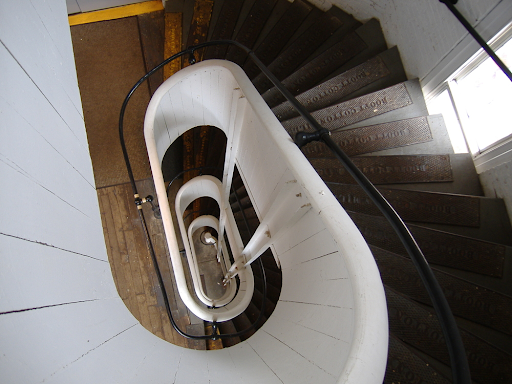
The stair tower in the Boott Mill. At the start and end of each shift, these stairs filled with young women going to and from their machines. Lowell National Historical Park
What happens in the chapter
- With Diana gone, Lyddie is lonely at work. Some looms stand idle even after the new girls are hired, and the weave room is much quieter than it was. Lyddie starts teaching Brigid her letters.
- Two letters arrive. Charlie writes that Rachel is well and presses Lyddie to answer Luke Stevens' proposal of marriage. The second letter brings news of her mother's death — and Lyddie, grieving, finds she can no longer picture her mother's face.
- Leaving work one evening, Lyddie notices Brigid isn't with her. She hesitates, starts to walk on, then turns back upstairs — and finds the overseer, Mr. Marsden, far too close to Brigid. Lyddie seizes a fire bucket full of water, empties it over him and brings it down on his bald head. Grabbing Brigid's hand, she runs with her out of the mill toward the boardinghouses.
Was it real?
Partly. In the mid-1840s the mills were not yet mostly Irish, and looms rarely sat idle.
- During the 1840s, Yankee mill girls made up a slightly smaller share of the workforce than in the two decades before. Some left because of speed-ups and stretch-outs, and some for better opportunities elsewhere.
- At the same time, Irish immigrants were pouring into Lowell to escape the Great Hunger. Many Irish women went into the mills, but foreign-born workers did not become a majority until after the 1860s.
- As native-born workers left, managers changed how they recruited. With plenty of people looking for work, looms seldom stood idle, and Lowell's mills kept expanding.
What historians found
Thomas Dublin (Women at Work, 1979) notes that bigger mills and additions to old ones raised production, and that the most dramatic change in the workforce was the rise in immigrants. At the Hamilton mill in Lowell:
| Year | Workers born abroad |
|---|---|
| 1836 | 3.7% |
| 1850 | 38.6% |
| A decade later | 61.8% |
David A. Zonderman (Aspirations and Anxieties, 1992) describes how Irish operatives arrived in large numbers in the late 1840s and were mostly channelled into the lowest-paid, hardest jobs, while the better places went to native-born workers. The Irish were shut out of most of the corporations' paternalistic care and not treated as part of the mill "family." Zonderman calls this a deliberate, if unwritten, policy of discrimination — probably meant to calm American women workers, who worried about the growing Irish presence and were leaving the mills in rising numbers.
For more on Lowell's Irish community, see "The Acre" by Dave McKean, director of the Archives of St. Patrick Parish, teacher and author of Lowell Irish.
Fire was a constant danger in the mills, so fire buckets lined the weave room walls — the weapon closest to hand when Lyddie defends Brigid. Boott Cotton Mills Museum weave room
Questions to write about
- Opinion: How else could Lyddie have helped Brigid, other than attacking Mr. Marsden? Give reasons and information to support your view.
- Explain: How are the idle looms a metaphor for Lyddie's mood? Use precise language.
- Narrative: Lyddie makes Brigid an alphabet of words — "A is for agent. B is for bobbin and Brigid." Write an acrostic poem about yourself using the letters of your first and last names.
See it yourself
The fire buckets still hang in the weave room of the Boott Cotton Mills Museum at Lowell National Historical Park.
Sources
Based on "Lyddie: Chapter 20 - B is for Brigid," from the National Park Service Books to Parks series (Lowell National Historical Park), a work of the United States government in the public domain. It cites Thomas Dublin's Women at Work (1979) and David A. Zonderman's Aspirations and Anxieties (1992), both paraphrased here. Lyddie is a novel by Katherine Paterson; this page summarizes the chapter. A chart from the Center for Lowell History and a portrait photograph are left out; rewritten in hubnx's own words.
이 페이지가 속한 컬렉션Lowell National Historical ParkLyddie - Books to Parks
이용 허락: CC0 1.0 (퍼블릭 도메인) · 출처 www.nps.gov
1
0
0
0

코멘트


