

Excess algae like this can block sunlight needed by native bottom-dwelling plants, which can kill them. Excess algae results from an overproduction of organic matter, or eutrophication. Eutrophication is a condition caused by excessive amounts of nutrients — such as nitrogen and phosphorus — in a waterbody.
There are many types of nonpoint source pollutants. When these accumulate in high enough concentrations in a waterbody, they can seriously affect the environment and the organisms living there. They can also affect human health.

Fish kills, like this one in the Chautauqua National Wildlife Refuge, can result from hypoxia, or very low levels of oxygen in the water. Hypoxia occurs when excessive algae block out sunlight, killing off underwater plants, which decay and deplete the oxygen in the water.
The primary nutrients of concern in nonpoint source pollution are nitrogen and phosphorus. Both are essential for plant growth, but if too much of these substances enters a waterbody, it can lead to a condition called eutrophication (pronounced you-tro-fi-kay-shun). Eutrophication results in an overproduction of organic matter, particularly the microscopic plants called algae.
You may have seen green masses of algae growing on a pond or lake. This excess algae blocks the sunlight needed by native bottom-dwelling plants, often killing them. As the algae and bottom-dwelling plants die, they decay, using up oxygen in the water. This leads to a condition called hypoxia — very low levels of oxygen in the water — which makes it difficult for aquatic animals like fish and crabs to survive. A NOAA report notes that "potential consequences of eutrophication range from mere nuisances to serious human health threats."
In addition to hypoxia, eutrophication may be associated with conditions that result in harmful algal blooms (HABs). Harmful algae are often small, single-celled organisms that live in aquatic environments. Although these organisms are not harmful in small quantities, too many of them can negatively affect the environment and people's health. When fish and shellfish feed on HABs, they can accumulate toxins that the algae produce. Consequently, when people eat seafood with algal toxins in it, they may get sick. The distribution, frequency, and intensity of HABs appears to be increasing worldwide.
Nonpoint sources of nutrients often originate from agricultural activities. Excess nutrients applied to crops in the form of fertilizers are washed away in runoff, typically during rainstorms. Nutrients also originate from urban and suburban areas, from sources such as lawn fertilizers, and even pet wastes.
Nitrogen and phosphorus also come from atmospheric inputs. Scientists believe that the combustion of fossil fuels like oil and coal by power plants, large industries, and automobiles is a major source of nutrients in the atmosphere (USGS, 2004). Controlling nutrient inputs is proving to be very difficult because the nutrients frequently originate from multiple sources that are challenging to identify and control.
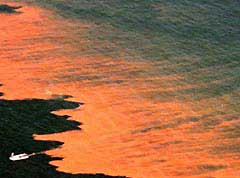
Harmful algal blooms (HABs) occur under eutrophic conditions. Although these organisms are not harmful in small quantities and exist naturally, they grow at rapid rates when eutrophication occurs. When fish and shellfish feed on HABs, they ingest toxins that the algae produce. If people eat this seafood, they can become sick.

Shellfish that ingest harmful algae become poisonous to humans. Unfortunately, harmful algal blooms (HABs) affect many shellfisheries on a regular basis, requiring authorities to close the areas at certain times of the year.
Where this page came from
This page was imported from NOAA National Ocean Service. A lesson from NOAA's National Ocean Service tutorials; as a work of the United States government, in the public domain.
Nobody has written it yet — it is the source material at a new address, which is why search engines are asked to skip it and why no one earns from it. It is up for grabs: take it on, and it is yours to rewrite and to earn from.
이 페이지가 속한 매거진Nonpoint Source Pollution: a NOAA Ocean Service tutorial
이용 허락: CC0 1.0 (퍼블릭 도메인) · 출처 oceanservice.noaa.gov
1
0
0
0

코멘트


