Severe COVID-19 is more common in older adults, but young children are affected too. By December 2022, more than 3 million COVID-19 cases had been reported in children under 5, with more than 500 deaths since the pandemic began. One in four children hospitalized with COVID-19 needed intensive care, and 21.2% of MIS-C cases were in children aged 1–4, with 3.2% in infants.
On June 17, 2022, the FDA authorized the Moderna vaccine for children 6 months–5 years and Pfizer-BioNTech for 6 months–4 years. CDC used vaccine administration data from the 50 states and D.C. to measure coverage among children 6 months to 4 years from June 20 to December 31, 2022.
Key findings
| At least 1 dose | Completed primary series | |
|---|---|---|
| All children 6 months–4 years | 10.1% (1,755,596 children) | 5.1% |
| Ages 6–23 months | 9.7% | 4.5% |
| Ages 2–4 | 10.2% | 5.4% |
| Highest: District of Columbia | 36.1% | 21.4% |
| Lowest: Mississippi | 2.1% | 0.7% |
By comparison, two months after vaccines were approved for older children, 24.0% of children aged 5–11 and 33.3% of those 12–15 had been vaccinated.
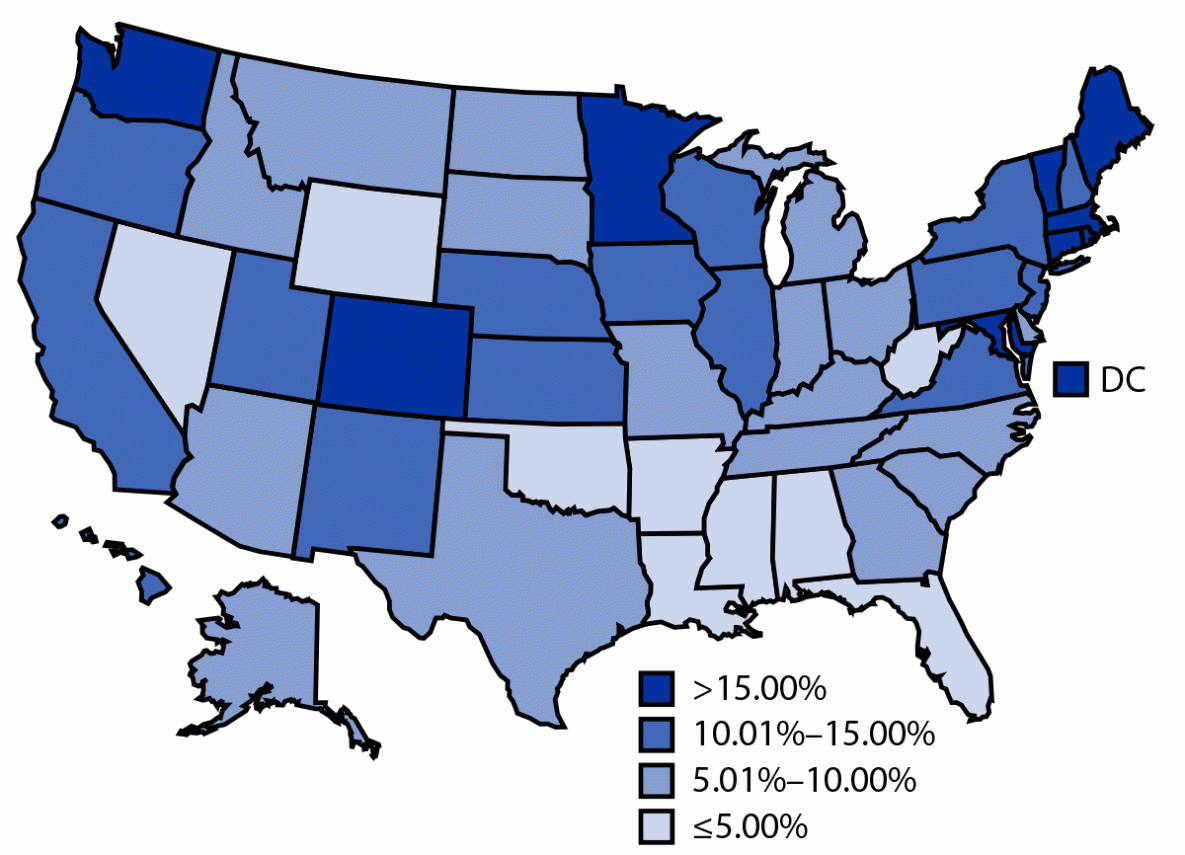
Children aged 6 months–4 years with at least one COVID-19 vaccine dose, by jurisdiction. From CDC's MMWR.
Gaps
Urban and rural: coverage was 10.5% in urban counties but 3.4% in rural ones, falling steadily from 12.5% in large metro areas to 2.7% in the most rural. Urban coverage was higher in 41 jurisdictions; Arizona and Wyoming were exceptions, with higher rural coverage, for reasons not well understood.
Race and ethnicity (known for 71.4% of vaccinated children):
| Group | Share of vaccinated children | Share of all children 6 months–4 years |
|---|---|---|
| Black | 7.0% | 13.9% |
| Hispanic | 19.9% | 25.9% |
| White | 55.3% | 48.4% |
| Asian | 13.4% | 5.7% |

Race and ethnicity of children with at least one dose, compared with all U.S. children aged 6 months–4 years. From CDC's MMWR.
Why
- Poverty is higher in Black (19.5%) and Hispanic (17.0%) communities than White (8.2%), which can limit access to vaccination sites, time off work and pediatric care.
- In a July 2022 Kaiser Family Foundation survey, 47% of parents with household incomes of $90,000 or more had talked with a pediatrician about the vaccine, versus 18% with incomes of $40,000–$90,000 and 28% under $40,000.
- About 40% of Hispanic parents said they couldn't get the vaccine somewhere they trust, and about a third worried about paying out of pocket (versus 13% of White parents). About 40% of Black parents worried about taking time off work for the shot or side effects (versus 18% of White parents).
- In a survey, 53% of rural parents said they would probably or definitely not vaccinate their child, versus 38% of suburban parents.
- Hesitancy: among parents of unvaccinated young children, about 80% worried about side effects and 70% that the vaccine wouldn't prevent illness; by September 2022, more than half said they would "definitely not" vaccinate.
What can help
A medical home and a recommendation from a trusted provider can address parents' concerns about safety and effectiveness. Public health workers, clinicians, child care and school leaders, and state and local governments can use evidence-based practices to lower barriers and build confidence. The low coverage is especially concerning now that bivalent booster doses are also authorized for this age group.
Limits: doses given by different providers may not have been linked, understating series completion; race and ethnicity were unknown for about 30%; "other" race is reported inconsistently; and the 2013 urban-rural categories may be out of date.
Sources
Based on Murthy BP, Fast HE, Zell E, et al., "COVID-19 Vaccination Coverage and Demographic Characteristics of Infants and Children Aged 6 Months–4 Years — United States, June 20–December 31, 2022," Morbidity and Mortality Weekly Report 72(7), CDC; a work of the United States government in the public domain.
이용 허락: CC0 1.0 (퍼블릭 도메인) · 출처 www.cdc.gov
1
0
0
0

코멘트