
Created in collaboration with the Hard History Project
Grade Level
This activity is designed for fifth grade students (age 10-11)
Objectives
Students will express pride, confidence, and healthy self-esteem without denying the value and dignity of other people.
Students will express comfort with people who are both similar to and different from them and engage respectfully with all people.
Students will express empathy when people are excluded or mistreated and concern when they themselves are treated unfairly.
Guiding Questions
How do we form impressions and make assumptions about others based on what they are wearing? What do others think they know about me because of how I present myself?

National Woman's Party members picketing the Republican convention in Chicago, June 1920. International Film Service Co., Inc., Chicago (Photographer). National Woman's Party collection, The Library of Congress
Take a few minutes to examine this picture of a group of women protesting outside of the Republican National Convention in June 1920. The banner held by the first woman reads "Republicans, We Are Here. Where is the 36th State?"
Congress passed an amendment to the U.S. Constitution in June 1919 which reads "The right of citizens of the United States to vote shall not be denied or abridged by the United States or by any state on account of sex." In order for a proposed amendment to become part of the Constitution, it must be ratified by at least three-quarters of the states. In 1920, there were 48 states (Alaska and Hawaii had not become states yet,) so the amendment needed 36 state ratifications. At the time of the event pictured here, 35 states had ratified the amendment. One more was needed.
Women in the suffrage movement had multiple items they wore that identified them as suffragists and supporters or advocates for the movement. Not only would they wear these items while they were protesting or picketing, but they would wear them to meetings and out in public settings.
Think About It
- How can you identify the suffragists in the crowd? What sets them apart from the other people in the picture?
- How do you imagine that the suffragists are feeling? What do you see in the picture that supports your answer?
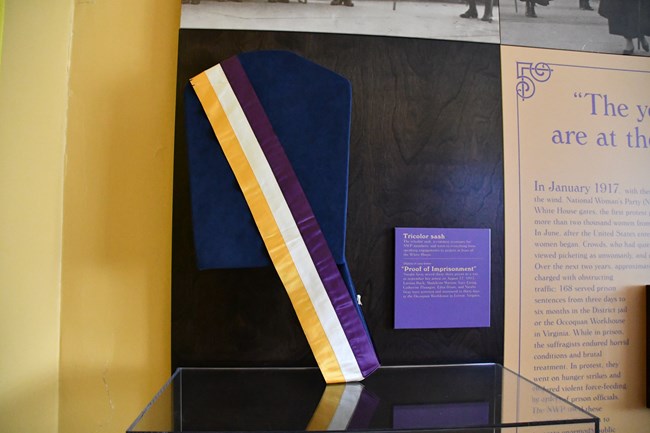
A purple, white, and gold suffrage sash on display at the Belmont-Paul Women's Equality National Monument museum NPS Photo/R. Mendoza
Vocabulary
**amendment: **a change, especially to a document like the Constitution
**ratify: **to sign, approve, or give formal agreement to something
**suffrage: **the right to vote
**suffragist: **someone who believes in and works for the right to vote, especially for women
Extension Activity
The purple, white, and gold striped sash worn by suffragists in the 1900s did not have any words or images on it. The American public had become so familiar with the colors as a symbol of the woman suffrage movement that slogans like "Votes for Women" weren't necessary. But when suffrage protestors carried banners, they often included text with a specific message.
Design your own sash or banner for a cause that is important to you. Think about colors, design, symbols, and words that you use to get your message across. Write a paragraph explaining your design.
Additional Resources
NPS Links
The 19th Amendment: A Crash Course
Symbols of the Woman Suffrage Movement
Design Your Own 19th Amendment Ratification Star
Other Resources
She Resisted: Strategies of Suffrage interactive from PBS's documentary series "The Vote"
Suffrage Strategies: Voices for Votes lesson plan from The Library of Congress
For Teachers
This activity uses a photograph as a primary source to facilitate student inquiry into the development of social identities and movements through symbolism and appearance.
Part of a series of articles titled
Teaching Suffrage.
Previous:
Teaching Suffrage: Protest
Next:
Teaching Suffrage: Forward Into Light
Where this belongs
- Belmont-Paul Women's Equality National Monument
- National Mall and Memorial Parks
Where this page came from
This page was imported from National Park Service. Produced by the U.S. National Park Service and, as a work of the United States government, in the public domain.
Nobody has written it yet — it is the source material at a new address, which is why search engines are asked to skip it and why no one earns from it. It is up for grabs: take it on, and it is yours to rewrite and to earn from.
이 페이지가 속한 컬렉션National Mall and Memorial ParksBelmont-Paul Women's Equality National MonumentTeaching Suffrage
이용 허락: CC0 1.0 (퍼블릭 도메인) · 출처 www.nps.gov
1
0
0
0

코멘트


