Drillers call it the "Western Haynesville." According to the U.S. Geological Survey, the gas actually comes from the Bossier Formation — and the discovery of deep, highly overpressured, productive shales on the western flank of the East Texas Basin was reason enough to reassess the whole formation. The new estimate: a mean of 343.5 trillion cubic feet of undiscovered, technically recoverable gas in the onshore United States and State waters of the Gulf Coast.
The estimate
| Resource | Mean | F95–F5 range |
|---|---|---|
| Gas | 343,499 billion cubic feet (343.5 trillion) | 103,943–611,703 billion cubic feet |
| Natural gas liquids | 374 million barrels | 109–721 million barrels |
| Oil | 3 million barrels | 1–8 million barrels |
F95 is a 95 percent chance of at least that amount; F5, a 5 percent chance. The figures are fully risked. Almost all of it is continuous gas held in shale:
| Assessment unit | Mean gas (billion cubic feet) |
|---|---|
| Bossier Western Shale Gas | 203,200 |
| Bossier Interplatform Shale Gas | 84,253 |
| Bossier Peripheral Shale Gas | 55,395 |
| Bossier Conventional Oil and Gas | 651 |
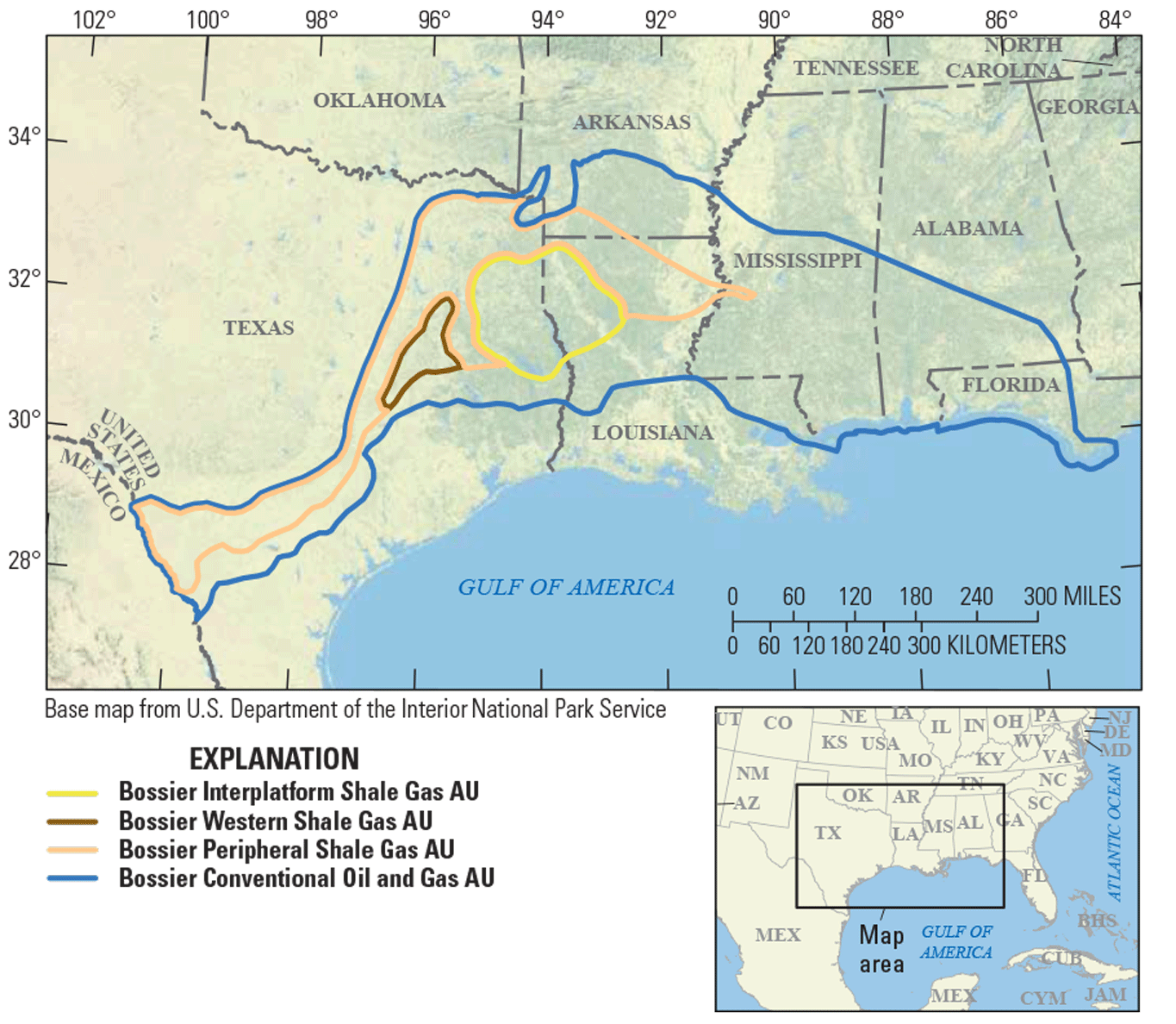
The three continuous and one conventional assessment units in the Bossier Formation. Credit: USGS.
The formation
The Jurassic Bossier Formation lies under Texas, Arkansas, Louisiana, Mississippi, Alabama and Florida. About 2,000 wells have targeted it in the onshore Gulf Coast. Its shale gas may be mostly self-sourced, possibly topped up by gas from the underlying Smackover and Haynesville Formations. The USGS places it in an Upper Jurassic–Cretaceous–Tertiary Composite Total Petroleum System covering oil and gas across the Gulf Coast, and drew four assessment units from differences in geology, petroleum system and the pressure and temperature limits of drilling.
Four units
| Unit | Where | The model |
|---|---|---|
| Western Shale Gas | a pod of highly overpressured shale beside the faults along the East Texas Basin's western margin | gas trapped in overpressured, fractured, hot, organic-rich shale. Pressures approach or exceed the fracture gradient, and the few wells drilled have much higher estimated ultimate recoveries than typical Bossier shale. With so few wells, it was hard to call the accumulation conventional or continuous; the USGS assessed it as continuous |
| Interplatform Shale Gas | largely the Sabine Uplift — the Bossier's main shale gas production area | horizontal wells target fractured shale; the fracturing may relate to movements of the uplift |
| Peripheral Shale Gas | the rest of the formation's shale | little drilling data; recoveries are generally lower than in the Interplatform unit, possibly because the rock is less fractured |
| Conventional Oil and Gas | sandstone and carbonate reservoirs, up to where they were eroded or never laid down, down to drilling limits, and out to the State–Federal waters line | gas migrated up into traps formed by facies changes, salt tectonics and faults; a general lack of sealing rock may limit it |
| Key inputs (mean) | Western | Interplatform | Peripheral |
|---|---|---|---|
| Potential production area (acres) | 1,100,333 | 4,367,000 | 10,867,000 |
| Average drainage area of a well (acres) | 130 | 200 | 200 |
| Success ratio | 95% | 95% | 50% |
| Untested area | 99.7% | 99.4% | 100% |
Sources
Based on "Assessment of undiscovered oil and gas resources in the Bossier Formation within the onshore United States and State waters of the Gulf Coast region," a USGS fact sheet by Rand Gardner and the Bossier Formation Assessment Team, a work of the United States government in the public domain. Input data are in Gardner (2026), a USGS data release; the previous assessment was Paxton and others (2017).
이용 허락: CC0 1.0 (퍼블릭 도메인) · 출처 pubs.usgs.gov
1
0
0
0

코멘트