이 페이지는 공개 상태입니다.
| 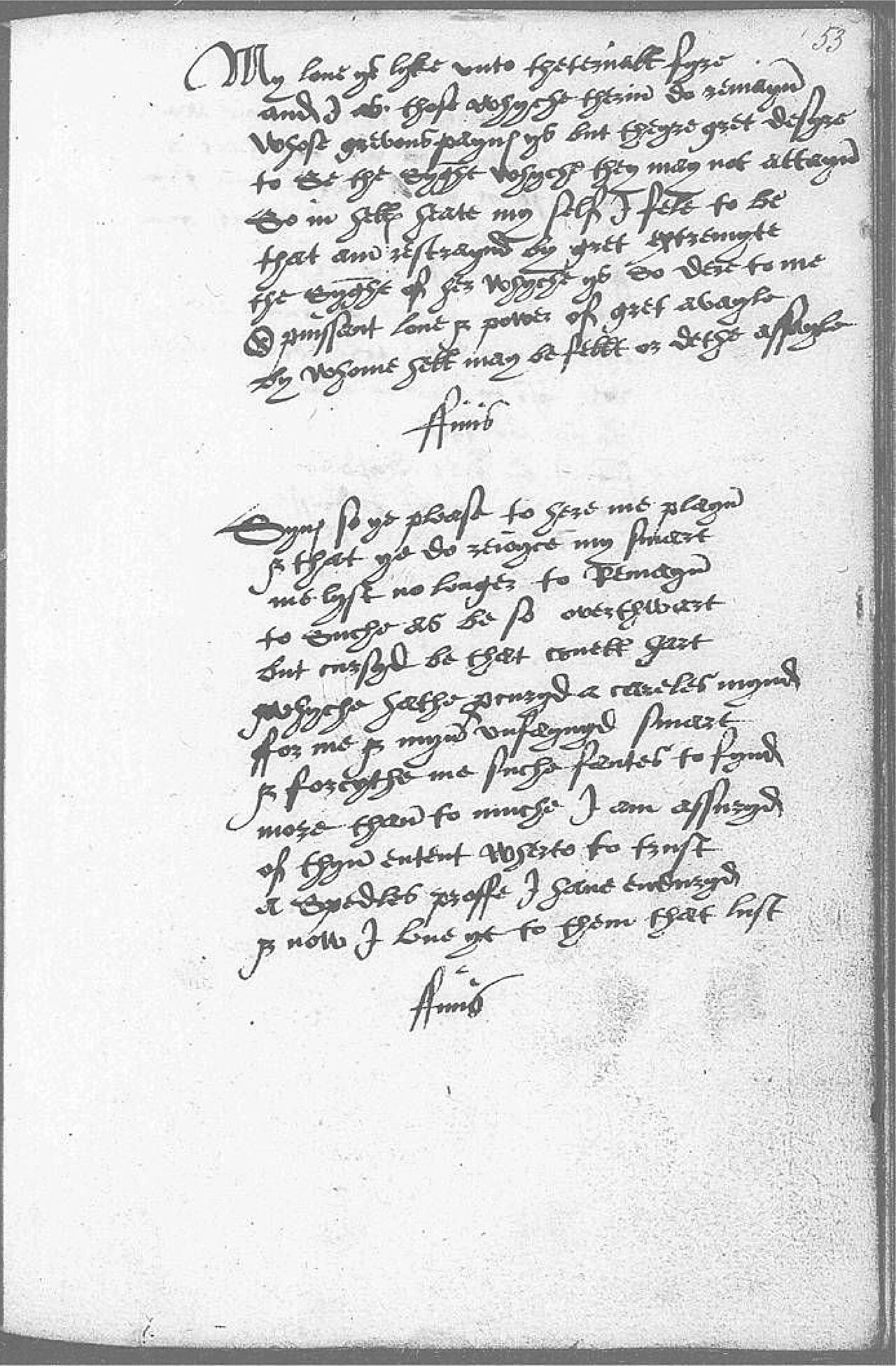
The Devonshire Manuscript facsimile 53r (Image: DMSEG, CC BY-SA 3.0) |
| --- |
|---|
f. [53r]
1 My loue ys lyke vnto theternall the eternal fyre
2 and I as those whyche therin do remayn
3 whose grevous paynes{es} ys but theyre gret desyre
4 to se the syght whyche they may not attayn
5 So in hells heate my self I fele to be
6 that am restraynd by gret extremyte
7 the syght of her whyche ys so dere to me
8 O puissant loue & power of gret avayle
9 by whome hell may be fellt or dethe assayle
ffinis
Commentary
Attributed to Sir Thomas Wyatt,1] this poem was entered by [H6 and is unique to the manuscript. The speaker associates his frustrated desire to behold the object of his love with the agony of the damned in hell separated from the presence of God. Agnes K. Foxwell argues that the poem is a "madrigal" due to its rhyme scheme.[2]
Works Cited
- ↑ R.A. Rebholz, ed. Sir Thomas Wyatt: The Complete Poems. London: Penguin, 1978. 228-29.
- ↑ Agnes K. Foxwell. The Poems of Sir Thomas Wiat. New York: Russell and Russell, 1913.
Where this page came from
This page was imported from Wikibooks. From “The Devonshire Manuscript” on Wikibooks, by its contributors, under CC BY-SA 4.0. Changed here: set as a page; navigation and edit links left out; each image under its own licence, credited in its caption.
Nobody has written it yet — it is the source material at a new address, which is why search engines are asked to skip it and why no one earns from it. It is up for grabs: take it on, and it is yours to rewrite and to earn from.
이 페이지가 속한 매거진The Devonshire Manuscript
이용 허락: CC BY-SA 4.0 · 출처 en.wikibooks.org
코멘트